In BaZi, the 10-year luck cycle, also called Da Yun, refers to the major life phases a person moves through after birth as time unfolds. A natal chart shows a person's inborn structure, while the 10-year luck cycle shows how that structure is activated across different stages of life. Because each major luck period usually covers ten years, it is commonly described as a 10-year cycle. In traditional Four Pillars analysis, Da Yun is a core part of chart interpretation. It is usually calculated from the month pillar, together with the forward or backward direction of the cycle and the starting age of luck.
What Is the 10-Year Luck Cycle in BaZi?
Put simply, the 10-year luck cycle divides life into stages, with each stage covering about ten years.
A BaZi chart describes a person's original structure, such as Five Elements balance, Day Master strength, Ten Gods relationships, and overall chart formation. The 10-year luck cycle explains when that structure enters different phases over time.
So Da Yun does not exist separately from the birth chart.
It is better understood as a timeline that moves the natal chart forward, gradually bringing certain chart features into the foreground at different stages of life.
Traditional BaZi thought often separates ming and yun.
Ming refers more to the inborn foundation, while yun refers more to post-birth timing and life phases.
For this reason, a BaZi reading is not complete if it looks only at the natal chart without considering the major luck periods. In traditional practice, Da Yun is widely treated as one of the main frameworks for understanding how life stages unfold.

What Is Da Yun in BaZi?
Many beginners confuse the natal chart and the 10-year luck cycle, but they serve different purposes.
The natal chart describes your original structure.
In other words, it shows the Five Elements distribution you were born with, the Ten Gods relationships in your chart, and the structural features that define your BaZi.
Da Yun describes which stage of life you are moving through.
Even with the same birth chart, a person's life expression can look very different in different major luck periods. The natal chart is like the foundation, while Da Yun is like the timing. The chart is like the framework, while the 10-year luck cycle reflects the changing conditions of each phase. In traditional calculation methods, Da Yun is not created independently. It is derived from the month pillar, which shows that it is always built on the original chart.
So the natal chart answers the question, “What is this person’s basic structure?”
And the 10-year luck cycle answers, “Which life phase is this person currently in?”
Why Can’t You Read BaZi from the Natal Chart Alone?
If you look only at the original chart and ignore the major luck periods, you can only see a static structure, not how time changes its expression.
But one of the most obvious features of life is that it changes over time.
Some people go through noticeable ups and downs early in life and become more stable later.
Some seem average when young but develop more strongly in later years.
Some chart features show up differently at different ages, even in the same person.
This is why traditional BaZi interpretation consistently emphasizes that Four Pillars analysis cannot be separated from timing cycles. The point of Da Yun is not to replace the natal chart, but to explain when certain chart patterns are triggered, strengthened, or brought into clearer view.
From a reading perspective, the natal chart is the base manual,
while the 10-year luck cycle is the timeline.
How Is the 10-Year Luck Cycle Calculated?
In traditional BaZi practice, calculating Da Yun usually begins with two questions.
First, determine whether the cycle moves forward or backward.
Second, determine the age at which the first major luck period begins.
In common Zi Ping methods, the direction of the cycle is usually determined by the yin-yang nature of the birth year stem in combination with gender:
Men born in yang years and women born in yin years usually follow a forward sequence.
Men born in yin years and women born in yang years usually follow a backward sequence.
Traditional materials also repeatedly note that this direction is commonly determined from the year stem, not the Day Master.
Once the direction is fixed, the following stems and branches are arranged from the month pillar. This produces the first, second, third, and later major luck periods. Traditional explanations often summarize this by saying that Da Yun begins from the month pillar or is arranged from the birth month stem-branch sequence.
For most readers, the key point is not memorizing every calculation rule, but understanding this:
The 10-year luck cycle is not assigned randomly. It follows fixed rules for direction and a defined method for determining when the cycle begins.
At What Age Does Da Yun Begin?
The first 10-year luck cycle does not begin immediately at birth.
Before entering the first major luck period, the starting age of luck must be calculated.
This starting age refers to the amount of time between birth and entry into the first Da Yun period.
Different people begin their major luck periods at different ages. Some begin earlier, while others begin later.
In traditional methods, the starting age is usually calculated from the relationship between the birth time and the solar seasonal markers. The calculation uses the jie nodes rather than the qi points. A common method is:
First calculate the time between birth and the previous or next seasonal node, depending on the forward or backward direction.
Then convert that interval using the traditional rule that three days equal one year, one day equals four months, and one double-hour equals ten days.
This is why the beginning of Da Yun is different from person to person.
Some begin around age two or three, some around four or five, and some even earlier or later.
So when reading a BaZi chart, confirming the starting age of luck is a very basic step.
This article explains in detail how to calculate the starting time of the BaZi Luck Pillar:
What Is the Meaning of Forward and Backward Da Yun?
Forward and backward Da Yun refer to the direction in which the stems and branches are arranged in the major luck cycle.
A forward cycle moves along the normal order of the stem-branch sequence.
A backward cycle moves in the reverse order.
Why do some people move forward while others move backward?
Because traditional calculation systems treat gender and yin-yang alignment as part of the rule for unfolding the cycle. That is why classical explanations often summarize the rule as: yang-year male and yin-year female move forward, while yin-year male and yang-year female move backward.
The direction itself does not mean good luck or bad luck.
It only determines where the first major luck period starts from the month pillar and how the later periods continue in sequence.
In other words, forward and backward movement are calculation rules, not value judgments.
What Does “One Luck Period Every Ten Years” Mean?
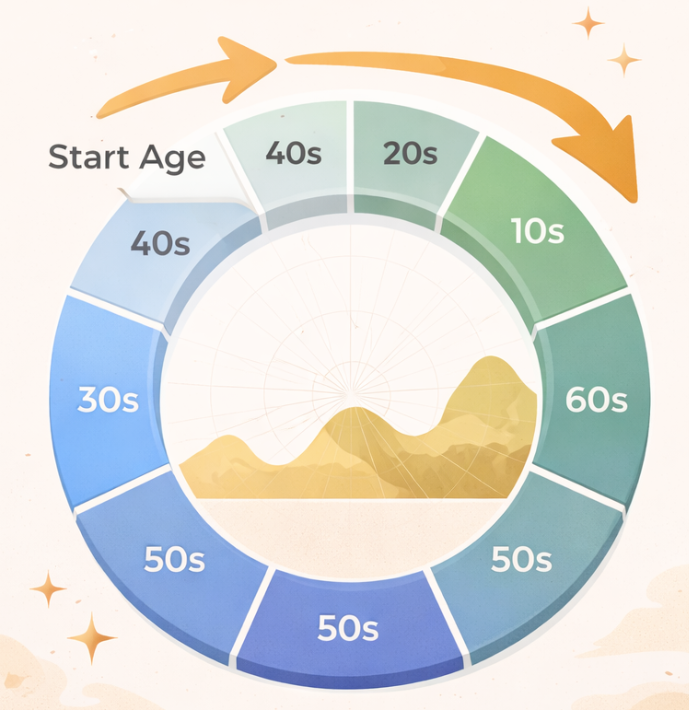
The phrase “one luck period every ten years” means that each Da Yun phase usually covers a ten-year span.
When a chart is arranged, several major luck periods are usually listed in sequence, and each one governs about ten years. That is why people often speak of multiple major luck stages across a lifetime.
This ten-year structure makes it easier to view life on a broader timeline. Compared with year-by-year changes, the major luck period emphasizes a larger stage: childhood, youth, adulthood, middle age, and beyond. Traditional materials also commonly list the first, second, and third luck periods together with their corresponding age ranges.
So “one luck period every ten years” does not mean every day within those ten years is the same.
It means that each ten-year span has a relatively stable background pattern.
Why Is the Major Luck Period So Important in BaZi?
The importance of Da Yun does not come from replacing the natal chart. Its importance comes from placing the chart into time.
The natal chart tells you what the person’s base structure is,
while the major luck period tells you when that structure moves into different life phases.
This is why traditional BaZi analysis usually continues with Da Yun after the Four Pillars are set. Whether in beginner guides or classical calculation methods, the starting age of luck and the direction of the cycle are both treated as fundamental parts of interpretation.
For ordinary readers, understanding the 10-year luck cycle has at least three practical meanings:
First, it shows that BaZi is not a static label.
Second, it explains why BaZi readings often ask when a person enters the next major luck period.
Third, it helps explain why the same chart must still be read together with age and stage of life.
Conclusion: Understand Da Yun Before Interpreting Life Stages
At its core, the 10-year luck cycle in BaZi is a time framework for observing how life unfolds in stages.
The natal chart describes the inborn structure, while Da Yun describes the changing phase.
The chart shows the foundation, while the major luck period shows the movement of time.
If you want to understand BaZi more clearly, it is important to first understand what Da Yun is.
Only after you know what the 10-year luck cycle means, how the starting age is determined, and what forward or backward movement refers to, can you read later changes in life stages without mixing up the concepts.
If the BaZi chart is like a map of life,
then Da Yun is the timeline drawn across that map.
Once that timeline is clear, many later questions become much easier to understand.