Lately, I have seen more and more people using different AI tools to read a BaZi chart.
Some use ChatGPT, some have started trying DeepSeek, and some simply ask a model to “read my fate.” After a while, though, one practical question always comes up:
What is the real difference between these tools, and which one is actually more useful for BaZi reading?
So I decided to try a simple test for myself.
I took the same BaZi chart and gave it to both DeepSeek and ChatGPT to see how each one would interpret it.
The result was more interesting than I expected, and a few parts were honestly a little surprising.
A point many people overlook
👉 When it comes to BaZi, the biggest problem is not a bad explanation. It is starting from the wrong chart.
A lot of people go straight to an AI model and ask things like:
-
“What is my BaZi chart?”
-
“How is my wealth luck?”
But if the chart itself is off, then everything that comes after will be off as well.
So for this test, I did not let the models calculate the chart for me. I first confirmed the chart with a dedicated tool.
(If you want a cleaner starting point, I recommend ShenShu AI. The layout is easy to follow, and the chart structure is clear and reliable.)
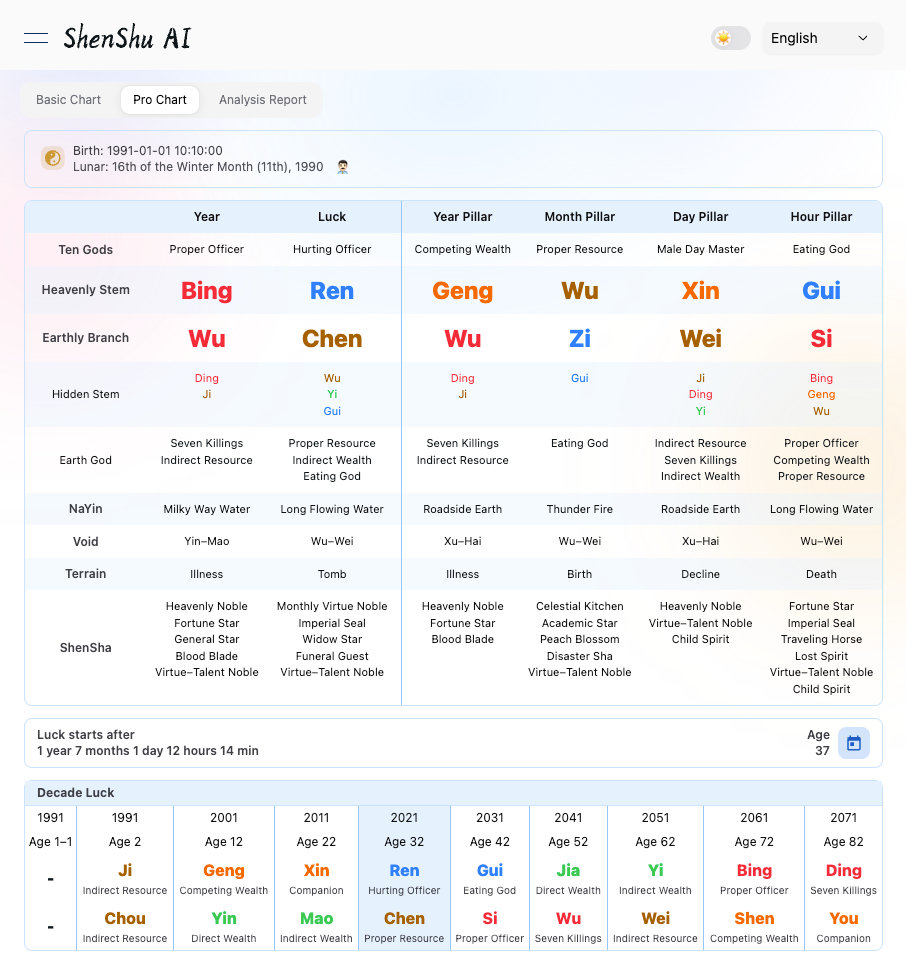
Only after that did I hand the same chart to both models. That makes the comparison much more meaningful.
How I tested them
The setup was pretty simple:
-
I used the same BaZi chart throughout
-
I gave DeepSeek and ChatGPT roughly the same chart information
-
I asked similar follow-up questions
What I paid attention to was:
-
Whether the Five Elements balance made sense
-
Whether the Ten Gods were explained clearly
-
Whether the language was easy to understand
-
Whether the answers stayed consistent after a few rounds of follow-up questions
Put simply, I was not looking for which one sounded more mystical.
I was looking for which one could actually explain a chart in a clear and useful way.
DeepSeek: quick with conclusions, sometimes a little too quick
Let’s start with DeepSeek.
My first impression was:
It is direct.
A lot of the time, it skips the buildup and goes straight to the point. For example, it will quickly tell you:
-
whether the chart looks strong or weak
-
where the Five Elements feel out of balance
-
which areas of life may need more attention
That has some very obvious advantages:
✔ Good for people who want a quick takeaway
If all you want is a rough sense of direction, such as:
-
whether luck is rising or falling
-
what kind of personality pattern stands out
-
which periods may need extra care
DeepSeek often gets there fast.
✔ Good at summarizing the main points
As long as the chart itself is already correct, it does a decent job of compressing a lot of information into a short answer:
-
it spots the main pattern quickly
-
it usually does not ramble
But the downsides are just as clear:
✘ Sometimes it leaves too much unsaid
There were moments when I felt:
👉 “The conclusion sounds fine, but you did not really show how you got there.”
That becomes more noticeable with BaZi logic, for example:
-
why the Day Master is judged a certain way
-
why a specific Ten Gods relationship matters
It often does not unpack those steps in much detail.
✘ After several follow-up questions, it can drift a little
Once you keep asking things like:
-
“What if the luck pillar changes?”
-
“Why is this combination interpreted that way?”
you may start to notice:
-
small inconsistencies from one answer to the next
-
or explanations that become a bit vague
ChatGPT: more complete, but sometimes a little too serious
Now let’s talk about ChatGPT.
If I had to sum up its style in one word, it would be: detailed.
✔ Easier to follow step by step
It often explains things in a clearer sequence:
-
first the chart structure
-
then the reasoning behind it
-
then the final takeaway
That makes it easier to understand how the judgment was formed in the first place.
For people who are still learning BaZi, this is very helpful.
✔ Better for follow-up questions
You can keep going with questions like:
-
“Why is this considered a useful god?”
-
“What does this combination suggest for relationships?”
-
“How would this change in a different year?”
Most of the time, it can continue the conversation without losing the thread.
That said, it has its own weaknesses too:
✘ It can be wordy
Sometimes you only want a simple judgment, but it gives you a whole block of explanation.
That can feel a little heavy if you just want the main point.
✘ Smooth wording does not always mean strict reasoning
This is the more subtle issue.
The writing is often very polished, but if you read carefully, you may notice:
👉 some parts feel more like reasonable inference than strict BaZi logic.
If you already know a bit of chart reading, that becomes easier to spot.
DeepSeek vs ChatGPT for BaZi chart interpretation

|
Feature |
ChatGPT |
DeepSeek |
|---|---|---|
|
Response speed |
✅ Very fast, usually feels instant |
🟡 A bit slower, but still acceptable |
|
Interpretation style |
✅ Easier to follow, clearer in plain language |
✅ More analytical, often goes deeper into patterns |
|
BaZi chart calculation |
❌ Not ideal for direct chart calculation |
❌ Chart accuracy can be unstable |
|
General reasoning and follow-up |
✅ Stronger, works better across multiple follow-up questions |
🟡 More limited, sometimes sticks to one track |
|
Internet access |
❌ Usually offline by default |
✅ Can work with real-time information |
|
Customization |
❌ Closed model, not customizable |
✅ Open-source and more flexible |
|
Best for |
Beginners or anyone who wants quick, readable explanations |
Users who want deeper analysis and already know the basics |
The real key to using AI for chart reading
👉 The real issue is not which model you choose. It is whether your workflow makes sense from the start.
A better order looks like this:
-
Get the BaZi chart right first
-
Confirm the chart structure
-
Then use AI to help you understand it better
Not the other way around.
If the first step is wrong, switching between models will not fix the result.
If you just want a practical way to use both
The method I have settled into is pretty simple:
-
first generate the chart clearly on ShenShu AI
-
then hand the same result to different models
-
sometimes compare how each one explains the same chart
That has felt more reliable than depending on just one model from start to finish.
If you want to look around first, the ShenShu AI homepage also gives a cleaner overview of the chart tools and reading flow before you start.
So which one should you choose?
A simple way to think about it is this:
-
If you want speed and direct conclusions → DeepSeek
-
If you want more explanation and step-by-step reasoning → ChatGPT
But no matter which one you pick:
👉 getting the chart right matters more than picking the model.
If you want the easier route, you can also use ShenShu AI directly for chart reading. The key difference is that the interpretation starts from a properly generated BaZi chart, which makes the explanation much more grounded and easier to trust.
Final thoughts
A lot of people now treat AI like a fortune-telling machine.
My own feeling is a little different.
It works better as an explanation tool.
What still matters most is:
-
the chart itself
-
how you read and understand it
AI simply gives you another way to talk through those patterns.
FAQ
Q: Can I use AI to calculate a BaZi chart directly?
It is not the safest option. For chart calculation, a dedicated tool is still the more reliable starting point.
Q: Which is more accurate for BaZi reading, DeepSeek or ChatGPT?
In practice, the bigger variable is whether the chart you give them is accurate in the first place.
Q: Can beginners use these tools for BaZi reading?
Yes. It is usually easier if you start from a clear chart first. That is also why tools like ShenShu AI are useful: they help you begin with a readable chart and then continue with guided interpretation if you want to go further.