BaZi (Four Pillars of Destiny, 八字) can describe recurring personality patterns, emotional habits, life timing, and relationship tendencies with surprising consistency when the birth data is correct and the reading is grounded in the full chart.
Its most valuable use is self-understanding. A good chart reading helps a person see inner tendencies earlier, manage emotions with more awareness, and correct habits that quietly damage work, relationships, and daily life.

What does "accurate" mean in BaZi?
In BaZi, accuracy usually refers to three things:
- whether the chart reflects a person's temperament and habits
- whether major life phases match the direction shown by luck cycles
- whether the reading remains coherent when the whole chart is considered together
A good BaZi reading gives a usable picture of strengths, friction points, and timing shifts. It does not function like a laboratory test.
Why do some people find BaZi accurate?
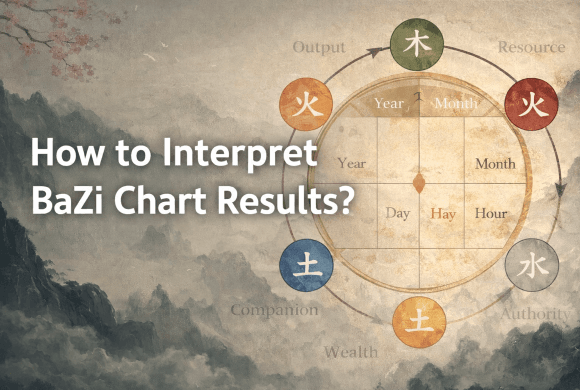
BaZi readings often feel accurate because the system is specific. A chart uses year, month, day, and hour to create a structured model of a person's elemental balance, Day Master, branch relationships, and luck cycles.
That structure allows readers to identify patterns that people can compare with real experience:
- a strong or weak Day Master
- recurring relationship themes
- career periods with more support or resistance
- years or luck pillars that activate visible change
People usually find BaZi most convincing when the reading stays concrete and tied to the chart instead of drifting into broad statements that could fit anyone.
Small examples make this easier to see:
- A person with a chart that shows strong control and impatience may realize that work problems do not come from bad luck alone. They come from speaking too hard, pushing too fast, and exhausting people around them.
- A person whose chart shows weak emotional boundaries may notice a repeated pattern of over-giving in relationships and staying too long in unstable situations.
- A person with a strong output pattern may see that talent is not the issue. The issue is scattered focus, unfinished plans, and emotional swings that break consistency.
These are practical observations. Once a person sees the pattern clearly, change becomes easier.
What can make a BaZi reading less accurate?
The biggest source of error is incomplete birth data. A wrong birth hour can change the Hour Pillar and affect later-life themes, emotional expression, children, and parts of relationship analysis.
The second source of error is shallow interpretation. Single-symbol readings create weak results. A branch clash, one Ten God, or one favorable element never tells the whole story on its own.
The third source of error is vague language. A reading becomes less reliable when it avoids specifics and replaces chart logic with generic advice.
Is BaZi scientifically proven?
BaZi is not scientifically proven by modern empirical standards.
There is no accepted body of repeatable experimental evidence showing that BaZi can predict outcomes with the kind of reliability expected in science. Its concepts come from traditional Chinese cosmology, Yin-Yang theory, the Five Elements, and calendar-based time systems rather than modern scientific models.
That does not stop people from using it. It places BaZi in the category of a traditional interpretive system instead of a scientifically validated predictive method.
Why do some people question BaZi's scientific validity?
Skeptics question BaZi for direct reasons:
- its core concepts are not measurable in the scientific sense
- different practitioners can interpret the same chart differently
- confirmation bias can shape how people remember accurate-seeming readings
- broad statements can feel persuasive even when they are hard to test
These criticisms are reasonable. A system that depends on symbolic interpretation and practitioner judgment will always face scientific skepticism.
What kind of evidence matters when judging BaZi?
The strongest evidence for BaZi is practical and personal rather than scientific.
People usually judge it by asking:
- Does the chart describe long-term personality patterns well?
- Do major luck-cycle shifts line up with real changes in work, relationships, or direction?
- Does the reading stay consistent across different parts of the same chart?
This is experience-based evaluation. It can show whether BaZi feels useful to a person. It does not establish scientific proof.
So, is BaZi accurate?
BaZi is accurate enough to be useful because it can describe a person's inner tendencies with real clarity.
Its strongest value is not event prediction. Its strongest value is helping a person understand temperament, emotional habits, blind spots, and repeated behavior patterns.
That kind of insight can improve daily life in direct ways. A person who understands their tendency toward anger can learn restraint. A person who sees a pattern of emotional dependency can build better boundaries. A person who notices chronic indecision can train steadier action.
BaZi does not offer scientific verification. It offers a structured mirror. For many people, that mirror is accurate enough to support real self-correction and a better way of living.