Five Elements in BaZi
What Is My Five Element in BaZi?
In BaZi, you do not have just one Five Element. Your Day Master determines your personal element, while your full birth chart contains a combination of Wood, Fire, Earth, Metal, and Water.
For example, if your Day Master is Jia (甲), your Day Master element is Yang Wood, while the rest of your chart may contain other elements.
Five Elements Calculator
What Do the Five Elements Mean in BaZi?
In BaZi, each of the Five Elements is associated with distinct qualities, natural processes, and patterns of energy.
Wood (木)
Wood represents growth, development, flexibility, and expansion. In BaZi, it is associated with upward movement, new beginnings, and the ability to adapt and progress.
Fire (火)
Fire represents activity, warmth, expression, and transformation. In BaZi, it is associated with outward energy, visibility, enthusiasm, and action.
Earth (土)
Earth represents stability, support, balance, and grounding. In BaZi, it is associated with structure, reliability, transition, and the ability to contain or support other energies.
Metal (金)
Metal represents structure, discipline, refinement, and boundaries. In BaZi, it is associated with order, precision, decisiveness, and the process of shaping or reducing.
Water (水)
Water represents adaptability, movement, depth, and flow. In BaZi, it is associated with flexibility, reflection, accumulation, and inward-moving energy.
What Role Do the Five Elements Play in a BaZi Chart?
The Five Elements are used to evaluate Day Master strength, chart balance, and which elements are favorable or unfavorable. Their generating and controlling relationships form the basis of BaZi analysis.
Five Elements of the Heavenly Stems and Earthly Branches
How Do the Five Elements Interact?
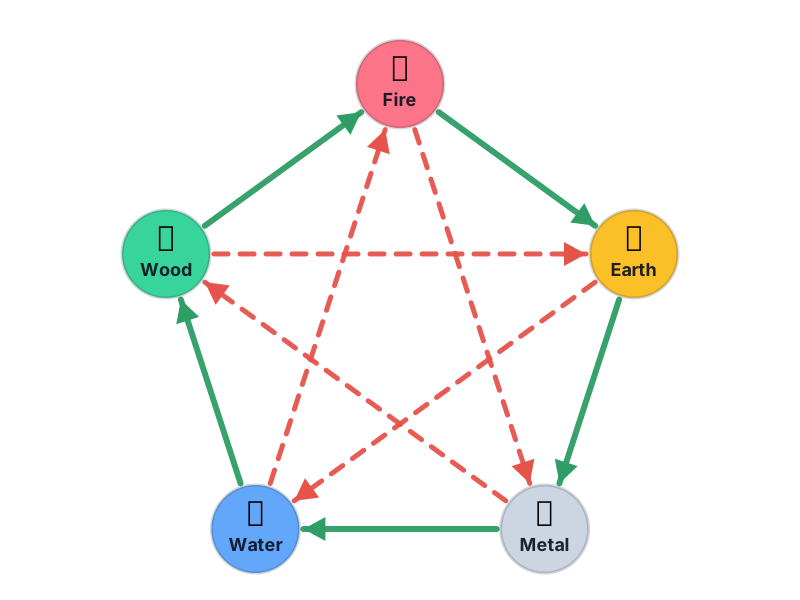
Generating
Wood generates Fire, Fire generates Earth, Earth generates Metal, Metal generates Water, Water generates Wood
Controlling
Wood controls Earth, Earth controls Water, Water controls Fire, Fire controls Metal, Metal controls Wood
How Are the Five Elements Determined in BaZi?
The Five Elements in BaZi are determined from the Heavenly Stems, Earthly Branches, and Hidden Stems in your Four Pillars, while their strength is evaluated based on season and chart interactions.
1. Generate the Four Pillars
Your birth year, month, day, and hour are converted into four Heavenly Stems and four Earthly Branches.
2. Identify the Five Elements
Each Heavenly Stem corresponds to one of the Five Elements, while each Earthly Branch has a primary element and also contains Hidden Stems. Hidden Stems inside the Earthly Branches add additional elemental influences.
3. Evaluate Element Strength
The strength of each element depends not only on how often it appears, but also on the birth season and its interactions with other elements in the chart.
What Does Five Elements Balance Mean in BaZi?
Five Elements balance in BaZi does not mean having equal amounts of Wood, Fire, Earth, Metal, and Water. Balance is judged by how the elements interact, not simply by how many times each element appears.
Flow (流通)
When several elements form a continuous generating cycle—for example, Wood generates Fire and Fire generates Earth—energy can move through the chart rather than becoming concentrated in one element.
Balance (制衡)
When elements interact through control rather than generation, balance depends on whether one force can effectively regulate another. Equal element counts do not necessarily create balance; their relative strength and interaction matter more.
Blockage (阻隔)
Blockage occurs when the Five Elements neither flow smoothly through generation nor form an effective controlling balance. Clashes, punishments, breaks, and harms may further disrupt this flow.
This is only one level of BaZi analysis. A full reading also considers seasonal strength, the Day Master, chart structure, and other interactions.
What Does It Mean If One of the Five Elements Is Missing in BaZi?
What does “missing” mean?
A missing element means that the element does not appear in the part of the BaZi chart being counted. Missing is not the same as weak: a weak element is present but has limited strength.
What should you do if an element is missing?
A missing element does not automatically need to be added or strengthened. Whether it is helpful depends on the whole chart, including the season, Day Master, Hidden Stems, and element interactions.
How Do the Five Elements Affect Day Master Strength in BaZi?
The Day Master is strengthened by its own element and by the element that generates it, while other elements may drain, control, or consume its energy. However, Day Master strength also depends on the birth season, roots, Hidden Stems, and interactions within the chart—not simply on element counts.
Learn how to tell if your Day Master is strong or weak →How Do the Five Elements Become Favorable or Unfavorable in BaZi?
The Five Elements can play different roles depending on the structure of a BaZi chart. An element may act as the Useful Element (Yong Shen, 用神), a Favorable Element (Xi Shen, 喜神), or an Unfavorable Element (Ji Shen, 忌神).
Useful Element (Yong Shen, 用神)
The element that plays the most important role in balancing or regulating the chart.
Favorable Elements (Xi Shen, 喜神)
Elements that support the Useful Element or otherwise benefit the overall chart.
Unfavorable Elements (Ji Shen, 忌神)
Elements that strengthen an existing imbalance or interfere with helpful elements in the chart.
Calculate Your Five Elements
Enter your birth details to see the Five Elements in your BaZi chart and discover your Day Master.
☯️ Calculate My Five ElementsSources and Classical References
This page references the following classical texts; excerpts retain the original Chinese wording.
Shang Shu · Hong Fan (Great Plan) · Source: Chinese Text Project
Original text
水曰潤下,火曰炎上,木曰曲直,金曰從革,土爰稼穡。
Wu Xing Da Yi, Volume 2 · Generation and Overcoming · Source: Wikisource
Original text
木生火,火生土,土生金,金生水,水生木;木剋土,土剋水,水剋火,火剋金,金剋木。
San Ming Tong Hui, Volume 2 · Year, Month, Day, and Hour · Source: Wikisource
Original text
凡論人命,年月日時排成四柱……遁時從日,則以日為主。
Di Tian Sui · Decline and Strength · Source: Wikisource
Original text
旺則宜洩宜傷,衰則喜幫喜助,然旺中有衰者存,不可損也。
Di Tian Sui · Form and Function · Source: Wikisource
Original text
道有體用,不可以一端論也,要在扶之抑之得其宜。