The BaZi Spouse Palace is the Day Branch—the Earthly Branch beneath the Day Master. It is used to estimate a spouse’s appearance and personality, and to examine intimacy, marriage quality, relationship patterns, and changes in married life.

What Is the Spouse Palace in BaZi?
Spouse Palace, Marriage Palace, and Marital Palace are different names for the same position in a BaZi chart: the Day Branch. This article uses Spouse Palace throughout.
BaZi, also known as the Four Pillars of Destiny, arranges birth information into Year, Month, Day, and Hour pillars. In traditional Zi Ping interpretation, the Day Stem represents the chart owner. The branch directly below it is the Day Branch, traditionally associated with the spouse and married life.
This usage has a traceable classical basis. In the “Guidelines for Reading a Chart” section of Yuan Hai Zi Ping, “日干为己身,日支为妻妾” identifies the Day Stem with the self and uses the Day Branch to examine the wife or partner.
The wording reflects its historical, male-centered context. Modern practice generally applies the Day Branch as the Spouse Palace in charts of any gender. Classical texts may not use today’s standardized English label, but they establish its underlying principle: Day Stem as self, Day Branch as spouse.
How Do You Find the Spouse Palace in a BaZi Chart?
The Spouse Palace is the Earthly Branch of the Day Pillar, commonly called the Day Branch.
A BaZi chart contains four columns. Each pillar has a Heavenly Stem on top and an Earthly Branch below. These are cyclical symbols with Five Element and yin-yang qualities; an Earthly Branch is more than its familiar zodiac animal.
To find your Spouse Palace:
-
Locate the Day Pillar.
-
Look at the lower character in that pillar.
-
That Earthly Branch is your Day Branch and Spouse Palace.
For example:
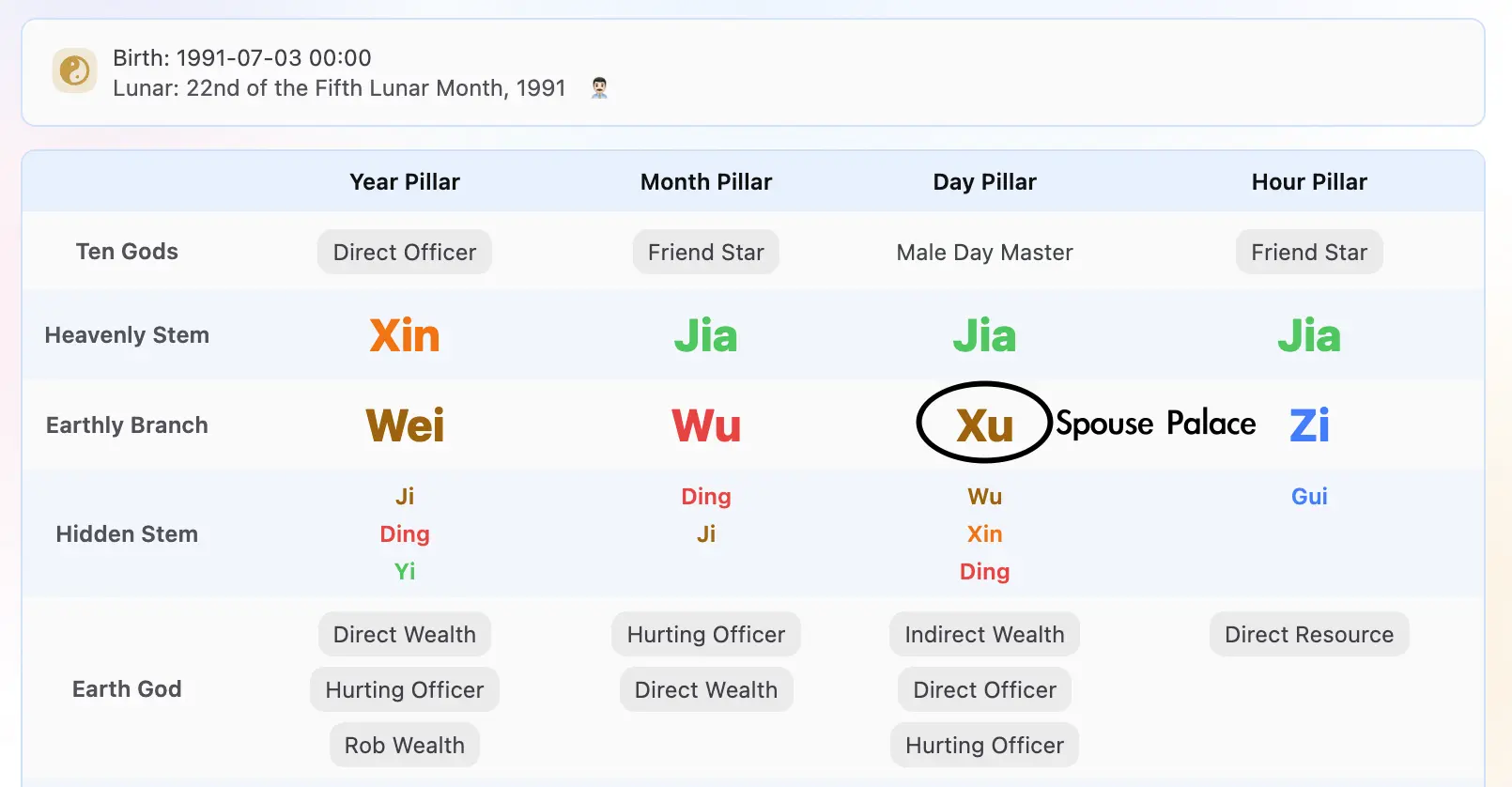
The Day Pillar in this example is Jia-Xu 甲戌:
-
Jia 甲 is the Day Stem, or Day Master, representing the chart owner.
-
Xu 戌 is the Day Branch and therefore the Spouse Palace.
The Spouse Palace is the Day Branch, not the entire Day Pillar. Only the lower character in the Day column is the palace.
If you do not yet have your Four Pillars, use a BaZi calculator to generate the chart and locate the Day column.
Read the Day Branch in three layers:
-
Identify the branch and its primary Five Element.
-
Examine its Hidden Stems and their Ten God relationships to the Day Master.
-
Check whether the Day Branch combines, clashes, punishes, harms, or breaks with other branches.
What Does the Spouse Palace Represent?
What Information Can the Spouse Palace Reveal?
The Spouse Palace is commonly used to explore:
-
traits in a long-term partner;
-
needs and reactions in intimacy;
-
patterns of closeness, conflict, cooperation, and change;
-
the atmosphere and pressure points of married life.
It is a relationship setting, not a description of one predetermined person. People with the same Day Branch can have different marriages because their Hidden Stems, elemental strength, Spouse Stars, and chart interactions differ.
Can the Spouse Palace Show Your Partner's Appearance?
The Day Branch can suggest a partner's overall appearance and presence. It is better at indicating a broad type—soft, refined, energetic, grounded, or sharp—than predicting exact features, height, or body shape.

The Day Branch's Five-Element association provides the first layer:
| Day Branch element | Branches | Traditional appearance and presence tendencies |
| Water | Zi 子, Hai 亥 | Softer lines; a quiet, fluid, gentle, or lively presence |
| Wood | Yin 寅, Mao 卯 | A longer or upright form; fresh, natural, or scholarly presence |
| Fire | Si 巳, Wu 午 | Bright expression, animated manner, warmth, and visibility |
| Earth | Chen 辰, Xu 戌, Chou 丑, Wei 未 | A steady form; grounded, practical, and dependable presence |
| Metal | Shen 申, You 酉 | Clear or angular lines; neat, composed, or refined presentation |
These are not a facial-recognition formula. Each branch contains Hidden Stems—underlying Heavenly Stem energies carried inside it. The Spouse Star, elemental strength, and chart interactions modify the picture. One Day Branch cannot reliably predict a specific face, build, or level of attractiveness.
Can the Spouse Palace Describe Your Partner's Personality?
The Spouse Palace may indicate emotional expression, temperament, priorities, and behavior within a relationship. Start with its element, then examine its Hidden Stems and the Ten Gods they form relative to the Day Master.
The Ten Gods are not deities. They are relationship categories describing how another element supports, expresses, controls, or competes with the Day Master.
| Ten Gods found in the Spouse Palace | Possible partner and relationship tendencies |
| Direct Officer / Seven Killings | Responsible, principled, decisive, or action-oriented; when imbalanced, forceful or pressuring |
| Direct Wealth / Indirect Wealth | Practical and attentive to planning or resources; when imbalanced, overly focused on results or material conditions |
| Direct Resource / Indirect Resource | Caring and concerned with security or emotional support; when imbalanced, conservative, sensitive, or fixed in personal views |
| Eating God / Hurting Officer | Expressive, creative, and freedom-seeking; when imbalanced, blunt or emotionally unrestrained |
| Friend / Rob Wealth | Independent and oriented toward equality or partnership; when imbalanced, competitive or unwilling to compromise |
A branch may contain several Hidden Stems. Its main energy may be most visible, while secondary stems add subtler traits. The full chart determines how and when they appear.
Can the Spouse Palace Show Marriage Quality?
To examine how a relationship operates, check both the Ten Gods inside the Spouse Palace and its interactions with other Earthly Branches:
-
Combination suggests connection or mutual involvement. It may support cooperation or create entanglement.
-
Clash suggests tension or change, including disagreement, distance, relocation, or a relationship transition.
-
Punishment often points to repeated friction, inner pressure, or recurring patterns.
-
Harm or Break may describe misunderstandings, weakened trust, hidden incompatibility, or mismatched routines.
If these terms are new to you, see Heavenly Stem and Earthly Branch relationships in BaZi for the specific combinations, clashes, punishments, harms, and breaks.

A combination does not guarantee a happy marriage, and a clash does not mean divorce. Its effect depends on the full chart and how the couple handles that relationship theme.
For example, an independent Spouse Palace combined with a strong control theme may create conflict over boundaries and decisions. A palace favoring change in a chart that needs stability may highlight freedom versus commitment.
Assess marriage quality through the Spouse Palace, Spouse Star, full chart, 10-year Luck Pillars, and annual influences together.
Frequently Asked Questions
What Is the Difference Between the Spouse Palace and the Spouse Star?
The Spouse Palace is a fixed position—the Day Branch—describing the partnership setting. The Spouse Star is a Ten God indicator calculated from the Day Master. Traditionally, Wealth is the male spouse star, while Direct Officer and Seven Killings are the female spouse stars. It may appear in any pillar or Hidden Stem.
The palace is like the room where the relationship unfolds; the star is the partner-related energy entering it. They may overlap but are not interchangeable. You can learn how to find your Spouse Star in BaZi in the separate guide.
Which Is More Important: the Spouse Palace or the Spouse Star?
Neither replaces the other. The Spouse Palace emphasizes intimacy, the marital environment, and interaction patterns. The Spouse Star emphasizes the partner indicator and how it functions. Read both, including whether each is supported or disturbed.
Can the Spouse Palace Predict Marriage Timing?
The Spouse Palace alone cannot determine when someone will marry. It can indicate when relationship matters are activated, but several timing factors normally need to agree.
A timing analysis commonly checks whether:
-
a 10-year Luck Pillar or annual pillar activates the Spouse Palace;
-
the Spouse Star appears, strengthens, weakens, or changes position;
-
a new combination, clash, or other interaction involves the Day Branch;
-
the full chart supports commitment and a stable partnership at that time.
A combination or clash signals activity or change, not a guaranteed wedding or breakup. Timing is more persuasive when the Spouse Palace, Spouse Star, full chart, Luck Pillar, and annual influence point in the same direction—and real-life choices still matter.