To understand how to read BaZi compatibility, place both birth charts side by side and examine them in a fixed order. Start by reading each natal chart separately. Next, compare the Day Masters and favorable elements, then the Day Pillars, Spouse Palaces, and all Stem-Branch interactions. Finally, compare Luck Pillars and annual influences with the couple's real relationship.
This sequence prevents a common mistake: deciding that two people are compatible because their zodiac signs combine, or incompatible because one pair of branches clashes.

If you already have both people's birth dates and times, use the BaZi Compatibility Calculator to generate the two charts, then follow the seven steps below.
Before You Begin: Prepare Two Complete BaZi Charts
For each person, you need the birth year, month, day, and time. Confirm the birthplace as well, especially if the charts will be adjusted for true solar time. An inaccurate birth time can change the Hour Pillar and the starting age of the Luck Pillars.
If one person's birth time is unknown, you can still compare the first three pillars. However, conclusions involving the Hour Pillar should remain open. This particularly affects private needs, views about children, later-life plans, and some Luck Pillar calculations.
Once you have both charts, do not begin by counting combinations and clashes. First, understand the relationship pattern within each chart.
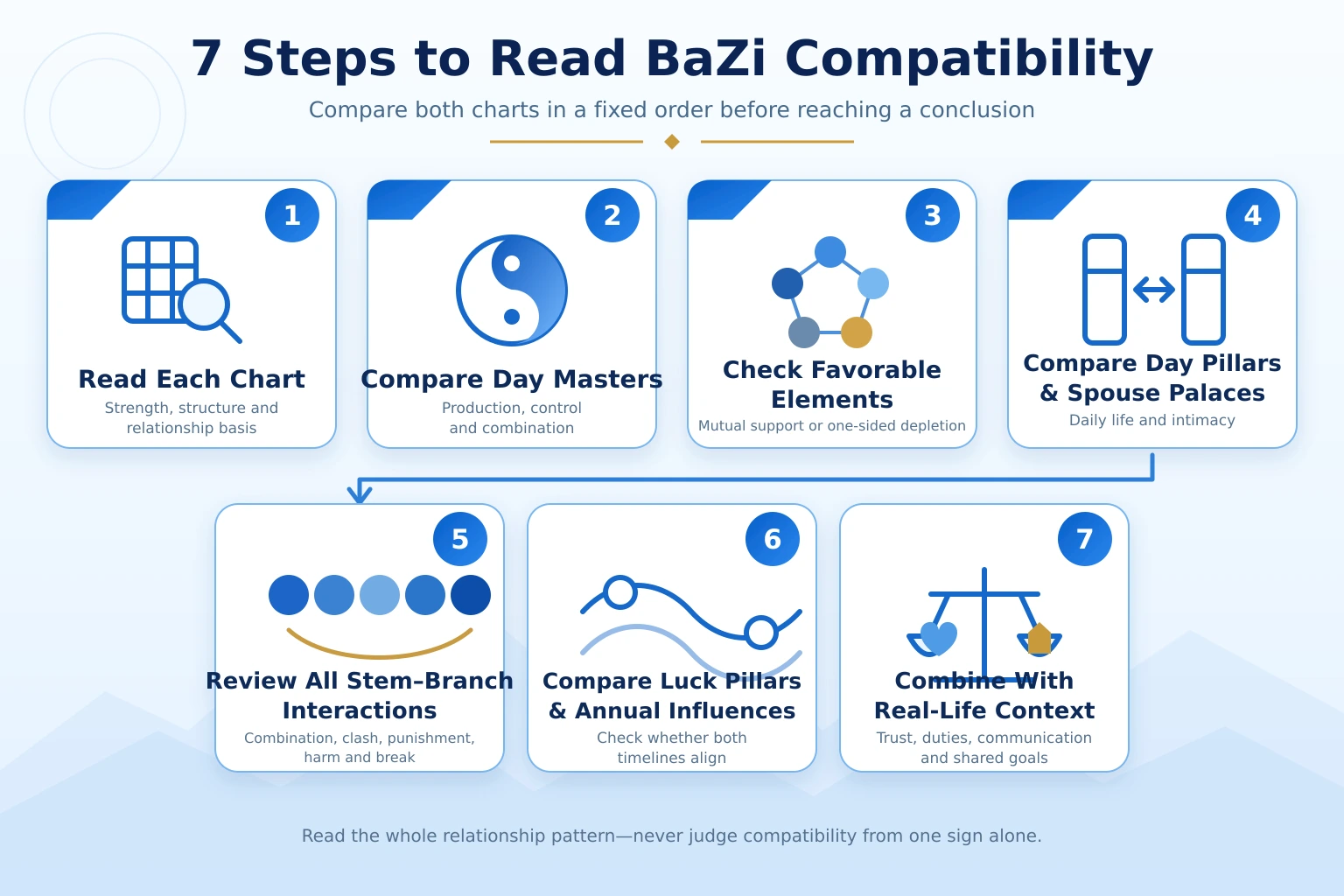
Step 1: Read Each Person's Relationship Foundation
The same Stem-Branch interaction can have a different effect in different charts. Before comparing the two people, examine each natal chart on its own.
Focus on five areas:
-
Day Master strength and chart structure: This shows how the person handles pressure and which elements may restore balance.
-
Favorable and unfavorable elements: Identify what the chart genuinely needs. Do not judge this from element counts alone.
-
Spouse Star: In traditional BaZi practice, the Wealth Star is commonly used to examine partner information in a man's chart, while the Officer and Seven Killings Stars are used in a woman's chart. Check whether the Spouse Star is supported, controlled, mixed, visible, or hidden.
-
Spouse Palace: The Day Branch is the Spouse Palace. It is used to examine intimacy, shared life, and stability within marriage.
-
Existing relationship indicators: Check whether the Spouse Palace repeatedly combines, clashes, receives punishment, harm, or break, and whether the Spouse Star is severely weakened.
This step answers one question: What relationship pattern does each person bring into a partnership?
If one chart already shows difficulty feeling secure in close relationships, the other person's chart may activate that pattern. It would be inaccurate to blame every problem on the two charts being “incompatible.”
Step 2: Compare the Day Masters
The Day Master, or Day Stem, represents the person. Comparing the two Day Masters gives you a first view of their core interaction.
If you are unfamiliar with the productive and controlling cycles, review the Five Element cycles before comparing the Day Masters.
Common patterns include:
-
One Day Master produces the other: One person may naturally support, encourage, or care for the other. If the producing person is already weak, however, continuous output can become draining.
-
One Day Master controls the other: This can appear as guidance, discipline, management, or pressure. Whether it helps or harms depends on both charts' strength and element preferences.
-
The Day Masters combine: A Heavenly Stem combination may create attraction, recognition, or attachment. A combination does not automatically mean a happy marriage.
-
The Day Masters share the same element: The two people may understand each other easily, but similar reactions can also make neither person willing to give way.
For example, suppose one person has an Earth Day Master and the other has a Water Day Master. Earth controls Water, but this alone does not mean the match is poor. If Earth is excessively strong and Water is useful to that chart, the interaction may reduce the excess Earth. If Earth is strong while the Water Day Master is weak, the same interaction may feel like one person dominates while the other experiences pressure.
Day Master interaction is therefore a starting point, not a final verdict.
Step 3: Check Whether Their Favorable Elements Complement Each Other
Elemental complement is important in BaZi compatibility, but it is often misunderstood.
“I lack Water and you have a lot of Water” is not enough to establish compatibility. A missing element is not necessarily a favorable element. A chart may need it, tolerate it, or be better without more of it.
Instead, ask:
-
Is an element strong in one chart genuinely useful to the other chart?
-
Can one person's element pattern moderate an excess or weakness in the other chart?
-
Does the relationship strengthen either person's unfavorable elements?
-
Is the support mutual, or does one person carry most of the output?
For example, a hot and dry chart dominated by Fire and Earth may benefit from an appropriate amount of Metal and Water. A partner with stable Metal and Water can provide balance. If both charts are dominated by Fire and Earth, impatience, rigidity, or pressure may intensify instead.
Elemental complement can appear through personality, daily pace, emotional expression, decision-making, and the way a couple shares resources.
Step 4: Compare the Day Pillars and Spouse Palaces
The Day Pillar contains the Day Stem and Day Branch. The Day Stem represents the person, while the Day Branch is the Spouse Palace, making the Day Pillar a key area in a compatibility reading.
Compare the Day Stems
Look for production, control, and combination between the two Day Stems. Then determine whether the resulting element is favorable or unfavorable to each chart. If the stems combine, also check whether transformation is possible and whether other Stems or Branches interfere.
Compare the Day Branches
The two Day Branches are the two Spouse Palaces. A combination, Three Harmony relationship, or appropriate support can strengthen closeness and cooperation in shared life. A clash, punishment, harm, or break can point to friction involving habits, emotional needs, family boundaries, or intimacy.
A Spouse Palace clash is frequently overinterpreted. It represents a direct collision and can bring movement, change, or tension, but it does not automatically mean divorce. Check:
-
whether the clash activates a favorable or unfavorable element for each person;
-
whether another Stem or Branch mediates the clash;
-
whether the same clash is repeated in the natal charts, Luck Pillars, or annual influences;
-
whether the corresponding problem already exists in real life; and
-
whether other important positions provide stability.
A Spouse Palace combination does not guarantee an ideal match, just as a clash does not justify telling a couple to separate. For a closer look at this position, read How to Read the Spouse Palace in BaZi.
Step 5: Compare All Combinations, Clashes, Punishments, Harms, and Breaks
The Day Pillar matters, but it is not the whole chart. Cross-check all four pillars. Examine production, control, and combination among the Heavenly Stems, followed by combinations, clashes, punishments, harms, and breaks among the Earthly Branches.
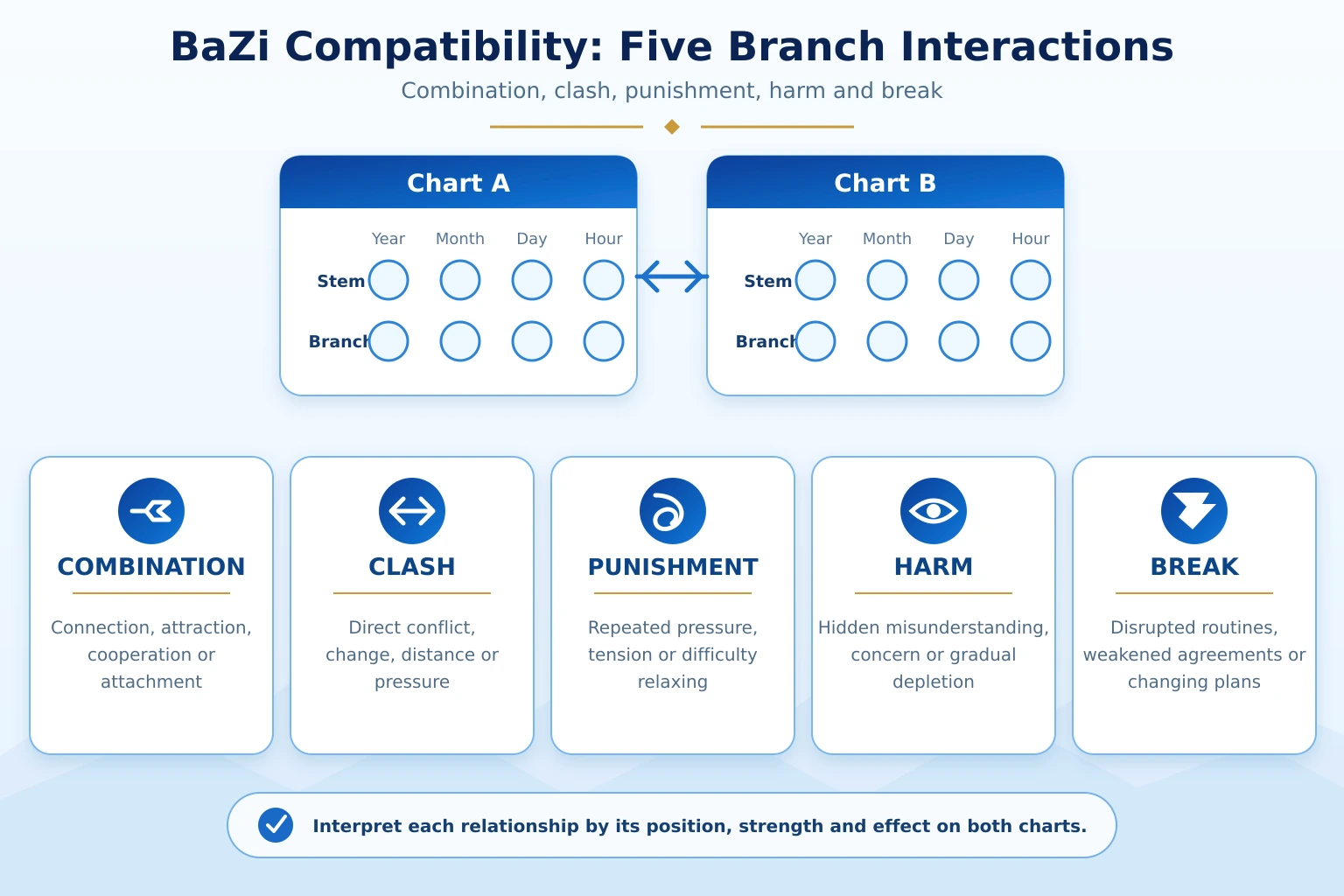
The four pillars can be read through these areas of shared life:
| Pillar | What to Examine in Compatibility |
|---|---|
| Year Pillar | Family background, inherited values, social environment, and zodiac interaction |
| Month Pillar | Family duties, working style, parental influence, and practical routines |
| Day Pillar | The two individuals, intimacy, the Spouse Palaces, and life as a couple |
| Hour Pillar | Private needs, future plans, views about children, and later-life direction |
Each Branch relationship describes a different kind of interaction:
-
Combination: connection, attraction, cooperation, or attachment;
-
Clash: direct conflict, movement, distance, or pressure to change;
-
Punishment: repeated pressure, awkwardness, or difficulty relaxing around an issue;
-
Harm: less visible misunderstanding, worry, or gradual depletion;
-
Break: disrupted order, weakened agreements, or plans that repeatedly change.
None of these is automatically favorable or unfavorable. A combination can bind an element that a chart needs to use. A clash can open a blocked structure and prompt necessary action.
Look for repetition. If the Day Branches clash, the Month Branches also conflict, and a Luck Pillar repeatedly activates the Spouse Palace, differences in daily life deserve greater attention. If the entire comparison contains only one clash while other key positions support each other, do not exaggerate that single signal.
Chinese zodiac compatibility compares only the Year Branches. It is one small part of this step and cannot replace a full BaZi comparison. You can use the Heavenly Stem and Earthly Branch Relationship Tool to check specific interactions.
Step 6: Compare Both People's Luck Pillars and Annual Influences
The natal charts show the relationship foundation. Luck Pillars and annual influences show when particular strengths or tensions are more likely to become prominent.
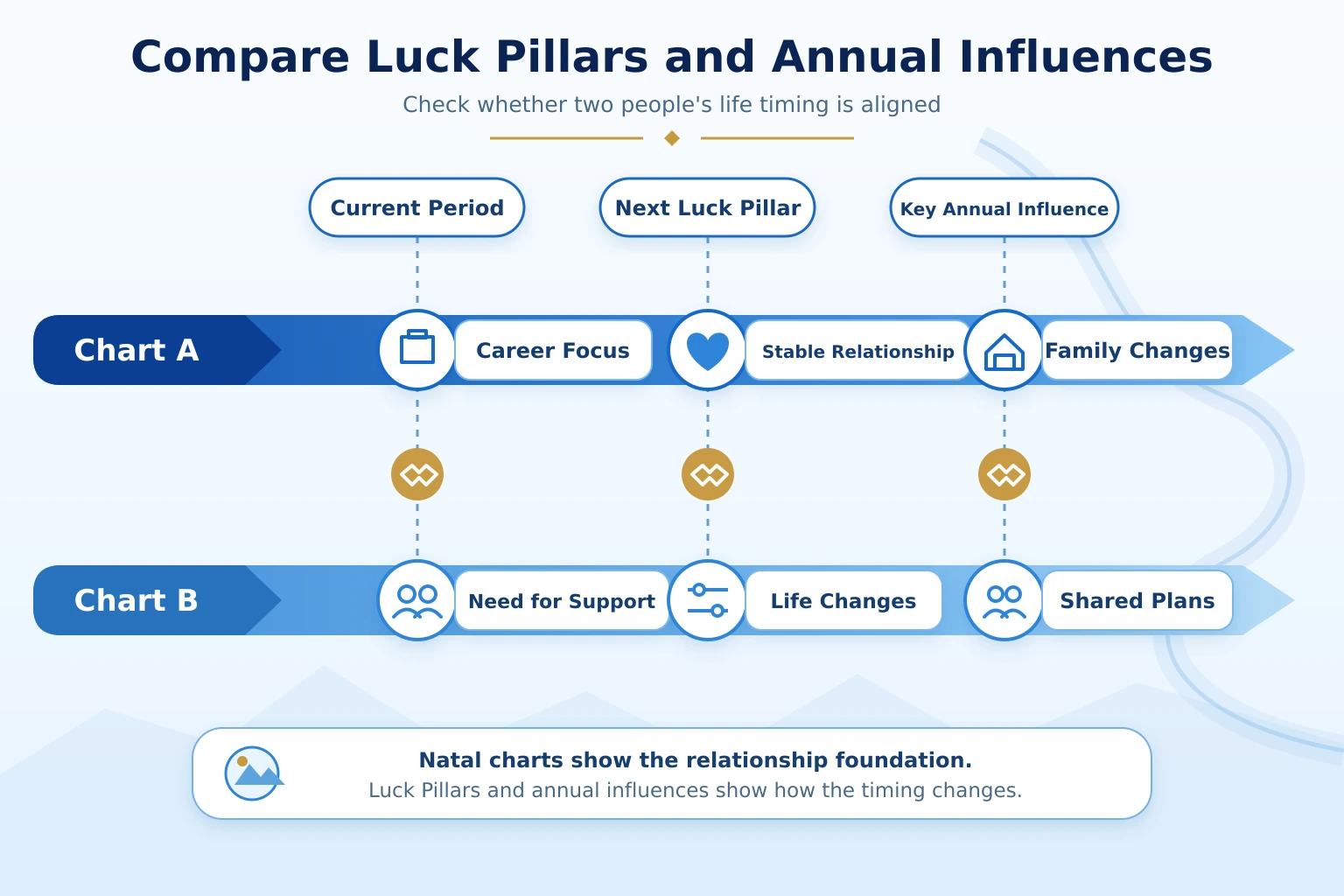
Check whether:
-
both people enter relatively stable relationship periods at the same time;
-
one person is focused on career or external development while the other needs more presence and stability;
-
a Luck Pillar repeatedly activates either person's Spouse Palace or Spouse Star;
-
their timing for relocation, career change, family duties, or children is aligned; and
-
a difficult year represents temporary pressure or a repeated natal pattern.
Strong natal attraction does not make every period easy. Natal tension does not make the entire relationship unworkable. Whether two lives move at a compatible pace often affects long-term stability.
Use Luck Pillars and annual influences to understand changing periods, not to decide on marriage or separation from one year alone.
Step 7: Combine the Evidence Instead of Counting “Good” and “Bad” Signs
After completing the comparison, weigh the evidence in this order:
-
Start with each natal chart: Does each person have the internal stability to maintain a long-term relationship?
-
Assess favorable and unfavorable elements: Does the partner add support or increase strain?
-
Prioritize the Day Pillars and Spouse Palaces: How do the two people relate in intimacy and daily life?
-
Look for repeated themes: Several placements pointing to the same issue carry more weight than one isolated interaction.
-
Add Luck Pillars and annual timing: When is support easier to use, and when might tension be activated?
-
Verify the reading against real life: Compare communication, trust, responsibility, money, family boundaries, and future goals.
For example, two Spouse Palaces may clash while the couple's useful elements complement each other and other important positions provide support. If the couple can clearly negotiate daily responsibilities, the clash may represent different habits or frequent changes rather than marital breakdown.
Conversely, two charts may contain several combinations, but those combinations may strengthen unfavorable elements. If the couple also avoids difficult conversations in real life, the combinations cannot create stability by themselves.
Six Common Mistakes When Reading BaZi Compatibility
Mistake 1: Compatible zodiac signs mean compatible BaZi charts
The zodiac sign represents only the Year Branch. It does not show the Day Master, favorable elements, Spouse Palace, or interactions across the other pillars.
Mistake 2: A Day Pillar combination means a perfect match
The Day Pillars are important, but the Year, Month, and Hour Pillars, together with each natal chart's structure, can change how the combination operates.
Mistake 3: More combinations are always better
A combination can create attachment or pull an unfavorable element into the chart. Identify which pillars and elements combine and what the result means for each person.
Mistake 4: Any clash means the couple should not marry
A clash identifies tension or pressure, not an inevitable outcome. Its importance depends on position, strength, element preference, repetition, and whether the same problem is present in real life.
Mistake 5: A partner can automatically supply a missing element
Element counts alone cannot determine what a chart needs. Day Master strength, season, structure, and the full balance of the chart must be considered.
Mistake 6: Good BaZi compatibility outweighs real relationship problems
Supportive chart interactions cannot replace respect, responsibility, and communication. Deception, control, violence, or major conflicts in values should never be ignored because a BaZi reading appears favorable.
A BaZi Compatibility Case: Ding Fire Man and Jia Wood Woman
These charts come from the ShenShu AI BaZi Compatibility Calculator. The following is our seven-step reading process.
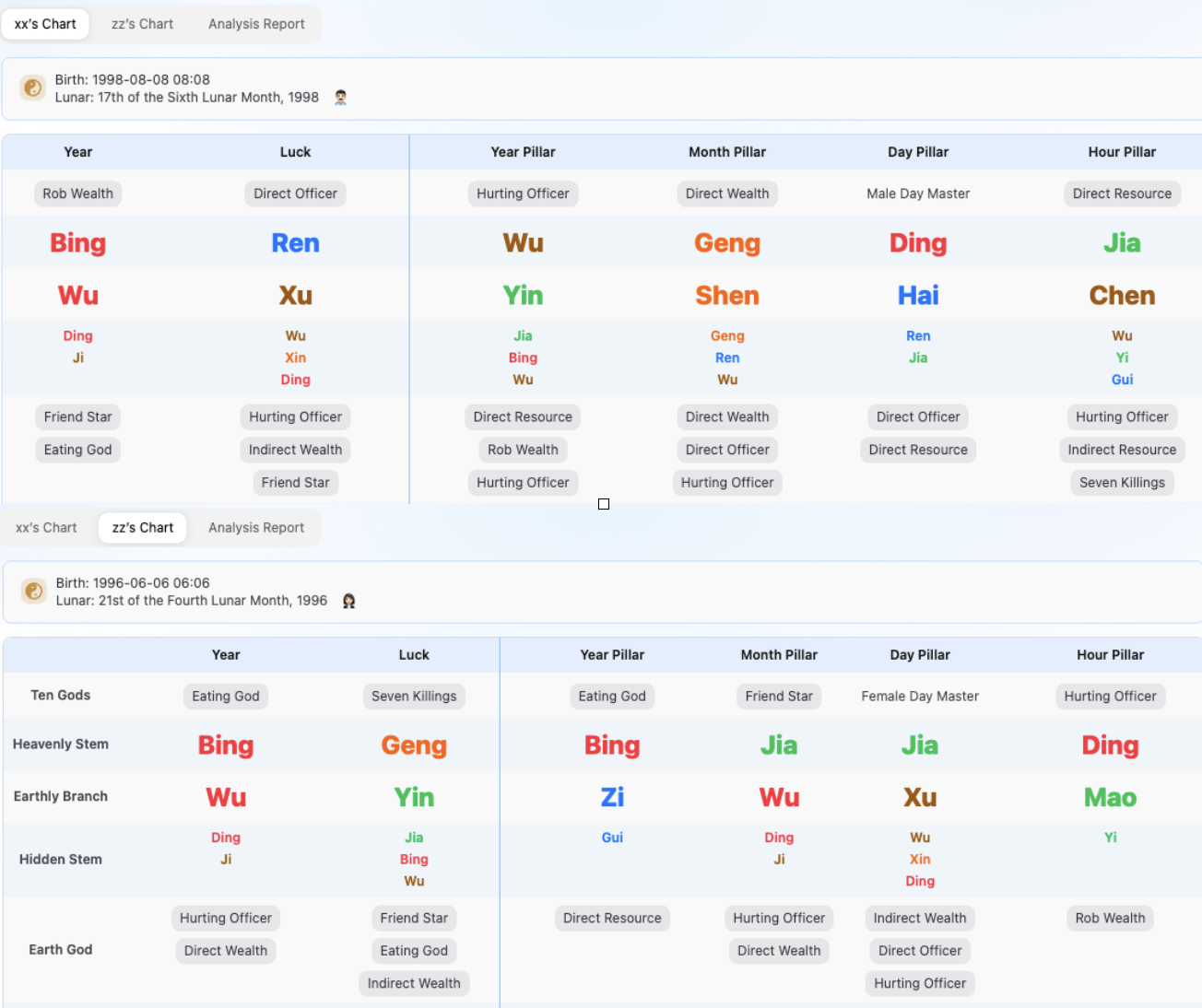
Step 1: Read Their Individual Relationship Foundations
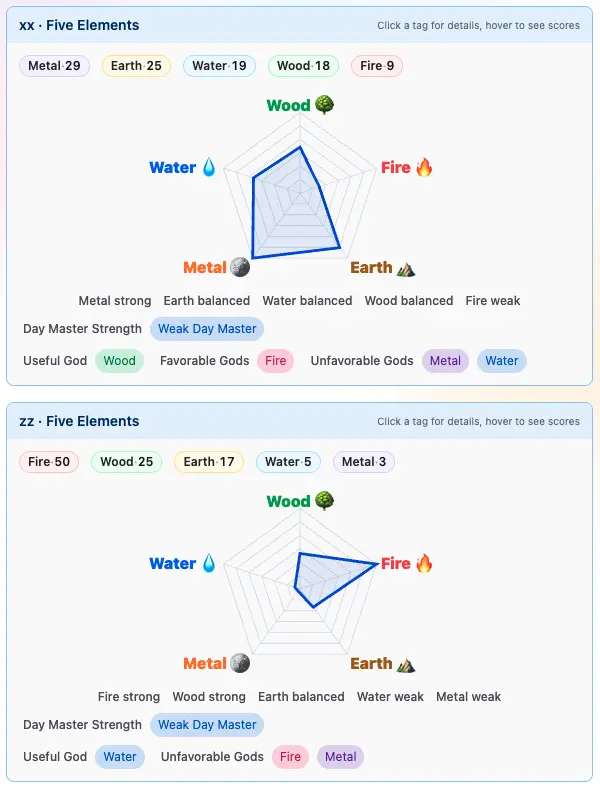
The man's Ding Fire Day Master is weak. Fire scores 9, while Metal scores 29. Wood is his useful element and Fire is favorable, meaning he benefits from Wood and Fire support. Metal is also his Spouse Star. The prominent Geng-Shen Metal makes partner and marriage themes visible, but relationships and practical duties may also create pressure. His Hai Spouse Palace combines with Yin and is harmed by Shen, indicating attraction mixed with practical friction.
The woman's Jia Wood Day Master is weak. Fire scores 50, while Water scores only 5. Water is useful to her; Fire and Metal are unfavorable. She needs Water for support and moderation, while additional Fire increases depletion. Metal is her Spouse Star, but the natal chart contains only Xin Metal hidden inside her Xu Spouse Palace. This means the Spouse Star is not visible on a Heavenly Stem. Xu combines with her Hour Branch Mao, linking marriage with future planning and home life.
Step 2: Compare Their Day Masters
The woman's Jia Wood produces the man's Ding Fire. This means she is more likely to support him through ideas, encouragement, or action. Wood is also his useful element, so this production benefits him.
However, the woman is weak and Fire is unfavorable to her. Continually producing Fire can drain her. The Day Master relationship is supportive, but the benefit is not equal.
Step 3: Compare Their Element Preferences
-
The woman's Wood is strong, and Wood is useful to the man. This supports what his chart needs.
-
Her Fire is strong, and Fire is favorable to him. The same Fire is unfavorable to her and increases her depletion.
-
The man's Water is moderate, and Water is useful to her. The same Water is unfavorable to him.
-
Metal is unfavorable to both charts, and Metal is the man's strongest element. This means rules, pressure, and practical obligations may affect both people.
The charts complement each other, but not evenly. Fire benefits the man and strains the woman; Water benefits the woman and strains the man.
Step 4: Compare the Day Pillars and Spouse Palaces
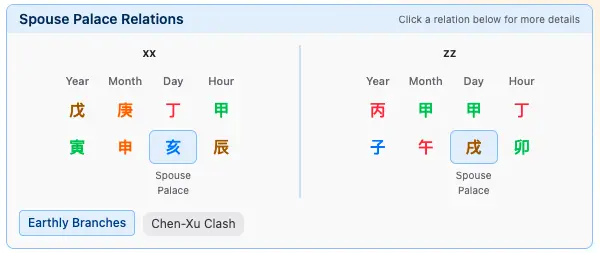
Their Day Pillars are Ding-Hai and Jia-Xu. Jia Wood produces Ding Fire, showing support between the Day Masters. Hai and Xu do not form a direct combination, clash, punishment, harm, or break, so the two Spouse Palaces have no strong direct interaction.
The man's Hai Spouse Palace forms a Hai-Mao half-combination for Wood with the woman's Hour Branch Mao. This adds Wood that supports the man. His Hour Branch Chen clashes with her Xu Spouse Palace, meaning that housing, family duties, views about children, or long-term plans may become their main source of disagreement.
Step 5: Compare Cross-Chart Stem and Branch Interactions
-
The man's Yin and the woman's Wu and Xu complete the Yin-Wu-Xu Fire combination. Fire is favorable to him but unfavorable to her, so the same structure supports him while draining her.
-
The man's Shen and Chen join the woman's Zi to complete the Shen-Zi-Chen Water combination. Water is useful to her but unfavorable to him, so this structure supports her while adding pressure to him.
-
The man's Hai and the woman's Mao form a Hai-Mao half-combination for Wood. Wood is useful to him, strengthening the support he receives from her chart.
-
The man's Chen clashes with the woman's Xu and harms her Mao. This indicates direct disagreement about future arrangements as well as concerns that may not be expressed immediately.
The two charts create both Fire and Water structures. Their connection is strong, but the same elemental force affects each person differently.
Step 6: Compare Their Luck Pillars and Annual Influences
-
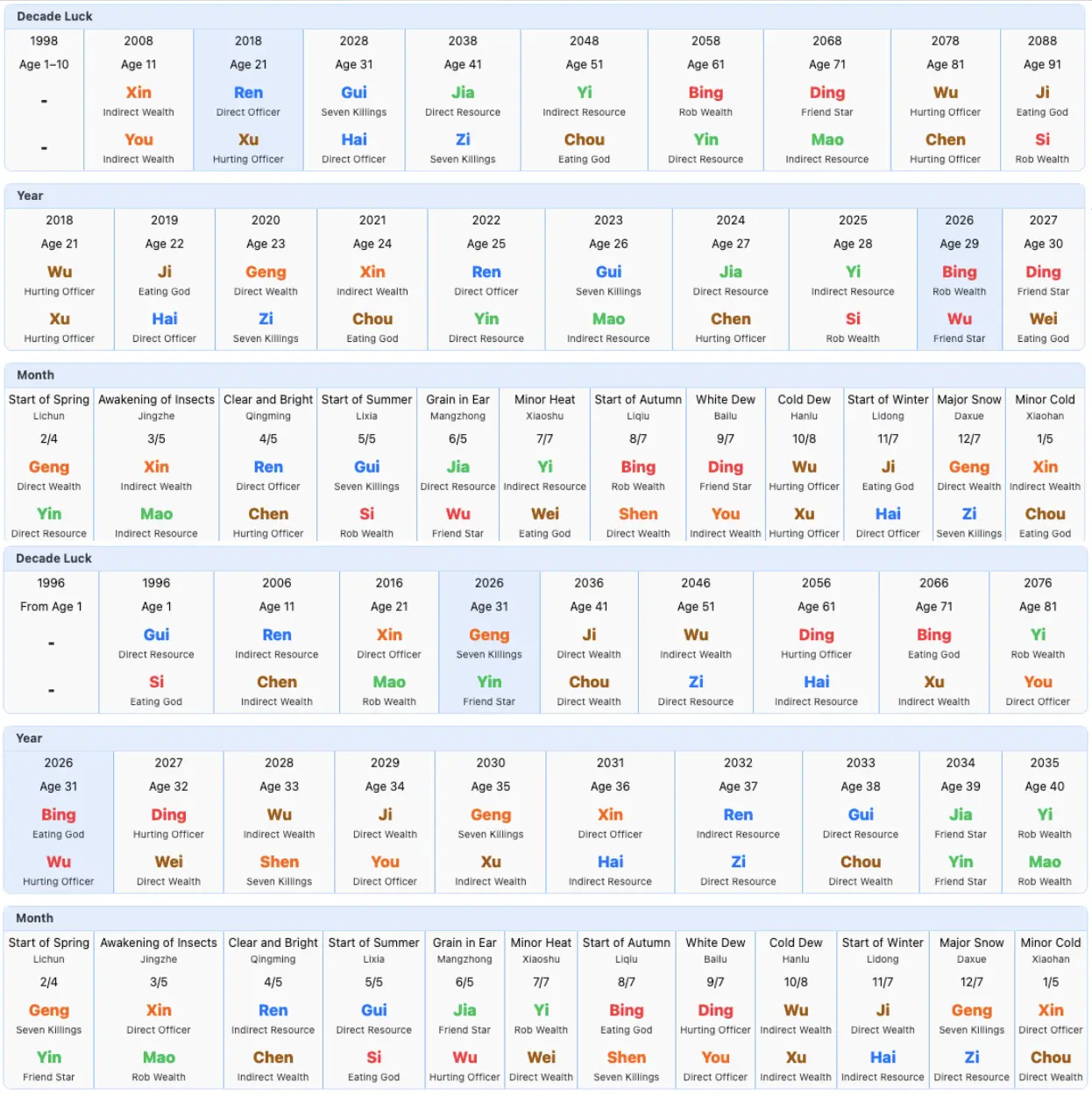
2026–2027: The woman enters a Geng-Yin Luck Pillar. Geng Metal is both her Spouse Star and an unfavorable element, so relationship themes and external pressure increase together. The man remains in a Ren-Xu Luck Pillar, and Ren Water is unfavorable to him. The Bing-Wu annual influence strengthens Fire, supporting him but further draining her.
-
2028–2035: The man enters a Gui-Hai Luck Pillar while the woman remains in Geng-Yin. Yin and Hai combine, strengthening the connection between them. However, Gui-Hai adds unfavorable Water to his chart, and Hai repeats his Spouse Palace. A stronger connection may therefore bring him more pressure as well.
-
2030–2031: Geng and Xin are the woman's Spouse Stars. Xu repeats her Spouse Palace in 2030, while Hai repeats the man's Spouse Palace in 2031. Marriage-related themes are more likely to be activated during these two years.
-
2038–2045: The woman's Ji-Chou Luck Pillar overlaps with the man's Jia-Zi Luck Pillar. Jia combines with Ji, and Zi combines with Chou. Finances, family, and long-term living arrangements are likely to become shared priorities.
Their Luck Pillars are not completely out of step. However, each combination also carries a different elemental effect for each person. A stronger connection does not necessarily mean an easier period.
Step 7: Reach a Practical Conclusion
These charts show clear attraction and elemental complementarity, but also unequal depletion. The woman's Wood and Fire support the man, while the man's Water supports the woman. Yet an element that helps one person is often unfavorable to the other.
In real life, three questions matter most: Does the woman carry most of the encouragement and forward movement? Can the man respond to her need for stability and moderation? Can they coordinate housing, family duties, and long-term plans?
If support becomes mutual, the elemental complement is easier to use constructively. If one person continually gives more, the opposing Fire and Water preferences are more likely to appear as exhaustion.
Frequently Asked Questions
Can two people marry if their BaZi charts clash?
Yes. A clash does not automatically prevent marriage, and one clash is not a reason to end a relationship. Identify where the clash occurs, whether it activates an unfavorable element for either person, whether other relationships moderate it, and whether Luck Pillars repeatedly trigger it.
BaZi compatibility can help a couple identify recurring issues involving routines, emotional expression, money, parental boundaries, or future plans. It cannot make the decision to marry or separate. Trust, responsibility, and the ability to solve problems remain more important.
Does a Spouse Palace combination guarantee a good marriage?
No. A combination can indicate closeness, attraction, or connection in shared life, but you must still assess the Day Masters, element preferences, Spouse Stars, and other Stem-Branch relationships. A combination can also create attachment or restriction.
Does one Day Master producing the other mean the couple is compatible?
Not necessarily. Production shows a relationship between giving and receiving. Check whether the producing person is strong enough to sustain the output and whether the produced element benefits both charts. One-sided support can become imbalance.
Is Chinese zodiac compatibility the same as BaZi compatibility?
No. Chinese zodiac compatibility compares only the two Year Branches. BaZi compatibility compares all four pillars, Day Masters, element preferences, Spouse Palaces, Spouse Stars, Luck Pillars, and annual influences.
What if the BaZi charts look incompatible but the relationship is good?
Give greater weight to the real relationship. Chart tension can identify potential problems, but it cannot invalidate trust, communication, and a stable life that the couple has already built. If the reading directly contradicts reality, verify the birth data and the method used.
Summary
To read BaZi compatibility, follow a clear sequence: read each natal chart first, compare the Day Masters and element preferences, examine the Day Pillars, Spouse Palaces, and full Stem-Branch interactions, then add both people's Luck Pillars and real relationship conditions.
Combinations and clashes are relationship signals, not outcomes. The purpose of a complete comparison is to identify where two people support each other, where the same problem may repeat, and what they need to discuss before building a life together.