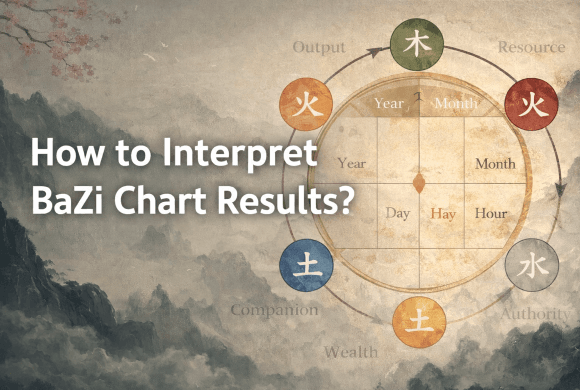
BaZi (Four Pillars of Destiny, Four Pillars, 八字) reads personality through a chart pattern. The main layers are the Day Master (Day Stem, Ri Gan, 日干), the Five Elements (Wu Xing, 五行), and the Ten Gods (Ten Stars, Shi Shen, 十神).
The Day Master gives the core operating style. The Five Elements show balance, excess, and weak points. The Ten Gods show how that personality expresses itself in daily life. Read these layers together and the chart starts to sound like a person rather than a list of traits.

What Part of a BaZi Chart Shows Personality?
Personality in BaZi comes from the whole natal chart, but three parts carry most of the weight.
First, the Day Master shows the basic nature of the self. It is the Heavenly Stem (Celestial Stem, Tian Gan, 天干) of the Day Pillar (Ri Zhu, 日柱), and it acts as the reference point for the entire chart.
Second, the Five Elements show the chart's emotional and behavioral climate. A chart with strong Fire behaves differently from a chart with strong Water, even if both people share the same Day Master.
Third, the Ten Gods translate elemental relationships into human tendencies such as discipline, creativity, competitiveness, caution, and social ease. This is the layer that turns abstract element theory into recognizable behavior.
The Earthly Branches (Terrestrial Branches, Di Zhi, 地支) and pillar placement also matter, especially when an element or Ten God is rooted, repeated, or placed in the Month Pillar. The clearest way to read personality starts with the Day Master, then moves into element balance and Ten Gods.
How the Day Master Reveals Core Personality
The Day Master is the center of personality reading in BaZi. It shows how a person tends to move through the world, make decisions, react to pressure, and express identity.
Each Day Master belongs to one of the Five Elements, so it already carries a natural style.
| Day Master element | Core personality direction |
|---|---|
| Wood | growth, principle, direction, initiative |
| Fire | expression, warmth, visibility, momentum |
| Earth | stability, practicality, reliability, containment |
| Metal | order, standards, decisiveness, clarity |
| Water | adaptability, perception, strategy, flexibility |
The element alone gives a starting point. Polarity refines it further. Yang Wood (Jia, 甲) feels more upright and direct than Yin Wood (Yi, 乙), which tends to show flexibility and tact. Yang Metal (Geng, 庚) cuts more openly, while Yin Metal (Xin, 辛) is more polished and selective.
This is why the Day Master works well as the first personality marker. It gives a stable center before the rest of the chart adds complexity.
How the Five Elements Shape Personality in BaZi
The Five Elements shape temperament by showing what is abundant, what is weak, and how forces support or restrain one another. They describe movement and direction inside the chart.
| Element | Common personality expression | When excessive | When weak |
|---|---|---|---|
| Wood | principled, growth-oriented, idealistic | rigid, impatient, forceful | hesitant, easily redirected |
| Fire | expressive, enthusiastic, socially warm | impulsive, dramatic, easily overextended | guarded, low in drive, hard to energize |
| Earth | grounded, patient, dependable | heavy, stubborn, resistant to change | scattered, unanchored, hard to settle |
| Metal | disciplined, precise, self-controlled | harsh, overly critical, inflexible | vague, inconsistent, weak on boundaries |
| Water | observant, adaptive, thoughtful | evasive, emotionally flooded, overly indirect | dry in expression, less responsive, rigid in thought |
Element balance matters more than counting symbols. A person with some Fire and some Water may express ideas clearly while staying reflective. A chart flooded with Water and lacking Earth may produce strong intuition with less steadiness. A chart with dominant Metal and weak Fire may show control, restraint, and sharp judgment with less outward warmth.
Season also affects personality tone. A Wood Day Master born in spring usually has more natural growth energy. The same Wood Day Master born in autumn often feels more pressured and cautious. The Month Branch changes how the Day Master lives out its element.
How the Ten Gods Refine Personality Traits
The Ten Gods are the most detailed layer of personality reading because they describe how the chart relates to support, expression, resources, rules, and competition. They are derived from the relationship between other chart elements and the Day Master.
For personality reading, it is easiest to begin with the five role families.
| Ten God family | What it often adds to personality |
|---|---|
| Resource | reflective, studious, receptive, protective |
| Output | expressive, creative, outspoken, productive |
| Wealth | practical, result-focused, responsible, managerial |
| Officer / Seven Killings | disciplined, restrained, duty-aware, forceful under challenge |
| Peers | independent, self-driven, competitive, socially equal |
Then refine the reading with specific Ten Gods:
- Direct Resource (Zheng Yin, 正印) often shows patience, learning, and a composed mind.
- Indirect Resource (Pian Yin, 偏印) often shows intuition, originality, and unconventional thinking.
- Eating God (Shi Shen, 食神) often shows ease, talent, and a softer style of expression.
- Hurting Officer (Shang Guan, 伤官) often shows sharp speech, originality, and a stronger need to say what one thinks.
- Direct Officer (Zheng Guan, 正官) often shows order, restraint, and respect for standards.
- Seven Killings (Qi Sha, 七杀) often shows decisiveness, urgency, courage, and a hard response to challenge.
- Friend (Bi Jian, 比肩) often shows independence and clear self-definition.
- Rob Wealth (Jie Cai, 劫财) often shows social boldness, rivalry, and quick engagement with people.
Placement still matters. Resource in the Month Pillar often becomes a habit of learning or caution. Strong Output in visible stems often makes a person easier to read. Officer or Seven Killings rooted in the branches can make discipline or pressure feel constant.
Common Mistakes When Reading Personality in BaZi
- Reading the zodiac animal first and ignoring the Day Master.
- Treating one element as the whole personality.
- Assuming a missing element explains every weakness.
- Reading one Ten God in isolation without checking balance.
- Ignoring the Month Branch and seasonal strength.
- Treating every strong Seven Killings pattern as aggression.
- Treating every Resource pattern as kindness or every Wealth pattern as money-mindedness.
- Forgetting that the same trait changes when the chart is balanced or overloaded.
These mistakes make charts sound generic. A strong personality reading stays tied to the full chart condition.
A Simple Step-by-Step Example of Personality Reading
Take a sample chart with these broad features:
- Day Master: Jia Wood (甲木)
- Season: winter birth
- Strong Water
- Visible Metal
- Light Fire
Step 1: Start with the Day Master. Jia Wood gives a direct, upright, and purposeful core personality. This person usually wants clarity, direction, and a reason behind action.
Step 2: Read the seasonal climate. Winter and strong Water increase thoughtfulness, sensitivity, and inner movement. The person thinks before acting and often notices more than they say.
Step 3: Check the Five Elements. Strong Water supports Wood, so the mind stays active and responsive. Visible Metal adds standards, caution, and external pressure. Light Fire reduces outward ease and spontaneous warmth.
Step 4: Translate this into personality. This chart often belongs to someone who is principled, mentally alert, observant, and serious about doing things properly. The person usually learns quickly, carries a strong inner standard, and stays careful with trust. They may appear calm and controlled while holding strong convictions underneath.
Step 5: Refine with Ten Gods. For a Jia Wood Day Master, Water becomes Resource and Metal becomes Officer or Seven Killings depending on polarity. That combination often adds study, reflection, discipline, and a sharper response to responsibility. If Fire is light, expression becomes more contained, so the person may communicate selectively rather than continuously.
This gives a personality reading with clear human traits: thoughtful, principled, alert, selective, self-controlled, and more serious than casual. That is how BaZi personality reading works in practice.
Read personality by starting with the Day Master, then checking the Five Elements, then refining with the Ten Gods. That order keeps the reading focused and precise.