The BaZi spouse star is the Ten God used to represent a spouse or long-term partner. In a traditional male chart, it is Wealth; in a traditional female chart, it is Officer and Seven Killings. To read yours, identify it from the Day Master, find it in the chart, and assess its strength, visibility, position, and interactions.

What Is the Spouse Star in BaZi?
The spouse star is determined by the Five Element relationship between the Day Master and the other stems.
-
Male chart: the element controlled by the Day Master—Direct Wealth and Indirect Wealth.
-
Female chart: the element that controls the Day Master—Direct Officer and Seven Killings.
“Spouse star” is the general term. “Wife star” usually refers to Wealth in a male chart, while “husband star” refers to Officer and Seven Killings in a female chart.
How Do You Find Your Spouse Star in BaZi?
Start With the Day Master
The Day Master is the Heavenly Stem at the top of the Day Pillar. Use it—not the Year Stem, zodiac animal, or Day Branch—to determine your spouse star.
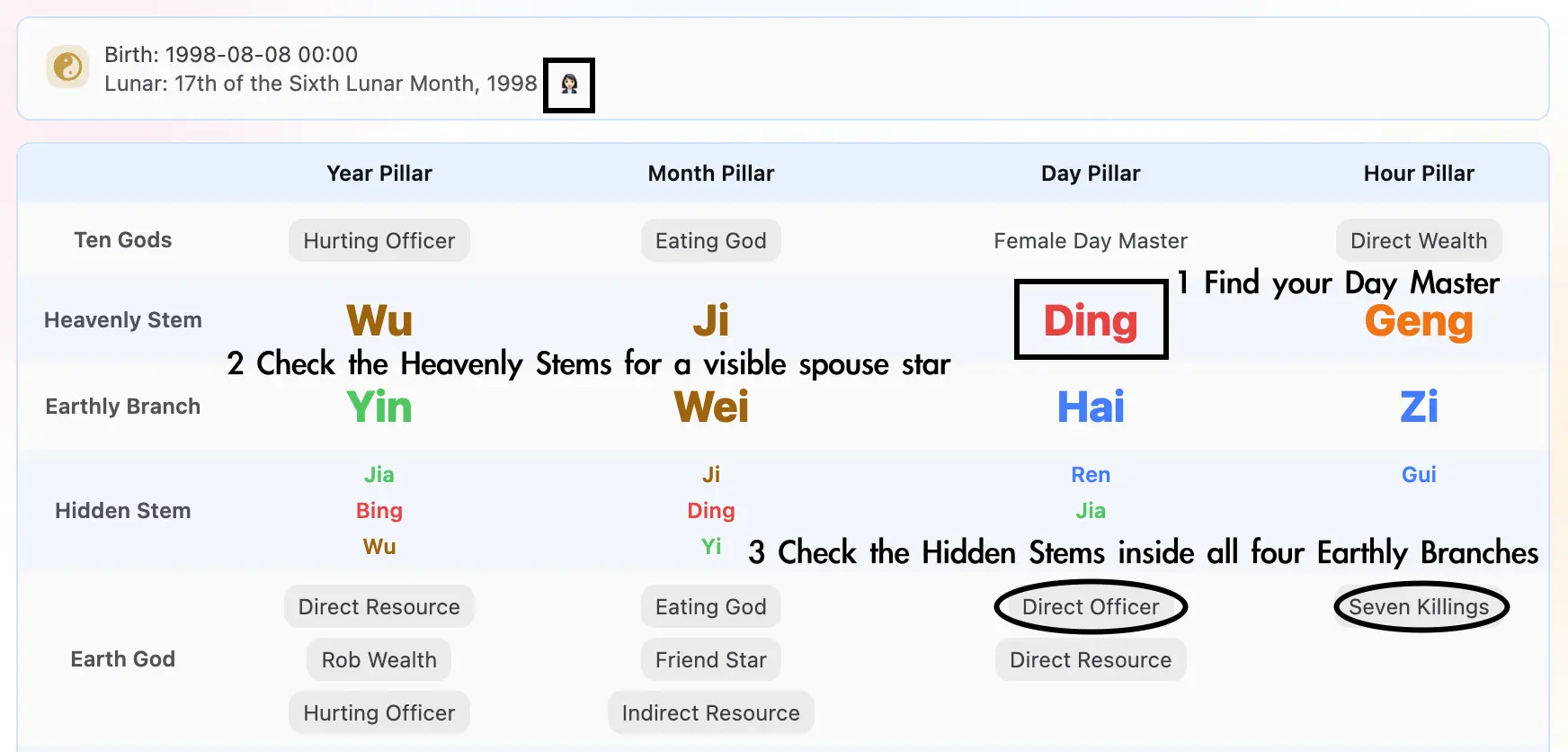
You can find yours in four steps:
-
Generate your Four Pillars with a BaZi calculator.
-
Locate the Heavenly Stem of the Day Pillar.
-
Apply the male or female rule below.
-
Search all four pillars, including hidden stems, for the corresponding element.
Spouse Stars in a Male BaZi Chart
In a traditional male chart, Wealth represents the wife because it is the element controlled by the Day Master. Both Wealth types belong to the spouse-star category:
-
Direct Wealth has the opposite yin-yang polarity from the Day Master.
-
Indirect Wealth has the same polarity as the Day Master.
Direct Wealth often indicates a more defined relationship pattern, while Indirect Wealth may be more flexible. Neither label alone describes relationship quality.
Spouse Stars in a Female BaZi Chart
In a traditional female chart, Officer and Seven Killings represent the husband because their element controls the Day Master. Both forms belong to the spouse-star category:
-
Direct Officer has the opposite yin-yang polarity from the Day Master.
-
Seven Killings has the same polarity as the Day Master.
Direct Officer often indicates a more defined relationship pattern. Seven Killings may be more forceful or unconventional. Neither label determines relationship quality.
BaZi Spouse Star Table for All Ten Day Masters
| Day Master | Male: Direct Wealth | Male: Indirect Wealth | Female: Direct Officer | Female: Seven Killings |
|---|---|---|---|---|
| Jia 甲, Yang Wood | Ji 己 Earth | Wu 戊 Earth | Xin 辛 Metal | Geng 庚 Metal |
| Yi 乙, Yin Wood | Wu 戊 Earth | Ji 己 Earth | Geng 庚 Metal | Xin 辛 Metal |
| Bing 丙, Yang Fire | Xin 辛 Metal | Geng 庚 Metal | Gui 癸 Water | Ren 壬 Water |
| Ding 丁, Yin Fire | Geng 庚 Metal | Xin 辛 Metal | Ren 壬 Water | Gui 癸 Water |
| Wu 戊, Yang Earth | Gui 癸 Water | Ren 壬 Water | Yi 乙 Wood | Jia 甲 Wood |
| Ji 己, Yin Earth | Ren 壬 Water | Gui 癸 Water | Jia 甲 Wood | Yi 乙 Wood |
| Geng 庚, Yang Metal | Yi 乙 Wood | Jia 甲 Wood | Ding 丁 Fire | Bing 丙 Fire |
| Xin 辛, Yin Metal | Jia 甲 Wood | Yi 乙 Wood | Bing 丙 Fire | Ding 丁 Fire |
| Ren 壬, Yang Water | Ding 丁 Fire | Bing 丙 Fire | Ji 己 Earth | Wu 戊 Earth |
| Gui 癸, Yin Water | Bing 丙 Fire | Ding 丁 Fire | Wu 戊 Earth | Ji 己 Earth |
Where Can You Find the Spouse Star in Your Chart?
After identifying the relevant stems, look for them in the Year, Month, Day, and Hour Pillars.
A spouse star may be:
-
visible as a Heavenly Stem;
-
hidden inside an Earthly Branch;
-
present in more than one pillar;
-
represented by both its Direct and Indirect forms;
-
absent from the natal chart but introduced by a luck cycle or annual pillar.
The spouse star does not occupy one fixed box. Its identity comes from the Day Master, while its location depends on where the relevant stems appear in the chart.
How Do You Read the Spouse Star?
Finding the correct element answers “Which star is mine?” The next step is to assess how that star functions in the chart.
Is the Spouse Star Visible, Hidden, or Absent?
A visible spouse star appears in a Heavenly Stem. Its relationship theme is usually easier to recognize and more openly expressed.
A hidden spouse star appears only in the hidden stems of an Earthly Branch. The theme is present, but it may be less obvious, more private, or dependent on later activation.
An absent spouse star does not appear in either the Heavenly Stems or hidden stems of the natal chart. This is different from a star that is merely not visible. A missing natal spouse star may still arrive through a 10-year luck pillar or annual pillar.
Is the Spouse Star Strong or Weak?
Do not judge strength by counting appearances alone. Check:
-
Season: Is the spouse-star element supported by the Month Branch and season?
-
Roots: Does it have the same element in one or more Earthly Branches?
-
Support: Is it produced or reinforced by other elements?
-
Control and drain: Is it heavily controlled, weakened, or drained?
-
Combinations and clashes: Is it combined, transformed, or disturbed by another stem or branch?
A visible star may still be weak if it lacks seasonal support and roots. A hidden star may be substantial if it is rooted and supported. Strength describes how active and available the element is; it is not a simple score for marriage quality.
What If There Is More Than One Spouse Star?
Some charts repeat the same spouse star or contain both Direct and Indirect forms. This can make relationship themes more prominent or complex, but repeated Wealth or mixed Officer and Seven Killings does not prove multiple marriages or infidelity. Check strength, position, interactions, and luck cycles.
What Does the Position of the Spouse Star Mean?
The pillar shows the life context in which the spouse-star theme is expressed.
| Position | General context |
|---|---|
| Year Pillar | Early environment, extended family, social background, or a more distant context |
| Month Pillar | Family environment, work, social life, and the main adult environment |
| Day Pillar | The self, intimate partnership, and the area closest to the Day Master |
| Hour Pillar | Private life, future plans, later development, and less immediately visible matters |
A spouse star in a Heavenly Stem is more exposed. One hidden in a branch may require the branch or hidden stem to be activated before its role becomes clear.
Position should not be reduced to a fixed rule such as “Year means early marriage” or “Hour means late marriage.” The pillar provides context; timing still depends on the full chart and luck cycles.
How Do Combinations and Clashes Affect the Spouse Star?
A spouse star is stronger when it is seasonally supported and rooted in the Earthly Branches. It may weaken when it is heavily controlled or drained. If a visible spouse star is involved in a Heavenly Stem combination, check whether it is simply bound or able to transform. If the branch containing a hidden spouse star is clashed, the relationship theme may be activated or changed. These interactions are not automatically favorable or unfavorable.
For definitions of combinations, clashes, punishments, harms, controls, and other BaZi interactions, see our BaZi interactions glossary.
Can the Spouse Star Show Relationship Luck or Marriage Timing?
The spouse star helps identify periods when relationship matters may become more active. A 10-year luck pillar or annual pillar may:
-
introduce a spouse star missing from the natal chart;
-
expose a spouse star previously hidden in a branch;
-
strengthen or weaken an existing spouse star;
-
combine or clash with the spouse star;
-
activate the Day Branch or Spouse Palace at the same time.
Such periods may correspond with meeting someone, commitment, or changes in an existing partnership. A spouse star arriving does not automatically mean a wedding. Marriage timing is stronger when the spouse star, Spouse Palace, natal chart, luck pillar, and annual pillar point to the same event.
Worked Example 1: Gui Water Female Chart
The first example has the following Four Pillars:
| Year | Month | Day | Hour | |
|---|---|---|---|---|
| Heavenly Stem | Geng Metal | Wu Earth | Gui Water | Ren Water |
| Earthly Branch | Wu Horse | Zi Rat | You Rooster | Zi Rat |
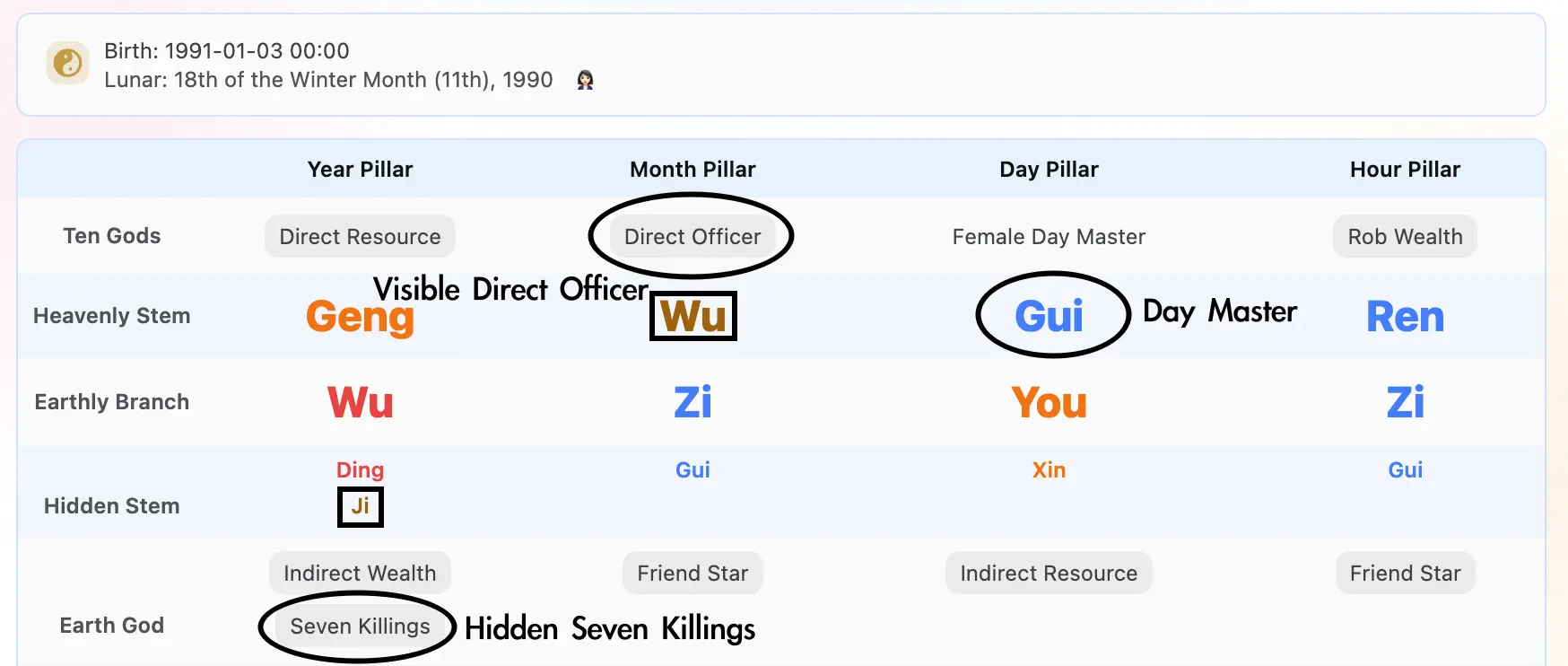
The Day Master is Gui Water. Earth controls Water, so Earth is the female spouse-star element. Wu Earth is Direct Officer because Wu and Gui have opposite polarity; Ji Earth is Seven Killings because both are yin.
Wu Earth is visible in the Month Stem. Ji Earth is hidden inside the Year Branch, Wu Horse. The chart therefore has a visible Direct Officer and a hidden Seven Killings—not an absent husband star.
The chart is born in Zi month, when Water is seasonally strong. Gui Water is also supported by Ren Water and two Zi branches. The exposed Wu Earth sits above Zi Water without a root in the Month Branch, although the Year Branch Wu contains Ji Earth and Fire that support Earth. Wu is visible, but its strength still depends on season, roots, and support; hidden Ji remains part of the natal chart.
Because Direct Officer appears in the Month Pillar, its theme connects with the main adult environment, including family, work, and social life. Later Fire or Earth cycles may reinforce it, but specific timing also requires the Spouse Palace and other interactions.
Worked Example 2: Jia Wood Male Chart
The second example has these Four Pillars:
| Year | Month | Day | Hour | |
|---|---|---|---|---|
| Heavenly Stem | Xin Metal | Jia Wood | Jia Wood | Jia Wood |
| Earthly Branch | Wei Goat | Wu Horse | Xu Dog | Zi Rat |
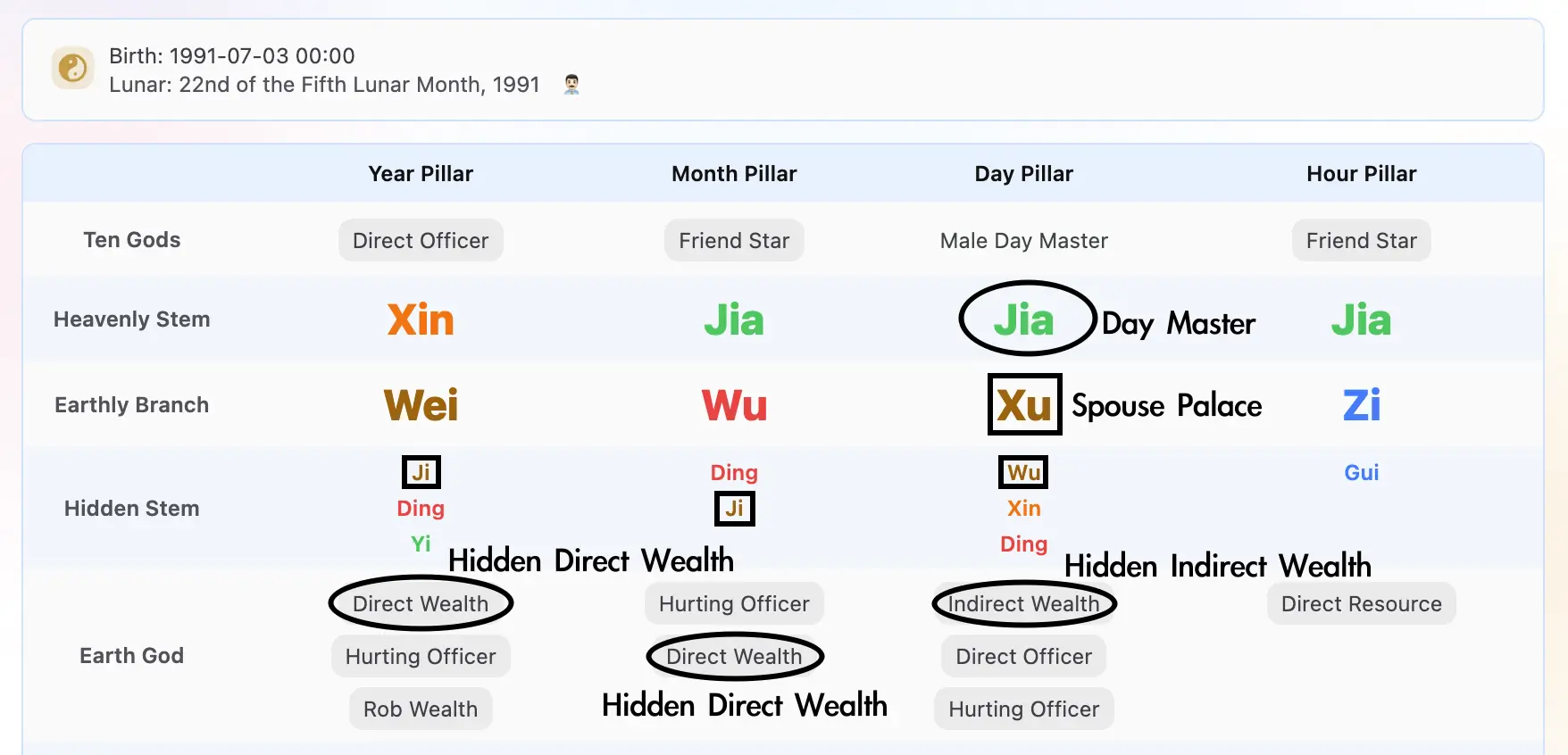
The Day Master is Jia Wood. Wood controls Earth, so Earth is the male spouse-star element. Ji Earth is Direct Wealth because Ji and Jia have opposite polarity; Wu Earth is Indirect Wealth because both are yang.
No Earth appears in the Heavenly Stems, so the spouse star is not visible. It is nevertheless present in three hidden-stem positions:
-
Ji Earth, Direct Wealth, is hidden in the Year Branch Wei.
-
Ji Earth, Direct Wealth, is hidden in the Month Branch Wu.
-
Wu Earth, Indirect Wealth, is hidden in the Day Branch Xu.
The Hour Branch Zi contains no Earth spouse star.
The spouse star is hidden but not absent. The chart is born in Wu month, when Fire is seasonally strong. Fire produces Earth, so the hidden Earth spouse stars receive seasonal support. Hidden does not automatically mean weak.
The Day Branch Xu is also the Spouse Palace and contains Wu Earth, the Indirect Wealth spouse star. Xu is the palace because it is the Day Branch; Wu Earth is the star because of its Ten God relationship with Jia Wood.
Frequently Asked Questions
What Is the Difference Between the Spouse Star and the Spouse Palace?
The Spouse Star is a Five Element and Ten God relationship calculated from the Day Master. The Spouse Palace is a fixed position: the Day Branch beneath the Day Master.
| Spouse Star | Spouse Palace | |
|---|---|---|
| How it is identified | From the Day Master and Five Element relationships | It is always the Day Branch |
| What it describes | Spouse-related energy, relationship patterns, and activation | The relationship position and close partnership environment |
| Where it appears | Any stem, hidden stem, pillar, or luck cycle | One fixed position in the natal chart |
The spouse star may appear inside the Spouse Palace as a hidden stem, as in the Jia Wood male example, but the two terms still describe different things.
To understand how the Day Branch is read in detail, continue to BaZi Spouse Palace.
What Do These BaZi Marriage Terms Mean?
| Term | Meaning |
|---|---|
| Spouse Star | The general relationship indicator calculated from the Day Master |
| Wife Star | Wealth in a traditional male chart |
| Husband Star | Direct Officer and Seven Killings in a traditional female chart |
| Spouse Stars / Husband and Wife Stars | Collective terms for Wife Star and Husband Star |
| Wealth Star | The element controlled by the Day Master; includes Direct Wealth and Indirect Wealth |
| Direct Wealth | Wealth with the opposite polarity from the Day Master |
| Indirect Wealth | Wealth with the same polarity as the Day Master |
| Officer Star | A term often used for the element that controls the Day Master; its precise use varies, so Direct Officer and Seven Killings should be named separately |
| Direct Officer | The controlling element with the opposite polarity from the Day Master |
| Seven Killings | The controlling element with the same polarity as the Day Master; also called Indirect Officer |
| Spouse Palace / Marriage Palace | The Day Branch, representing the fixed partnership position in the chart |
| Marriage Star | A less precise term that may refer to the spouse star or to marriage-related indicators more generally |
Does My Partner Need to Have the Same Day Master as My Spouse Star?
No. Your spouse star is a relationship indicator in your own chart, not a required Day Master for your partner.
For example, Earth is the spouse-star element for a Jia Wood man. This does not mean he must marry a Wu Earth or Ji Earth Day Master. A real partner may reflect Earth through other stems, branches, chart structure, behavior, or the interaction between both charts.