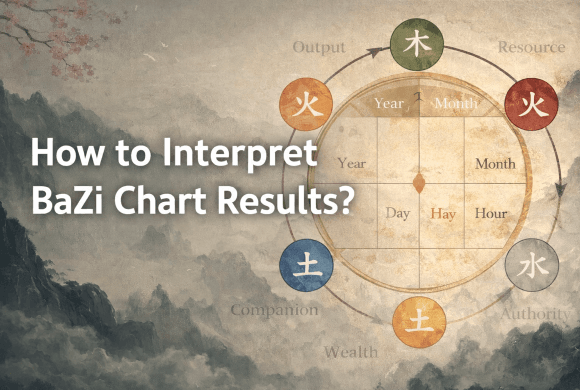
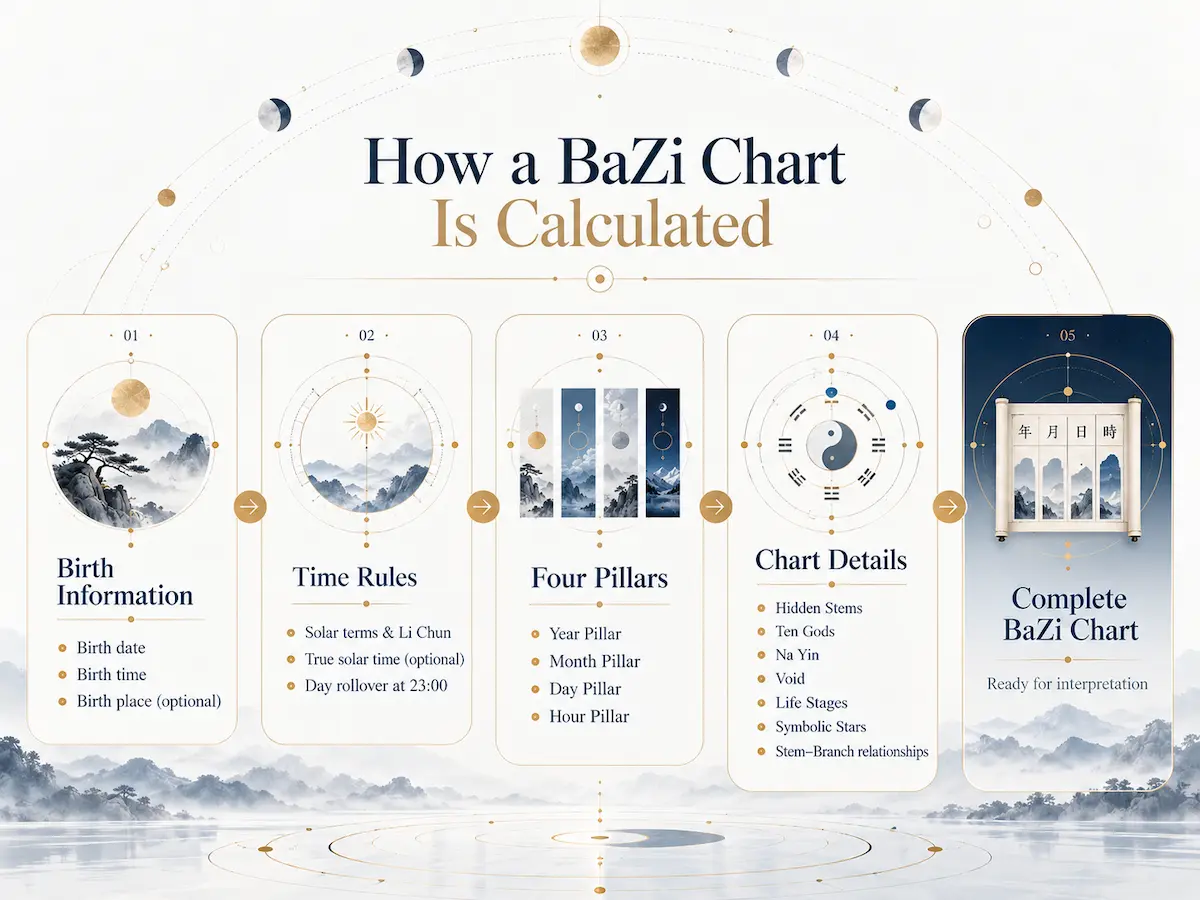
A BaZi chart is calculated from a person's birth date and time using the Chinese solar terms and the 60 Jia Zi cycle. The calculation first determines the Year, Month, Day, and Hour Pillars, then derives additional information such as Hidden Stems, Ten Gods, Na Yin, Void, Twelve Life Stages, Symbolic Stars, and relationships between the Heavenly Stems and Earthly Branches.
The process follows four main steps:
-
Establish the birth time: Confirm the birth date, exact time, and whether a location-based time correction is needed.
-
Calculate the Four Pillars: Use solar terms, the 60 Jia Zi cycle, and the traditional Chinese two-hour periods to determine the Year, Month, Day, and Hour Pillars.
-
Calculate the chart details: Derive the Hidden Stems, Ten Gods, Na Yin, Void, Life Stages, and Symbolic Stars from the Four Pillars.
-
Identify Stem–Branch relationships: Check the chart for combinations, clashes, punishments, harms, and other interactions.
This guide explains each calculation, with examples and the specific rules used by ShenShu AI's BaZi calculator.
1. What Birth Information Do You Need for a BaZi Chart?
A BaZi calculation requires your birth date and an accurate birth time.
When using ShenShu AI, you also need to select your gender. Your name is optional. If you enable true solar time correction, you will need to select your birth city.
Your birth date and time determine the Four Pillars. Gender is used in certain Symbolic Star and Luck Pillar calculations, while the Four Pillars themselves remain the same for people born at the same moment.
1.1 Is BaZi Calculated Using the Lunar or Solar Calendar?
A BaZi chart can be calculated from either a Gregorian or Chinese lunar birth date. The date must first be converted into the calendar system used for the Four Pillars calculation.
Two solar-term boundaries are especially important:
-
The Year Pillar changes at Li Chun (立春), the Start of Spring. Births before the exact transition belong to the preceding sexagenary year; births afterward belong to the new one.
-
The Month Pillar changes at one of twelve designated solar terms. These include Li Chun, Jing Zhe, Qing Ming, and nine others, each marking the beginning of a new BaZi month.
As a result, BaZi year and month boundaries can differ from Chinese New Year and the first day of a lunar month.
For example, Chinese New Year fell on February 10 in 2024, while Li Chun occurred on February 4 at approximately 4:27 PM Beijing time.
Someone born on February 5, 2024 therefore has a Jia Chen (甲辰) Year Pillar, even though Chinese New Year had yet to arrive.
The dates and solar-term times can be checked in the Hong Kong Observatory's 2024 Almanac.
ShenShu AI accepts Gregorian birth dates and uses a calendar calculation library to determine the corresponding Heavenly Stems and Earthly Branches.
1.2 What Is True Solar Time, and How Does It Affect BaZi?
The time shown on a clock generally follows the legal time used in a particular location. Cities within the same time zone often share the same clock time, even though they lie at different longitudes and experience solar noon at different moments.
Some traditional BaZi calculation methods account for these geographical differences by adjusting the recorded birth time.
True solar time correction involves two components:
-
Longitude correction: Accounts for the difference between the birth location's longitude and the standard meridian of its time zone.
-
Equation of time: Accounts for variations in the Sun's apparent motion caused by Earth's elliptical orbit and axial tilt.
The longitude correction is calculated as:
Longitude correction (minutes) = (Birth longitude − Standard meridian longitude) × 4
China Standard Time (UTC+8) is based on a standard meridian of 120°E.
Suppose someone was born at 105°E:
(105 − 120) × 4 = −60 minutes
The local mean solar time at that longitude is therefore 60 minutes behind Beijing time.
If the recorded birth time was 9:30 AM, applying the longitude correction gives 8:30 AM.
Under the traditional Chinese two-hour system, 9:30 AM falls within Si Hour (巳时), while 8:30 AM falls within Chen Hour (辰时). A time correction can therefore change the Hour Pillar.
The equation of time provides the additional adjustment needed to calculate apparent, or true, solar time.
The approximate formula is:
True solar time = Recorded clock time + Longitude correction + Equation of time
Consider a birth recorded at 9:30 AM Beijing time on February 10, 2024, at a hypothetical longitude of 105°E.
| Calculation | Value |
|---|---|
| Recorded birth time | 09:30 |
| Longitude correction | −60 minutes |
| Equation of time | Approximately −14.1 minutes |
| Total correction, rounded | −74 minutes |
| Corrected birth time | Approximately 08:16 |
The corrected time falls within Chen Hour rather than Si Hour.
The longitude in this example is hypothetical and does not represent the coordinates of a particular city.
ShenShu AI combines longitude correction with the equation of time when true solar time correction is enabled. It uses an approximation based on NOAA's solar calculation formulas, adds both corrections, and rounds the result to the nearest minute. If the correction crosses midnight, the date used for the BaZi calculation is adjusted as well.
For the astronomical formulas, see NOAA's General Solar Position Calculations.
True solar time correction is disabled by default when first using ShenShu AI. You can enable it under Advanced Settings and select your birth city. Previously entered settings may be restored during the same browser session, so check the selected option before submitting your birth information.
There is also an important limitation for historical birth records. The current city database uses fixed time-zone offsets and does not automatically reconstruct historical daylight saving time or time-zone changes. For births affected by these changes, the legal time in use on the birth date should be verified before applying the correction.
1.3 When Does a New BaZi Day Begin?
In the traditional Chinese time system, Zi Hour (子时) runs from 11:00 PM to 12:59 AM.
BaZi calculations commonly use one of two conventions for changing the Day Pillar:
-
Zi Hour rollover: The new sexagenary day begins at 11:00 PM.
-
Midnight rollover: The new sexagenary day begins at 12:00 AM.
For example, suppose the current day is Jia Zi (甲子).
Under the Zi Hour rollover convention, a birth at 11:30 PM is assigned to the next sexagenary day, Yi Chou (乙丑). Under the midnight convention, it remains Jia Zi until 12:00 AM.
ShenShu AI uses the 11:00 PM Zi Hour rollover rule.
For example, on February 10, 2024, with true solar time correction disabled:
-
At 10:59 PM, the Day Pillar is Jia Chen (甲辰).
-
From 11:00 PM onward, the Day Pillar changes to Yi Si (乙巳).
This makes an accurate birth time particularly important for births around 11:00 PM.
When true solar time correction is enabled, ShenShu AI first adjusts the birth date and time, then calculates the Day and Hour Pillars from the corrected result.
2. How Are the Four Pillars of BaZi Calculated?
The Four Pillars consist of the Year Pillar, Month Pillar, Day Pillar, and Hour Pillar. Each pillar contains one Heavenly Stem and one Earthly Branch.
The Ten Heavenly Stems are:
Jia (甲), Yi (乙), Bing (丙), Ding (丁), Wu (戊), Ji (己), Geng (庚), Xin (辛), Ren (壬), and Gui (癸).
The Twelve Earthly Branches are:
Zi (子), Chou (丑), Yin (寅), Mao (卯), Chen (辰), Si (巳), Wu (午), Wei (未), Shen (申), You (酉), Xu (戌), and Hai (亥).
The stems and branches advance in parallel through their respective cycles. Together, they produce 60 unique combinations, beginning with Jia Zi (甲子), Yi Chou (乙丑), and Bing Yin (丙寅).
This repeating sequence is known as the 60 Jia Zi, or the sexagenary cycle.
All Four Pillars use this cycle, with a different method for determining each pillar.
2.1 How Is the Year Pillar Calculated?
The Year Pillar is determined by the sexagenary year in which a person was born. The year changes at the exact moment of Li Chun, the Start of Spring.
For example, 2024 is the Jia Chen (甲辰) year, followed by the Yi Si (乙巳) year in 2025.
In 2024, Li Chun occurred on February 4 at approximately 4:27 PM Beijing time.
Therefore:
-
A birth before that moment belongs to the Gui Mao (癸卯) year.
-
A birth after that moment belongs to the Jia Chen (甲辰) year.
For someone born on the day of Li Chun, the exact birth time must be compared with the solar-term transition time.
2.2 How Is the Month Pillar Calculated?
The Month Pillar is calculated in two stages: determine the Earthly Branch from the solar terms, then determine the Heavenly Stem from the Year Stem.
There are twelve BaZi months, beginning with Yin Month (寅月).
| Month Branch | Starting Solar Term |
|---|---|
| Yin (寅) | Start of Spring — Li Chun |
| Mao (卯) | Awakening of Insects — Jing Zhe |
| Chen (辰) | Clear and Bright — Qing Ming |
| Si (巳) | Start of Summer — Li Xia |
| Wu (午) | Grain in Ear — Mang Zhong |
| Wei (未) | Minor Heat — Xiao Shu |
| Shen (申) | Start of Autumn — Li Qiu |
| You (酉) | White Dew — Bai Lu |
| Xu (戌) | Cold Dew — Han Lu |
| Hai (亥) | Start of Winter — Li Dong |
| Zi (子) | Major Snow — Da Xue |
| Chou (丑) | Minor Cold — Xiao Han |
These are the twelve Jie (节) among the 24 solar terms. Each marks the beginning of a new BaZi month.
For an explanation of the solar terms and their astronomical basis, see the Hong Kong Observatory's guide to the 24 Solar Terms.
Once the Month Branch is known, the Month Stem is calculated using the traditional Five Tigers Rule (Wu Hu Dun, 五虎遁).
This rule establishes the starting stem for Yin Month according to the Year Stem:
| Year Stem | Yin Month Pillar |
|---|---|
| Jia (甲), Ji (己) | Bing Yin (丙寅) |
| Yi (乙), Geng (庚) | Wu Yin (戊寅) |
| Bing (丙), Xin (辛) | Geng Yin (庚寅) |
| Ding (丁), Ren (壬) | Ren Yin (壬寅) |
| Wu (戊), Gui (癸) | Jia Yin (甲寅) |
The following months advance through the Heavenly Stem sequence.
For example, in 2024, the Year Stem is Jia (甲). According to the Five Tigers Rule:
-
Yin Month is Bing Yin (丙寅).
-
Mao Month is Ding Mao (丁卯).
-
Chen Month is Wu Chen (戊辰).
February 10, 2024 falls after Li Chun and before Jing Zhe, so its Month Pillar is Bing Yin (丙寅).
The traditional mnemonic for deriving the Month Stem from the Year Stem appears in Shen Feng Tong Kao (《神峰通考》), in the section titled Qi Ba Zi Jue (起八字诀).
2.3 How Is the Day Pillar Calculated?
The Day Pillar is determined by the birth date's position in the continuous 60 Jia Zi day cycle.
Each successive day advances to the next Stem–Branch combination. After 60 days, the cycle begins again.
For example:
-
February 10, 2024: Jia Chen (甲辰)
-
February 11, 2024: Yi Si (乙巳)
-
February 12, 2024: Bing Wu (丙午)
For a manual calculation, you can begin with a reference date whose Day Pillar is known, count the number of days to the target date, and advance through the 60 Jia Zi cycle.
BaZi software uses calendar algorithms to determine the corresponding sexagenary day, applying its selected day-rollover rule for late-night births.
The Heavenly Stem of the Day Pillar is called the Day Master, or Day Stem. It serves as the reference point for many other calculations, particularly the Ten Gods and Twelve Life Stages.
2.4 How Is the Hour Pillar Calculated?
The Hour Pillar begins with the traditional Chinese system of twelve two-hour periods.
Each period corresponds to one Earthly Branch:
| Hour Branch | Clock Time |
|---|---|
| Zi (子) | 23:00–00:59 |
| Chou (丑) | 01:00–02:59 |
| Yin (寅) | 03:00–04:59 |
| Mao (卯) | 05:00–06:59 |
| Chen (辰) | 07:00–08:59 |
| Si (巳) | 09:00–10:59 |
| Wu (午) | 11:00–12:59 |
| Wei (未) | 13:00–14:59 |
| Shen (申) | 15:00–16:59 |
| You (酉) | 17:00–18:59 |
| Xu (戌) | 19:00–20:59 |
| Hai (亥) | 21:00–22:59 |
After determining the Hour Branch, the Hour Stem is derived from the Day Stem using the traditional Five Rats Rule (Wu Shu Dun, 五鼠遁).
| Day Stem | Zi Hour Pillar |
|---|---|
| Jia (甲), Ji (己) | Jia Zi (甲子) |
| Yi (乙), Geng (庚) | Bing Zi (丙子) |
| Bing (丙), Xin (辛) | Wu Zi (戊子) |
| Ding (丁), Ren (壬) | Geng Zi (庚子) |
| Wu (戊), Gui (癸) | Ren Zi (壬子) |
For someone born on a Jia (甲) day, the sequence begins with Jia Zi at Zi Hour, Yi Chou at Chou Hour, and Bing Yin at Yin Hour.
Suppose the birth time is 10:30 AM on a Jia day.
10:30 AM falls within Si Hour. Advancing through the Five Rats sequence gives the Hour Pillar Ji Si (己巳).
Both the Five Tigers and Five Rats rules are recorded in the traditional Qi Ba Zi Jue section of Shen Feng Tong Kao (《神峰通考》).
With the Year, Month, Day, and Hour Pillars established, the basic BaZi chart is complete.
3. How Are Hidden Stems and the Ten Gods Calculated?
Once the Four Pillars are known, the next step is to derive additional information from their Heavenly Stems and Earthly Branches.
Two of the most important calculations are the Hidden Stems and the Ten Gods.
3.1 How Are Hidden Stems Calculated?
In traditional BaZi, each Earthly Branch contains one or more Hidden Heavenly Stems, known as Cang Gan (藏干).
Each of the twelve branches has a defined set of Hidden Stems. Some contain one, while others contain two or three.
You can find the Hidden Stem correspondences for all twelve branches in the Earthly Branches reference guide.
For example, Yin (寅) contains three Hidden Stems:
-
Jia (甲), Yang Wood
-
Bing (丙), Yang Fire
-
Wu (戊), Yang Earth
These stems can then be compared with the Day Master to calculate their Ten Gods relationships.
ShenShu AI extracts the Hidden Stems from each of the Four Pillars and displays them in a consistent order. Some traditional sources use a different ordering for the same set of Hidden Stems.
3.2 How Are the Ten Gods Calculated?
The Ten Gods are calculated by comparing each Heavenly Stem with the Day Master.
The calculation uses two properties:
-
The Five Element relationship between the two stems
-
Whether their Yin–Yang polarity is the same or different
The ten relationships fall into five groups:
| Relationship to the Day Master | Same Yin–Yang Polarity | Opposite Yin–Yang Polarity |
|---|---|---|
| Same element | Friend Star | Rob Wealth |
| Element produced by the Day Master | Eating God | Hurting Officer |
| Element controlled by the Day Master | Indirect Wealth | Direct Wealth |
| Element that controls the Day Master | Seven Killings | Direct Officer |
| Element that produces the Day Master | Indirect Resource | Direct Resource |
Consider a person whose Day Master is Jia (甲), which represents Yang Wood.
The Ten Gods corresponding to the ten Heavenly Stems are:
| Heavenly Stem | Relationship to Jia Wood | Ten God |
|---|---|---|
| Jia (甲) | Same Yang Wood | Friend Star |
| Yi (乙) | Yin Wood, same element | Rob Wealth |
| Bing (丙) | Yang Fire produced by Wood | Eating God |
| Ding (丁) | Yin Fire produced by Wood | Hurting Officer |
| Wu (戊) | Yang Earth controlled by Wood | Indirect Wealth |
| Ji (己) | Yin Earth controlled by Wood | Direct Wealth |
| Geng (庚) | Yang Metal controls Wood | Seven Killings |
| Xin (辛) | Yin Metal controls Wood | Direct Officer |
| Ren (壬) | Yang Water produces Wood | Indirect Resource |
| Gui (癸) | Yin Water produces Wood | Direct Resource |
The same method applies to Hidden Stems.
For example, if a Jia Wood Day Master encounters Yin (寅), its Hidden Stems are Jia, Bing, and Wu. Their corresponding Ten Gods are:
-
Jia → Friend Star
-
Bing → Eating God
-
Wu → Indirect Wealth
A complete BaZi chart therefore includes Ten Gods associated with the visible Heavenly Stems and those associated with the Hidden Stems inside each Earthly Branch.
The traditional text San Ming Tong Hui (《三命通会》), Volume Five, discusses the relationships between the Day Master and the categories of Wealth, Officer, Resource, and Eating God, including the origins of these terms.
For a fuller explanation of each relationship, see the Ten Gods in BaZi guide.
4. How Are Na Yin, Void, and the Twelve Life Stages Calculated?
A detailed BaZi chart also includes Na Yin, Void, and the Twelve Life Stages.
Each is derived from the already established Stem–Branch combinations using a separate traditional rule.
4.1 How Is Na Yin Calculated?
Na Yin is a traditional Five Element classification assigned to the 60 Jia Zi combinations.
Each pair of consecutive sexagenary combinations shares one Na Yin designation, producing 30 Na Yin categories in total.
For example:
| Stem–Branch Combinations | Na Yin |
|---|---|
| Jia Zi (甲子), Yi Chou (乙丑) | Sea Metal |
| Bing Yin (丙寅), Ding Mao (丁卯) | Furnace Fire |
| Wu Chen (戊辰), Ji Si (己巳) | Great Forest Wood |
| Jia Chen (甲辰), Yi Si (乙巳) | Covered Lamp Fire |
To determine a pillar's Na Yin, identify its complete Stem–Branch combination and look up the corresponding designation.
For example, Jia Chen (甲辰) corresponds to Covered Lamp Fire.
Na Yin follows its own traditional classification system. Jia is Wood and Chen is Earth, while the Na Yin assigned to Jia Chen is Fire.
ShenShu AI calculates Na Yin separately for the Year, Month, Day, and Hour Pillars.
4.2 How Is Void (Xun Kong) Calculated?
Void, also called Xun Kong (旬空), is calculated from the ten-combination groups within the 60 Jia Zi cycle.
The full cycle contains six groups, or Xun, of ten combinations each.
Each group uses all ten Heavenly Stems paired with ten of the twelve Earthly Branches. The two branches absent from that group are its Void branches.
| Xun | Void Branches |
|---|---|
| Jia Zi Xun (甲子旬) | Xu (戌), Hai (亥) |
| Jia Xu Xun (甲戌旬) | Shen (申), You (酉) |
| Jia Shen Xun (甲申旬) | Wu (午), Wei (未) |
| Jia Wu Xun (甲午旬) | Chen (辰), Si (巳) |
| Jia Chen Xun (甲辰旬) | Yin (寅), Mao (卯) |
| Jia Yin Xun (甲寅旬) | Zi (子), Chou (丑) |
For example, Jia Chen belongs to Jia Chen Xun, whose Void branches are Yin and Mao.
ShenShu AI determines the Void field of each pillar from the Xun to which that pillar belongs.
You may also see Void Star in the Symbolic Stars section of the chart.
For this additional designation, the calculator uses the Xun of the Year and Day Pillars as reference points and checks whether other pillars contain the corresponding Void branches.
A pillar's own Void field and a Void Star appearing under that pillar can therefore be based on different reference combinations.
4.3 How Are the Twelve Life Stages Calculated?
The Twelve Life Stages, also known as Shi Er Chang Sheng (十二长生), describe the traditional stages assigned to a Heavenly Stem across the twelve Earthly Branches.
The stages follow this sequence:
Birth, Bath, Crown Belt, Official, Peak, Decline, Illness, Death, Tomb, Extinction, Fetus, and Nurture.
Each stage is determined by comparing a reference Heavenly Stem with a particular Earthly Branch.
In ShenShu AI's natal chart, the Day Master is used as the reference stem for all Four Pillars.
For a Jia Wood Day Master, several examples are:
| Earthly Branch | Life Stage |
|---|---|
| Hai (亥) | Birth |
| Yin (寅) | Official |
| Mao (卯) | Peak |
| Chen (辰) | Decline |
| Si (巳) | Illness |
For example, a Jia Wood Day Master with Yin as the Month Branch has Official (Lin Guan, 临官) as the Month Pillar's Life Stage.
These rules describe the Life Stages displayed for the natal Four Pillars. Luck Pillars and annual pillars have their own calculation contexts and should be checked separately.
5. How Are Symbolic Stars (Shen Sha) Calculated?
Symbolic Stars, known as Shen Sha (神煞), are traditional reference markers derived from combinations of Heavenly Stems, Earthly Branches, Na Yin, and other chart attributes.
Each Symbolic Star has its own lookup rule.
The rules can be grouped according to the information they use.
5.1 Stars Based on the Year or Day Stem
Stars such as Heavenly Nobleman and Academic Star can be identified by comparing the Year Stem or Day Stem with the Earthly Branches in a chart.
For example, under the Academic Star rules used by ShenShu AI:
-
A Jia (甲) Day Stem corresponds to Si (巳).
-
An Yi (乙) Day Stem corresponds to Wu (午).
The calculator first identifies the relevant Year and Day Stems, then checks the Four Pillars for matching branches.
5.2 Stars Based on the Year or Day Branch
Other Symbolic Stars, including Peach Blossom Star, Traveling Horse Star, Canopy Star, and General Star, use the Year or Day Branch as a reference.
For example, the Traveling Horse Star follows these correspondences:
| Year or Day Branch Group | Traveling Horse Branch |
|---|---|
| Yin (寅), Wu (午), Xu (戌) | Shen (申) |
| Shen (申), Zi (子), Chen (辰) | Yin (寅) |
| Hai (亥), Mao (卯), Wei (未) | Si (巳) |
| Si (巳), You (酉), Chou (丑) | Hai (亥) |
If someone has Wu (午) as the Day Branch and Shen (申) appears in another pillar, the chart meets the corresponding Traveling Horse rule.
San Ming Tong Hui, Volume Three, includes traditional discussions of the Traveling Horse and the Ten Stem Prosperity positions.
5.3 Stars Based on the Month Branch or Complete Pillar
Some Symbolic Stars depend on the Month Branch, while others are associated with specific Day Pillars or complete Stem–Branch combinations.
For example, the traditional Kui Gang designation is associated with four Day Pillars:
Geng Chen (庚辰), Geng Xu (庚戌), Ren Chen (壬辰), and Wu Xu (戊戌).
A chart with one of these Day Pillars can meet the corresponding Kui Gang lookup rule.
ShenShu AI applies a separate set of conditions for each supported Symbolic Star. Certain rules also consider gender, the Yin–Yang polarity of the Year Stem, or Na Yin.
Some Symbolic Stars have multiple traditional calculation methods. As a result, the stars displayed by different BaZi calculators may vary.
A Symbolic Star indicates that a chart matches a particular traditional rule. Its significance is assessed alongside the Four Pillars, Ten Gods, and relationships across the chart.
For more information, see the BaZi Symbolic Stars guide.
6. How Are Heavenly Stem and Earthly Branch Relationships Calculated?
A complete BaZi calculation also compares the stems and branches across the Four Pillars to identify traditional Stem–Branch relationships.
These include combinations, overcoming relationships, clashes, punishments, harms, breaks, and other defined patterns.
6.1 Relationships Between Heavenly Stems
One of the best-known sets of relationships is the Five Heavenly Stem Combinations.
| Heavenly Stems | Traditional Combination |
|---|---|
| Jia (甲) + Ji (己) | Jia–Ji Combination toward Earth |
| Yi (乙) + Geng (庚) | Yi–Geng Combination toward Metal |
| Bing (丙) + Xin (辛) | Bing–Xin Combination toward Water |
| Ding (丁) + Ren (壬) | Ding–Ren Combination toward Wood |
| Wu (戊) + Gui (癸) | Wu–Gui Combination toward Fire |
For example, if the Year Stem is Jia and the Hour Stem is Ji, the chart contains a Jia–Ji combination.
ShenShu AI also identifies specific Heavenly Stem overcoming relationships.
A detected combination describes the relationship between the stems present in the chart. Whether the combination results in a transformation depends on additional conditions, including the Month Branch and the surrounding stems and branches.
Traditional discussions of the Five Heavenly Stem Combinations and their transformation conditions can be found in San Ming Tong Hui, Volume Two.
6.2 Relationships Between Earthly Branches
The Earthly Branches have several types of relationships.
| Relationship | Examples |
|---|---|
| Six Combinations | Zi–Chou, Yin–Hai |
| Six Clashes | Zi–Wu, Mao–You |
| Six Harms | Zi–Wei, Yin–Si |
| Breaks | Zi–You, Mao–Wu |
| Punishment | Zi–Mao |
| Self-Punishment | Chen–Chen |
| Three Punishments | Yin–Si–Shen, Chou–Xu–Wei |
| Three Combinations | Shen–Zi–Chen toward Water |
| Three Meetings | Yin–Mao–Chen toward Wood |
| Half Combinations | Shen–Zi toward Water |
For example, if Zi and Wu appear in different pillars, the chart contains a Zi–Wu clash.
If Shen, Zi, and Chen are all present, the chart meets the conditions for the Shen–Zi–Chen Three Combination toward Water.
ShenShu AI compares the Heavenly Stems and Earthly Branches in the natal chart and identifies relationships that satisfy its predefined rules.
The calculator also supports selected hidden combinations, hidden arches, and hidden clasps.
Some of these patterns require additional conditions:
-
Three Punishments: The calculator identifies the full Yin–Si–Shen or Chou–Xu–Wei punishment only when all three branches are present.
-
Hidden arches and hidden clasps: The current implementation requires the two participating pillars to share the same Heavenly Stem, along with the specified Earthly Branch pattern.
These calculations describe the structural relationships present in the chart. Their interpretation depends on the Day Master, seasonal influence, and other elements of the Four Pillars.
7. Worked Example: Calculating a Complete BaZi Chart
The following example brings the calculation methods together using one birth date and time.
Birth details
-
Date: February 10, 2024
-
Time: 10:30 AM, Beijing time (UTC+8)
-
Gender: Male
-
True solar time correction: Disabled
[[SHENSHU_CHART:2024-02-10|10:30|male]]Step 1: Calculate the Four Pillars
February 10, 2024 falls after Li Chun and before Jing Zhe.
The Year Pillar is Jia Chen (甲辰), and the Month Pillar is Bing Yin (丙寅).
The Day Pillar is Jia Chen (甲辰).
10:30 AM falls within Si Hour (巳时). Using the Five Rats Rule for a Jia day gives Ji Si (己巳) as the Hour Pillar.
The complete Four Pillars are:
| Component | Year Pillar | Month Pillar | Day Pillar | Hour Pillar |
|---|---|---|---|---|
| Heavenly Stem | Jia (甲) | Bing (丙) | Jia (甲) | Ji (己) |
| Earthly Branch | Chen (辰) | Yin (寅) | Chen (辰) | Si (巳) |
| Complete Pillar | Jia Chen (甲辰) | Bing Yin (丙寅) | Jia Chen (甲辰) | Ji Si (己巳) |
The Day Master is Jia Wood (甲木).
Step 2: Calculate the Hidden Stems and Ten Gods
Using Jia Wood as the Day Master, the visible stems and Hidden Stems produce the following results:
| Component | Year Pillar | Month Pillar | Day Pillar | Hour Pillar |
|---|---|---|---|---|
| Heavenly Stem | Jia (甲) | Bing (丙) | Jia (甲) | Ji (己) |
| Ten God / Day Master Label | Friend Star | Eating God | Male Day Master | Direct Wealth |
| Earthly Branch | Chen (辰) | Yin (寅) | Chen (辰) | Si (巳) |
| Hidden Stems | Wu (戊), Yi (乙), Gui (癸) | Jia (甲), Bing (丙), Wu (戊) | Wu (戊), Yi (乙), Gui (癸) | Bing (丙), Geng (庚), Wu (戊) |
| Hidden Stem Ten Gods | Indirect Wealth, Rob Wealth, Direct Resource | Friend Star, Eating God, Indirect Wealth | Indirect Wealth, Rob Wealth, Direct Resource | Eating God, Seven Killings, Indirect Wealth |
Every Ten God in this table is calculated relative to Jia Wood.
Because the Day Stem represents the Day Master itself, ShenShu AI displays Male Day Master in that position for a male birth and Female Day Master for a female birth.
These are Day Master labels within the chart display.
Step 3: Calculate Na Yin, Void, and Life Stages
The four pillar combinations and the Jia Wood Day Master produce the following additional details:
| Component | Year Pillar | Month Pillar | Day Pillar | Hour Pillar |
|---|---|---|---|---|
| Pillar | Jia Chen | Bing Yin | Jia Chen | Ji Si |
| Na Yin | Covered Lamp Fire | Furnace Fire | Covered Lamp Fire | Great Forest Wood |
| Void | Yin–Mao | Xu–Hai | Yin–Mao | Xu–Hai |
| Life Stage | Decline | Official | Decline | Illness |
Each row follows its own calculation:
-
Na Yin is looked up from the complete Stem–Branch combination of each pillar.
-
Void is determined by the ten-combination Xun to which each pillar belongs.
-
Life Stage is calculated by comparing each pillar's Earthly Branch with the Jia Wood Day Master.
Step 4: Calculate Symbolic Stars and Stem–Branch Relationships
The calculator then applies the Symbolic Star rules to the Four Pillars.
For example, Jia Wood has its Prosperity Star at Yin (寅). Because Yin is the Month Branch, the Month Pillar meets the Prosperity Star rule.
Both the Year and Day Branches are Chen (辰). The Shen–Zi–Chen group has its Traveling Horse at Yin, so the Month Pillar also meets the Traveling Horse rule.
For this male birth example, ShenShu AI produces the following Symbolic Stars:
| Pillar | Symbolic Stars |
|---|---|
| Year | Golden Carriage, Canopy Star |
| Month | Monthly Virtue Nobleman, Fortune Star Nobleman, Prosperity Star, Traveling Horse Star, Hanging Guest Star, Academic Hall, Virtue and Excellence Nobleman, Void Star |
| Day | Golden Carriage, Canopy Star, Ten Spiritual Days, Ten Great Defeat Days |
| Hour | Heavenly Kitchen Nobleman, Academic Star, Robbery Sha, Solitary Star, Celebration Star, Literary Hall, Heavenly Net and Earthly Net, Jin Shen (Golden God) |
These labels indicate that the chart meets particular traditional lookup conditions. They do not, by themselves, predict specific real-world events.
The Month Pillar provides a useful example of how different Void calculations appear in the same chart.
Bing Yin (丙寅) has Xu–Hai as its own Void pair. However, its Symbolic Stars include Void Star because the Year and Day Pillars are both Jia Chen, whose Xun has Yin–Mao as its Void pair.
Since the Month Branch is Yin, it meets that separate Void Star condition.
The natal chart also contains three identified Stem–Branch relationships:
-
Jia–Ji Combination: The Jia Stems in the Year and Day Pillars form a Five Stems Combination with Ji in the Hour Pillar.
-
Chen–Chen Self-Punishment: Both the Year and Day Branches are Chen.
-
Yin–Si Harm: The Month Branch Yin and Hour Branch Si form a Six Harms relationship.
These three relationships appear in ShenShu AI's natal chart relationship section.
When the same relationship occurs between multiple pairs of pillars, its displayed name is deduplicated. For example, Jia–Ji Combination appears once even though two Jia Stems participate.
This example shows how a complete BaZi chart develops from the Four Pillars. The Hidden Stems, Ten Gods, Na Yin, Void, Life Stages, Symbolic Stars, and Stem–Branch relationships are all calculated from the underlying pillar data.
8. What Calculation Rules Does ShenShu AI Use?
ShenShu AI applies a defined set of calendar and Stem–Branch rules so that users can review and compare their BaZi chart results.
The current calculation rules are:
| Chart Component | ShenShu AI Calculation Rule |
|---|---|
| Birth date | Entered using the Gregorian calendar |
| Year Pillar | Changes at the exact time of Li Chun |
| Month Pillar | Changes at the twelve designated Jie solar terms |
| Day Pillar | Changes at 11:00 PM, the beginning of Zi Hour |
| Hour Pillar | Calculated using the twelve traditional hours and the Five Rats Rule |
| True Solar Time | Disabled by default on first use; when enabled, combines longitude correction with the equation of time and rounds to the nearest minute |
| Historical Time Zones and DST | Uses a fixed time-zone offset from the city database; historical changes are not automatically reconstructed |
| Hidden Stems | Retrieved from the defined Hidden Stem correspondences for each Earthly Branch |
| Ten Gods | Calculated relative to the Day Master using Five Element and Yin–Yang relationships |
| Na Yin | Looked up from the 60 Jia Zi Na Yin correspondences |
| Void | Determined by each pillar's Xun |
| Life Stages | Calculated for natal pillars using the Day Master as the reference stem |
| Symbolic Stars | Determined through traditional lookup rules involving stems, branches, seasonal position, Na Yin, and, for selected stars, gender |
| Stem–Branch Relationships | Identifies predefined combinations, overcoming relationships, clashes, punishments, breaks, harms, and selected additional patterns |
BaZi chart calculation and AI interpretation are handled as separate processes.
ShenShu AI first calculates the Four Pillars and derives their associated chart data using its calendar and rule-based calculation system.
AI interpretation then works with those calculated results to explain the Five Elements, Ten Gods, and relationships within the chart.
This allows users to check their birth information and Four Pillars before exploring the interpretation.
9. Frequently Asked Questions
Why Do Different BaZi Calculators Give Different Results?
Different BaZi calculators may use different time conventions and calculation rules.
Common sources of variation include:
-
Whether birth-location solar time correction is enabled
-
Whether the equation of time is included
-
How historical daylight saving time and time-zone changes are handled
-
Whether the Day Pillar changes at 11:00 PM or midnight
-
How precisely solar-term transition times are calculated and applied
If the Four Pillars match but the Symbolic Stars differ, the calculators may use different traditional lookup methods.
To investigate a discrepancy, compare the Four Pillars first, then check the Hidden Stems, Ten Gods, and other chart details.
Can I Calculate My BaZi Without Knowing My Birth Time?
A known birth date can be used to determine part of a BaZi chart, although an accurate Hour Pillar requires the birth time.
ShenShu AI currently requires a time to be entered. If you use 12:00 AM or another estimated time, the resulting chart represents that assumed birth time.
Uncertainty around 11:00 PM can also affect the Day Pillar because ShenShu AI uses the Zi Hour rollover convention.
For births close to Li Chun or another solar-term transition, an uncertain birth time may also affect the Year or Month Pillar.
An estimated time can help with preliminary comparisons. An accurate birth record provides a more reliable basis for the full calculation.
Why Can the BaZi Year Differ Around Li Chun?
The BaZi Year Pillar changes at Li Chun, while Chinese New Year is determined by the traditional lunisolar calendar.
The two dates can fall on different days, so someone born near the beginning of February may have a BaZi Year Pillar associated with a different year than expected from Chinese New Year.
The exact Li Chun transition time is particularly important for these births.
What Is the Difference Between BaZi Calculation and BaZi Interpretation?
BaZi calculation determines the Four Pillars and derives their Hidden Stems, Ten Gods, Na Yin, Void, Life Stages, Symbolic Stars, and other chart information.
BaZi interpretation examines the Day Master, Five Elements, Ten Gods, Stem–Branch relationships, and broader structure of the resulting chart.
If you already have your Four Pillars, see How to Read a BaZi Chart for a guide to understanding the information displayed.
Calculate Your BaZi Chart with ShenShu AI
You can generate your own Four Pillars chart using the ShenShu AI BaZi Calculator.
To get started:
-
Enter your birth information. Provide your Gregorian birth date, birth time in 24-hour format, and gender. Your name is optional.
-
Choose your time settings. If you want to apply true solar time correction, open Advanced Settings, enable the option, and select your birth city. City searches currently work primarily with English names or pinyin, such as
beijingandhangzhou. -
Review your chart. Generate the chart and check your birth information, time correction, and Four Pillars. You can then examine the Hidden Stems, Ten Gods, Na Yin, Void, Life Stages, Symbolic Stars, and Stem–Branch relationships.
-
Explore the AI interpretation. Once you have reviewed your chart, you can use the AI features to explore how the Five Elements, Ten Gods, and other chart components relate to one another.
References and Calculation Sources
The calendar explanations, astronomical calculations, and traditional BaZi concepts discussed in this guide are based on the following references:
-
Hong Kong Observatory — 2024 Almanac. Used to check the Chinese lunar calendar dates, solar terms, and transition times for 2024.
-
Hong Kong Observatory — The 24 Solar Terms. Explains the astronomical basis of the solar terms and their role in the traditional Chinese calendar.
-
National Oceanic and Atmospheric Administration (NOAA) — General Solar Position Calculations. Provides approximate formulas for the equation of time and solar time corrections.
-
Shen Feng Tong Kao (《神峰通考》). The Qi Ba Zi Jue (起八字诀) section contains the traditional rules for deriving Month Stems from Year Stems and Hour Stems from Day Stems.
-
San Ming Tong Hui (《三命通会》), Volume Five. Discusses the traditional relationships underlying Wealth, Officer, Resource, Eating God, and other Ten Gods categories.
-
San Ming Tong Hui, Volume Three. Includes traditional rules for the Traveling Horse and Prosperity positions of the Heavenly Stems.
-
San Ming Tong Hui, Volume Two. Discusses the Five Heavenly Stem Combinations and traditional transformation conditions.
The Hong Kong Observatory and NOAA references support the calendar and astronomical explanations. The classical Chinese texts provide historical sources for BaZi terminology and traditional calculation rules. The specific chart results produced by ShenShu AI follow the calculation methods implemented in its current software.