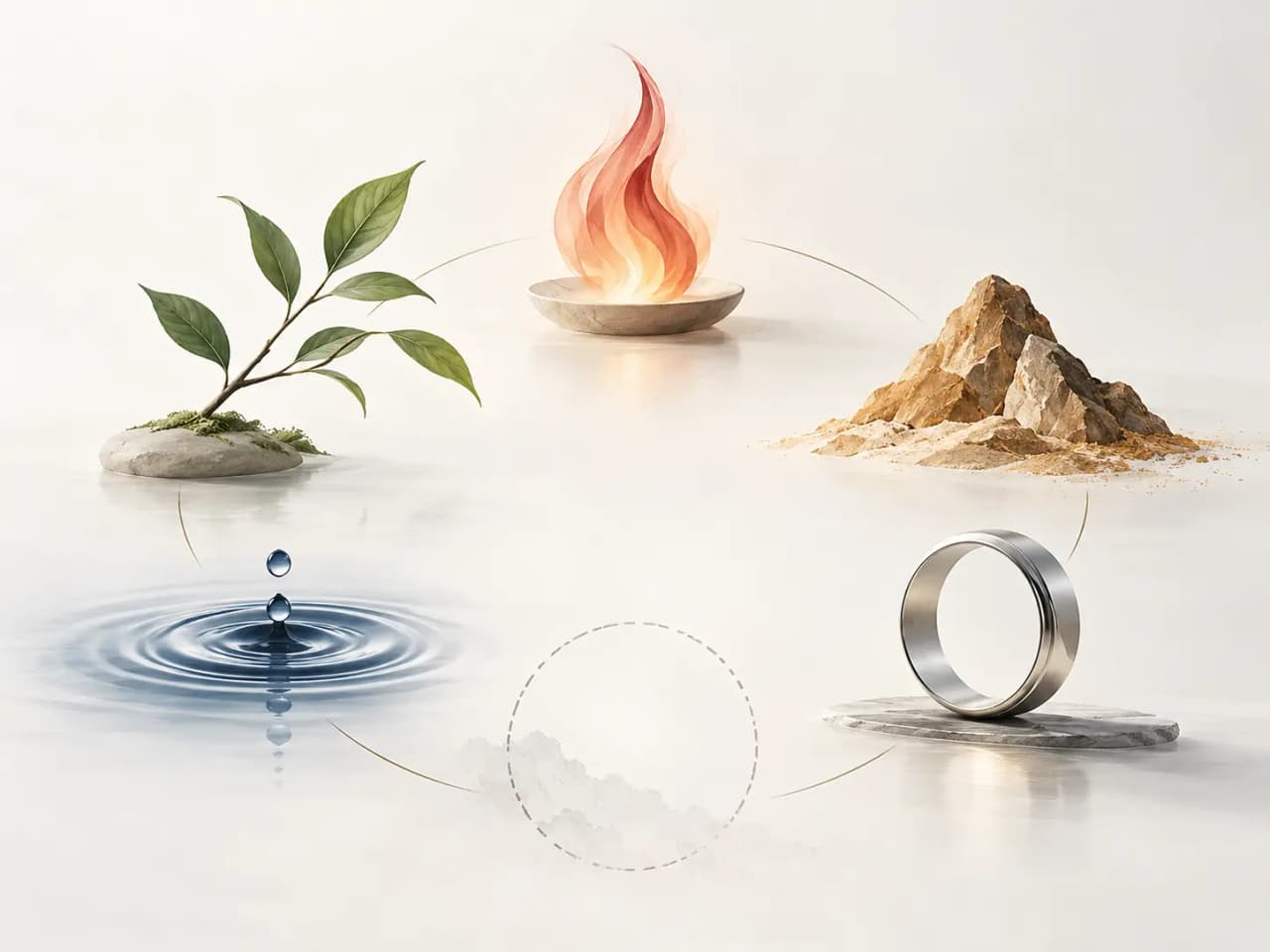
Nayin (纳音) is a traditional Five Element classification system that groups the 60 Jiazi into 30 pairs. Each pair is assigned to Metal, Wood, Water, Fire, or Earth and given a more specific symbolic name. For example, Jia Zi and Yi Chou are called Sea Gold, Bing Yin and Ding Mao are called Fire in the Furnace, and Wu Chen and Ji Si are called Great Forest Wood.
Names such as Sea Gold and Fire in the Furnace are not meant to describe literal substances. They use images from nature and everyday life to express how the qi of an element is developing in a particular Stem-Branch combination. San Ming Tong Hui (三命通会) gives an important warning about how these images should be read:
圣人借意而喻之,不可著意执泥。
The sages used imagery to convey an idea; it should not be interpreted too literally.
Nayin is therefore a language of analogy. A single Nayin name should not be used on its own to define someone's personality or predict their fate.
What Is Nayin?
Most people encounter Nayin through the 60 Jiazi Nayin chart.
The 60 Jiazi are formed by combining the Ten Heavenly Stems with the Twelve Earthly Branches in sequence. Nayin places every two consecutive Jiazi in one group, producing 30 pairs. Each pair belongs to one of the Five Elements and has its own symbolic name:
-
Metal: Sea Gold, Gold Foil, White Wax Gold, Gold in Sand, Sword Edge Gold, and Hairpin and Bracelet Gold
-
Wood: Mulberry Wood, Pine and Cypress Wood, Great Forest Wood, Willow Wood, Pomegranate Wood, and Wood on the Plain
-
Water: Water Below the Ravine, Great Stream Water, Long-Flowing Water, Heavenly River Water, Well Spring Water, and Great Sea Water
-
Fire: Thunderbolt Fire, Fire in the Furnace, Covered Lamp Fire, Fire in the Heavens, Fire Below the Mountain, and Fire on the Mountain
-
Earth: Wall Earth, City Wall Earth, Earth in Sand, Roadside Earth, Great Post Road Earth, and Roof Earth
Why does one element need six different names? Because Nayin is not only identifying an element. The image also describes that element's stage, setting, form, and function.
English translations of the 30 names vary. In the tables below, the Chinese name is included alongside a direct, readable English rendering. The element 金 is translated as Metal when referring to the Five Elements, although some symbolic names use Gold because it sounds more natural in English.
How Is Nayin Different From the Five Elements in a BaZi Chart?
Nayin is not the same as the ordinary Five Element associations of the Heavenly Stems and Earthly Branches.
Take Jia Zi (甲子) as an example:
-
Jia (甲) is Yang Wood.
-
Zi (子) is Water.
-
The Nayin of Jia Zi is Sea Gold (海中金).
This does not mean that Jia Wood and Zi Water somehow turn into Metal. Their original elemental associations remain Wood and Water. Sea Gold belongs to a separate symbolic classification applied to the Jiazi pair as a whole.
A complete BaZi chart has four pillars: year, month, day, and hour. Each pillar has its own Nayin. When someone is described as having a “Metal fate” or “Wood fate,” the label usually comes only from the Nayin of the year pillar. For example, a person born in a Jia Zi year may be called a Sea Gold person.
That label is easy to remember, but it does not represent the entire chart. The Nayin of the year pillar alone cannot determine a person's favorable elements, character, relationships, or future luck.
The 60 Jiazi Nayin Chart
| Jiazi Pair | Nayin | Element |
|---|---|---|
| Jia Zi (甲子), Yi Chou (乙丑) | Sea Gold (海中金) | Metal |
| Bing Yin (丙寅), Ding Mao (丁卯) | Fire in the Furnace (炉中火) | Fire |
| Wu Chen (戊辰), Ji Si (己巳) | Great Forest Wood (大林木) | Wood |
| Geng Wu (庚午), Xin Wei (辛未) | Roadside Earth (路旁土) | Earth |
| Ren Shen (壬申), Gui You (癸酉) | Sword Edge Gold (剑锋金) | Metal |
| Jia Xu (甲戌), Yi Hai (乙亥) | Fire on the Mountain (山头火) | Fire |
| Bing Zi (丙子), Ding Chou (丁丑) | Water Below the Ravine (涧下水) | Water |
| Wu Yin (戊寅), Ji Mao (己卯) | City Wall Earth (城头土) | Earth |
| Geng Chen (庚辰), Xin Si (辛巳) | White Wax Gold (白蜡金) | Metal |
| Ren Wu (壬午), Gui Wei (癸未) | Willow Wood (杨柳木) | Wood |
| Jia Shen (甲申), Yi You (乙酉) | Well Spring Water (井泉水) | Water |
| Bing Xu (丙戌), Ding Hai (丁亥) | Roof Earth (屋上土) | Earth |
| Wu Zi (戊子), Ji Chou (己丑) | Thunderbolt Fire (霹雳火) | Fire |
| Geng Yin (庚寅), Xin Mao (辛卯) | Pine and Cypress Wood (松柏木) | Wood |
| Ren Chen (壬辰), Gui Si (癸巳) | Long-Flowing Water (长流水) | Water |
| Jia Wu (甲午), Yi Wei (乙未) | Gold in Sand (沙中金) | Metal |
| Bing Shen (丙申), Ding You (丁酉) | Fire Below the Mountain (山下火) | Fire |
| Wu Xu (戊戌), Ji Hai (己亥) | Wood on the Plain (平地木) | Wood |
| Geng Zi (庚子), Xin Chou (辛丑) | Wall Earth (壁上土) | Earth |
| Ren Yin (壬寅), Gui Mao (癸卯) | Gold Foil (金箔金) | Metal |
| Jia Chen (甲辰), Yi Si (乙巳) | Covered Lamp Fire (覆灯火; also written 佛灯火) | Fire |
| Bing Wu (丙午), Ding Wei (丁未) | Heavenly River Water (天河水) | Water |
| Wu Shen (戊申), Ji You (己酉) | Great Post Road Earth (大驿土) | Earth |
| Geng Xu (庚戌), Xin Hai (辛亥) | Hairpin and Bracelet Gold (钗钏金) | Metal |
| Ren Zi (壬子), Gui Chou (癸丑) | Mulberry Wood (桑柘木) | Wood |
| Jia Yin (甲寅), Yi Mao (乙卯) | Great Stream Water (大溪水) | Water |
| Bing Chen (丙辰), Ding Si (丁巳) | Earth in Sand (沙中土) | Earth |
| Wu Wu (戊午), Ji Wei (己未) | Fire in the Heavens (天上火) | Fire |
| Geng Shen (庚申), Xin You (辛酉) | Pomegranate Wood (石榴木) | Wood |
| Ren Xu (壬戌), Gui Hai (癸亥) | Great Sea Water (大海水) | Water |
Some names appear in more than one written form. Covered Lamp Fire (覆灯火), for example, is also commonly written as Buddha Lamp Fire (佛灯火), while Roadside Earth may appear as either 路旁土 or 路傍土 in Chinese texts.
How Does San Ming Tong Hui Explain Nayin Symbolism?
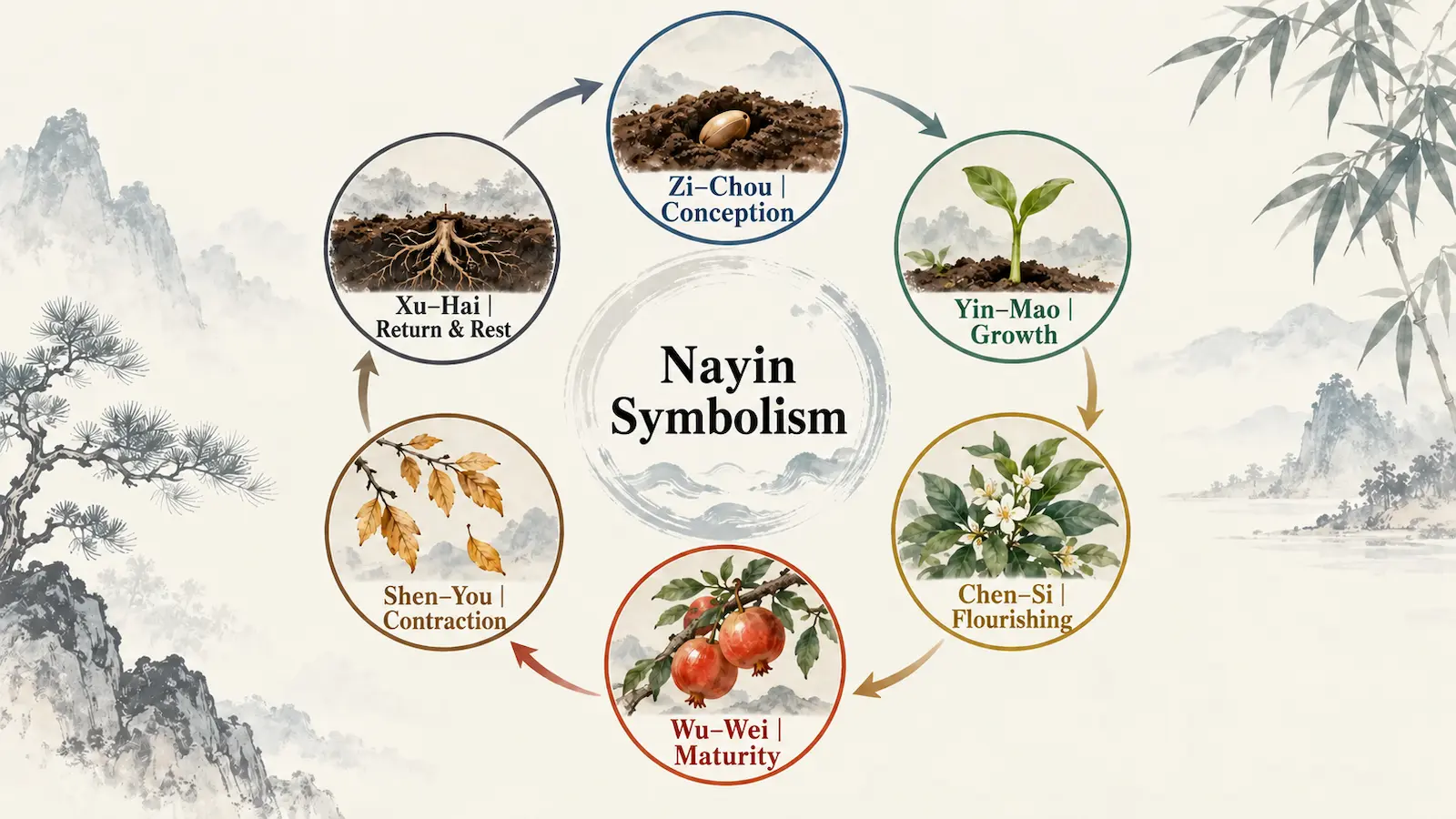
The discussion of Nayin in San Ming Tong Hui begins with the movement of yin and yang through the Twelve Earthly Branches. Qi is first concealed, then begins to grow, reaches maturity, contracts, and finally returns to a hidden state. The text uses this cycle to explain why the 30 Nayin were given different names.
It opens with the following passage:
昔者,黄帝将甲子分轻重而配成六十,号曰花甲子,其花字诚为奥妙,圣人借意而喻之,不可著意执泥。夫自子至亥十二宫,各有金、木、水、火、土之属……故甲子纳音象,圣人喻之,亦如人一世之事也。
In plain English, the passage says that the images attached to the 60 Jiazi are metaphors. The Twelve Branches provide a sequence through which the forms of the Five Elements can be understood, much like the changing stages of a human life.
The Cycle of Growth and Return
San Ming Tong Hui describes the sequence in this way:
子丑二位,阴阳始孕,人在胞胎,物藏根,未有涯际;寅卯二位,阴阳渐开,人渐生长,物以拆甲,群葩渐剖,如人将有立身也;辰巳二位,阴阳气盛,物当华秀,如人三十、四十而有立身之地,始有进取之象;午未二位,阴阳彰露,物已成齐,人至五十、六十,富贵贫贱可知,凡百兴衰可见;申酉二位,阴阳肃杀,物已收成,人已龟缩,各得其静矣;戌亥二位,阴阳闭塞,物气归根,人当休息,各有归著。
| Branches | Stage of Qi | Symbolic Meaning |
|---|---|---|
| Zi–Chou (子、丑) | Conception | Qi remains concealed, like a child in the womb or a root hidden underground. |
| Yin–Mao (寅、卯) | Growth | Yin and yang begin to open; plants sprout and visible form develops. |
| Chen–Si (辰、巳) | Flourishing | Qi becomes abundant and things grow outward into fullness. |
| Wu–Wei (午、未) | Maturity | Form and function are fully revealed. |
| Shen–You (申、酉) | Harvest and contraction | Growth has finished, and energy begins to withdraw. |
| Xu–Hai (戌、亥) | Return and rest | Qi returns to the root and becomes concealed again. |
The references to different ages are analogies for the rise and decline of qi. They do not assign a fixed modern age to each Branch. This six-stage sequence provides the background for the 30 names that follow.
The Six Metal Nayin
| Jiazi Pair and Nayin | Original Wording in San Ming Tong Hui | Meaning |
|---|---|---|
| Jia Zi–Yi Chou (甲子、乙丑): Sea Gold | “气在包藏,有名无形,犹人之在母腹也。” | At Zi and Chou, Metal qi is still concealed. It has a name but no visible form, like a child still in the womb. This hidden state is represented by gold beneath the sea. |
| Ren Yin–Gui Mao (壬寅、癸卯): Gold Foil | “绝地存金,气尚柔弱,薄若缯缟。” | Metal has appeared, but its qi remains soft and thin, like fine silk. The image is therefore a delicate sheet of gold foil. |
| Geng Chen–Xin Si (庚辰、辛巳): White Wax Gold | “金居火土之地,气已发生,金尚在矿,寄形生养之乡,受西方之正色。” | Metal has begun to develop but remains within the ore and has not yet been forged into a useful object. White wax conveys its pale color and unfinished form. |
| Jia Wu–Yi Wei (甲午、乙未): Gold in Sand | “气已成,物质自坚实,混于沙而别于沙,居于火而炼于火。” | The substance has become solid. It is mixed with sand yet distinct from it, and it can be separated and refined by fire. |
| Ren Shen–Gui You (壬申、癸酉): Sword Edge Gold | “申酉金之正位……金水淬砺,故取象剑锋而金之功用极矣。” | Shen and You are proper positions for Metal. Tempered by Water, Metal reaches its sharpest and most effective form: the edge of a sword. |
| Geng Xu–Xin Hai (庚戌、辛亥): Hairpin and Bracelet Gold | “金气藏伏……锻炼首饰,已成其状,藏之闺阁,无所施为,而金之功用毕。” | At Xu and Hai, Metal qi returns to concealment. It has already been shaped into finished jewelry and stored away, so its active function has come to an end. |
From Sea Gold to Hairpin and Bracelet Gold, Metal moves from concealment and early formation through refinement and sharpness, then returns to a finished and stored state.
The Six Wood Nayin
| Jiazi Pair and Nayin | Original Wording in San Ming Tong Hui | Meaning |
|---|---|---|
| Ren Zi–Gui Chou (壬子、癸丑): Mulberry Wood | “气居盘屈,形状未伸,居于水地……桑柘受气,取其时之生也。” | The qi is curled inward and has not yet extended into visible form. The image of mulberry wood reflects Wood beginning to receive life while still rooted in a Water setting. |
| Geng Yin–Xin Mao (庚寅、辛卯): Pine and Cypress Wood | “木居下得其旺,岁寒后凋,取其性之坚也。” | Wood grows strongly at Yin and Mao while enduring the hardness of Metal and frost. Pine and cypress remain green through the cold, expressing firmness and endurance. |
| Wu Chen–Ji Si (戊辰、己巳): Great Forest Wood | “物已及时,枝叶茂盛,郁然成林,取其木之盛也。” | The season is right, branches and leaves are abundant, and individual trees have grown into a dense forest. The name expresses Wood at its height. |
| Ren Wu–Gui Wei (壬午、癸未): Willow Wood | “木至午而死,至未而墓,故杨柳盛夏叶凋,枝干微弱,取其性之柔也。” | Wood moves toward decline at Wu and storage at Wei. The flexible, slender willow represents this softer and weaker expression of Wood. |
| Geng Shen–Xin You (庚申、辛酉): Pomegranate Wood | “五行属金而纳音属木,以相克取之……木居金地,其味成辛,故曰石榴木。” | Although Shen and You are Metal positions, their Nayin is Wood. The text explains the image through the tension between Metal and Wood and through the pomegranate's distinctive, pungent quality. |
| Wu Xu–Ji Hai (戊戌、己亥): Wood on the Plain | “气归藏伏,阴阳闭塞,木气归根,伏乎土中。” | At Xu and Hai, Wood qi returns to its roots and lies hidden in the Earth. It is no longer a flourishing forest but Wood resting close to the ground. |
The Six Water Nayin
| Jiazi Pair and Nayin | Original Wording in San Ming Tong Hui | Meaning |
|---|---|---|
| Bing Zi–Ding Chou (丙子、丁丑): Water Below the Ravine | “气未通济,高段非水流之所,卑湿乃水就之乡,由地中行。” | Qi has not yet begun to circulate freely. Water follows low, damp places and moves below the ground, like a small stream beneath a ravine. |
| Jia Yin–Yi Mao (甲寅、乙卯): Great Stream Water | “气出阳明,水势恃源,东流滔注,其势浸大。” | As yang opens, Water emerges from its source and flows eastward, gathering strength and becoming a broad stream. |
| Ren Chen–Gui Si (壬辰、癸巳): Long-Flowing Water | “水得归库,盈科后进,乃曰长流水也。” | Water fills each hollow before moving forward. The image emphasizes a continuous current that advances without breaking. |
| Bing Wu–Ding Wei (丙午、丁未): Heavenly River Water | “在高明火位,有水沛然作霖……惟天上乃有。” | Wu and Wei are bright Fire positions. Water capable of descending from above and relieving their heat can only be imagined as rain or a river in the heavens. |
| Jia Shen–Yi You (甲申、乙酉): Well Spring Water | “气息安静,子母同位,出而不穷,汲而不竭。” | The surface is still, yet the source continues below. Water can be drawn without being exhausted, like a well fed by a spring. |
| Ren Xu–Gui Hai (壬戌、癸亥): Great Sea Water | “势归乎宁谧之位,来之不穷,纳之不溢。” | At the stage of return and storage, waters gather in a calm and expansive place that receives an endless flow without overflowing: the great sea. |
The Six Fire Nayin
| Jiazi Pair and Nayin | Original Wording in San Ming Tong Hui | Meaning |
|---|---|---|
| Wu Zi–Ji Chou (戊子、己丑): Thunderbolt Fire | “气在一阳,形居水位,水中之火,非神龙则无。” | Fire is hidden in a Water position. The text invokes the divine dragon and the sudden release of lightning to represent Fire that is concealed and then erupts without warning. |
| Bing Yin–Ding Mao (丙寅、丁卯): Fire in the Furnace | “气渐发辉,因薪而显,阴阳为治,天地为炉。” | Yang qi is rising and Fire becomes visible through fuel. Heaven and Earth serve as the furnace in which its heat can be sustained and used. |
| Jia Chen–Yi Si (甲辰、乙巳): Covered Lamp Fire | “气形盛地,势定高冈,传明继晦,子母相承。” | Fire now has a stable form. A covered lamp carries light through darkness, producing a focused flame rather than a blaze that spreads outward. |
| Wu Wu–Ji Wei (戊午、己未): Fire in the Heavens | “重离相会,炳灵交光,发辉炎上。” | At Wu and Wei, Fire is fully revealed. Light meets light and rises upward, like the brilliance of the sun and the heavens. |
| Bing Shen–Ding You (丙申、丁酉): Fire Below the Mountain | “气息形藏,势力韬光……力微体弱,明不及远。” | At Shen and You, Fire begins to withdraw. Its light is weak and cannot reach far, resembling a glow partly hidden below a mountain. |
| Jia Xu–Yi Hai (甲戌、乙亥): Fire on the Mountain | “山乃藏形,头乃投光,内明外暗,隐而不显。” | The mountain conceals the body of the fire while its summit sends light outward. The result is a fire that is hidden yet still visible from a distance. |
The Six Earth Nayin
| Jiazi Pair and Nayin | Original Wording in San Ming Tong Hui | Meaning |
|---|---|---|
| Geng Zi–Xin Chou (庚子、辛丑): Wall Earth | “气居闭塞,物尚包藏,掩形遮体,内外不交。” | Qi remains enclosed and things are still concealed. Earth covers and protects their form, like the material of a wall separating inside from outside. |
| Wu Yin–Ji Mao (戊寅、己卯): City Wall Earth | “气能成物,功以育物,发乎根,壮乎萼蕊。” | At Yin and Mao, Earth supports growth from roots to buds. It also carries the protective image of the walls that enclose and defend a city. |
| Bing Chen–Ding Si (丙辰、丁巳): Earth in Sand | “气以承阳,发生已过,成齐未来。” | Growth has begun but maturity has not yet arrived. Moist earth mixed with sand still holds the potential to nourish and transform. |
| Geng Wu–Xin Wei (庚午、辛未): Roadside Earth | “气当承形,物以路彰,有形可质,有物可彰。” | Form has become visible. Earth beside a road supports movement and can also be used to grow crops, expressing Earth's capacity to carry and sustain. |
| Wu Shen–Ji You (戊申、己酉): Great Post Road Earth | “气以归息,物当收敛,龟缩退闲,美而无事。” | At Shen and You, activity contracts and settles. The imperial post road adds the image of Earth as a surface that connects places and carries movement in every direction. |
| Bing Xu–Ding Hai (丙戌、丁亥): Roof Earth | “气成物府,事以美圆,阴阳历遍,势得其间。” | At Xu and Hai, the process is complete. Earth has been shaped into roof tiles, given a finished purpose, and fixed in one place. |
The Role of Earth in the Five Elements
After explaining the six Earth Nayin, San Ming Tong Hui gives additional attention to the different uses of Earth:
路旁之土播殖百谷;大驿之土通达四方;城头之土取堤防之功,五公恃之,立国而卫民也;壁上之土明粉饰之用,臣庶资之,爰居而爰处也;沙中之土,土之最润者也,土润则生;屋上之土,土之成功者也,成功者静,故止于一定而不迁。
Roadside Earth can grow grain. Great Post Road Earth connects the four directions. City Wall Earth protects a settlement, while Wall Earth forms and finishes a dwelling. Earth in Sand is moist enough to nourish life, and Roof Earth has already been made into a finished material that remains fixed in place. The six names show how the same element takes on different functions in different settings.
The text continues:
盖居五行之中,行负载之令,主养育之权,三才五行皆不可失;处高下而得位,居四季而有功。金得之锋锐雄刚,火得之光明照耀,木得之英华越秀,水得之滥波不泛,土得之稼穑愈丰。聚之不散,必能为山;散之不聚,必能为地。用之无穷,生之罔极,土之功用大矣哉!
Earth carries and nourishes. Gathered together, it forms mountains; spread outward, it becomes the ground. Metal, Wood, Water, and Fire all depend on Earth in different ways to express their own forms and functions. The point is not that Earth is always more important than the other elements, but that its role changes according to its position, condition, and use.
Near the end of the passage, San Ming Tong Hui returns to the principle behind all 30 images:
圆看方看,不外旺相死休;因近取远,莫逃金木水火土。以干支而分配五行,论阴阳而大明终始……六十甲子圣人不过借其象以明其理。
Whether the images are viewed from one direction or another, they remain expressions of the waxing and waning of the Five Elements. The 60 Jiazi are used to reveal changes in yin and yang, and the images are simply a way to make those principles understandable.
Conclusion
In BaZi interpretation, Nayin is mainly a secondary system of imagery. It can help a practitioner describe the elemental quality of a Stem-Branch pair, and some traditional schools use it to supplement or confirm other patterns in a chart. It does not replace the Day Master, seasonal strength, the overall balance of the Five Elements, or the relationships among the Stems and Branches.
Knowing that your year is Sea Gold or Roadside Earth therefore tells you only the Nayin assigned to your year pillar. It does not identify the dominant element of your entire chart, reveal your favorable element, or predict your life by itself.
To find the Nayin of all four pillars, begin with a complete BaZi chart based on your birth date and time, then read each Nayin within the context of the full chart.