Interpreting a BaZi (Four Pillars of Destiny, Ba Zi, 八字) chart starts with reading it in the right order. Most mistakes happen when people jump straight to labels like Wealth, Officer, or a single clash before checking the whole chart.
If you want a useful reading, move in sequence: identify the Day Master, read the Four Pillars, check the Five Elements, map the Ten Gods, then judge combinations, clashes, and overall balance.
What does it mean to interpret a BaZi chart?
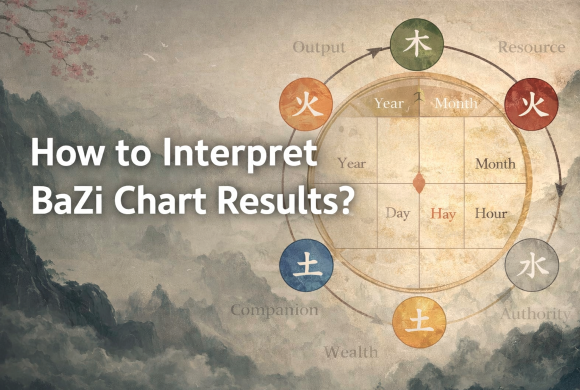
To interpret a BaZi chart means understanding and explaining how the eight characters of birth time work together as a system. In practice, BaZi interpretation turns those symbols into a reading about personality, relationships, work style, and life patterns.
Each chart has four pillars:
- Year Pillar
- Month Pillar
- Day Pillar
- Hour Pillar
Each pillar contains a Heavenly Stem and an Earthly Branch. Read those symbols as a system.
Before getting into the steps, keep one rule in mind: read a BaZi chart as a whole. Context decides how much force each symbol really has.
Step 1: Identify your Day Master first
The first step in BaZi chart interpretation is finding the Day Master (Ri Zhu, 日主). This is the Heavenly Stem of the Day Pillar, and it represents the person at the center of the chart.
The Day Master is the reference point for everything else:
- the Ten Gods are defined from it
- strength and weakness are judged from it
- support, pressure, and drain are measured against it
If the Day Master is Jia Wood, for example, then Water tends to support it, Fire tends to express it, Earth becomes wealth, Metal becomes authority, and Wood becomes peer energy. The same symbol means something different when the Day Master changes.
The Day Master gives the chart its point of view. Zodiac signs can add context, but the Day Master sets the main reference for interpretation.
Step 2: Read the Four Pillars in the right order
Once you know the Day Master, read the four pillars as a framework of life areas and timing.
| Pillar | Main focus |
|---|---|
| Year Pillar | family background, roots, early environment |
| Month Pillar | season, environment, work habits, social setting |
| Day Pillar | self, daily temperament, close relationships |
| Hour Pillar | children, later development, output, long-term direction |
For interpretation, the Day Pillar and Month Pillar usually carry the most weight at the start.
The Day Pillar matters because it contains the Day Master. The Month Pillar matters because the month branch sets the seasonal context of the chart. A Wood Day Master born in spring does not behave the same way as a Wood Day Master born in autumn.
Read Year and Hour after that. They add depth, but they should not replace the core reading.
Step 3: Understand what each pillar represents in real life
The same Ten God or same element can mean different things depending on where it appears.
For example:
- Resource in the Month Pillar may show education, habits, or the kind of support a person grows up with
- Wealth in the Day Pillar may affect daily priorities, marriage dynamics, or practical decision-making
- Officer in the Hour Pillar may show up later in life as responsibility, management, or pressure linked to future plans
This is one reason beginners misread charts. They notice a symbol but skip the question of placement.
When you interpret a BaZi chart, ask two questions every time:
- What does this symbol mean relative to the Day Master?
- Where is it located, and how does that change the meaning?
Step 4: Check the balance of the Five Elements
After the pillars are clear, check the Five Elements: Wood, Fire, Earth, Metal, and Water.
At this stage, you are checking whether the chart is balanced, dry, cold, crowded, over-controlled, or strongly supported.
Look at:
- which elements appear often
- which elements are missing or weak
- whether the season strengthens or weakens the Day Master
- whether the Day Master receives support, drain, or control from the rest of the chart
This step matters because many later judgments depend on the baseline condition of the chart. Wealth works differently in a weak chart and a strong chart. Officer also changes meaning depending on whether the chart can carry pressure smoothly.
Step 5: Read the Ten Gods based on the Day Master
The Ten Gods (Shi Shen, 十神) describe how the chart's other forces relate to the Day Master.
You do not need to memorize all ten at once to begin reading a chart. Start with the five role families:
| Role family | Common meaning in interpretation |
|---|---|
| Resource | learning, support, protection, memory |
| Output | expression, creativity, teaching, performance |
| Wealth | money, management, practical results, responsibility for resources |
| Officer / Seven Killings | rules, pressure, discipline, authority, challenge |
| Peers | self-drive, friends, rivals, teamwork, competition |
Then ask:
- Which role family is strongest?
- Which one is absent or weak?
- Which one helps the Day Master function well?
- Which one creates too much pressure or leakage?
The Ten Gods work best when you read them as roles inside a chart pattern.
Step 6: Look for combinations, clashes, punishments, and harm
After you understand the chart's main roles, move to interaction patterns.
This part includes:
- combinations (He, 合)
- clashes (Chong, 冲)
- punishments (Xing, 刑)
- harm (Hai, 害)
These interactions show where movement, tension, attachment, conflict, or hidden friction may appear.
A combination can support flow, and a clash can trigger change. Their effect depends on what they transform, what they disturb, and whether the result supports the chart.
For example, a clash may bring relocation, job change, or a break in routine. In one chart that may be disruptive. In another, it may push a stuck situation forward.
Read interaction patterns after the main chart condition is clear. If you read them too early, they tend to sound dramatic but stay vague.
Step 7: Judge strength and weakness before making conclusions
At this point, bring the earlier steps together and judge strength, weakness, and usability.
This step means asking how much force each part of the chart really has.
Check:
- whether the Day Master is rooted or unsupported
- whether key Ten Gods are strengthened by season or hidden stems
- whether controlling forces are manageable or excessive
- whether helpful elements are present but blocked
This is where interpretation becomes more precise. Weak, blocked, or heavily attacked Wealth tends to work unevenly. Officer turns into heavy pressure when the Day Master cannot carry it well.
Step 8: Connect the chart to real-life themes
Once the chart has been read in order, you can translate it into practical questions.
Common areas include:
- career style
- money habits
- relationship patterns
- family dynamics
- stress response
- timing of change
For example, if the chart has strong Output with weak Officer, the person may be expressive and capable but resist structure. If the chart has strong Resource and weak Wealth, the person may learn well and think deeply but take longer to convert knowledge into concrete results.
This is the point where a BaZi reading becomes useful. You are explaining how the chart behaves in life.
Common mistakes when interpreting a BaZi chart
These are the mistakes that create the most confusion:
- starting with the zodiac animal instead of the Day Master
- reading one symbol without checking the whole chart
- treating every clash as negative
- assuming every combination is supportive
- reading the Ten Gods before checking element balance
- ignoring the seasonal strength of the Month Pillar
- forcing one part of the chart to explain the whole life
If you keep the order consistent, most of these errors become easier to avoid.
Conclusion
If you want a repeatable way to interpret a BaZi chart, use this checklist:
- Find the Day Master.
- Check the Month Pillar and seasonal strength.
- Read the four pillars by placement.
- Review the Five Elements and chart balance.
- Map the Ten Gods from the Day Master.
- Check combinations, clashes, punishments, and harm.
- Judge strength, weakness, and whether each role can function.
- Translate the pattern into real-life themes.
That order gives beginners a reliable starting method. It keeps the reading anchored in the chart instead of in isolated items.