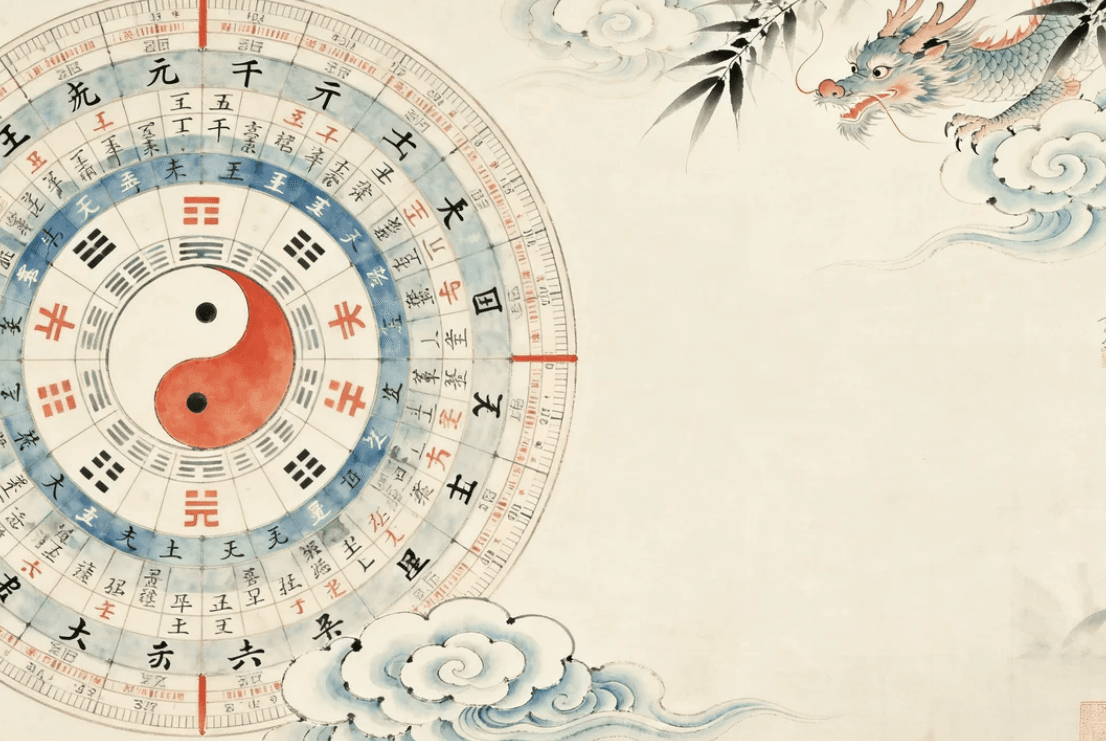
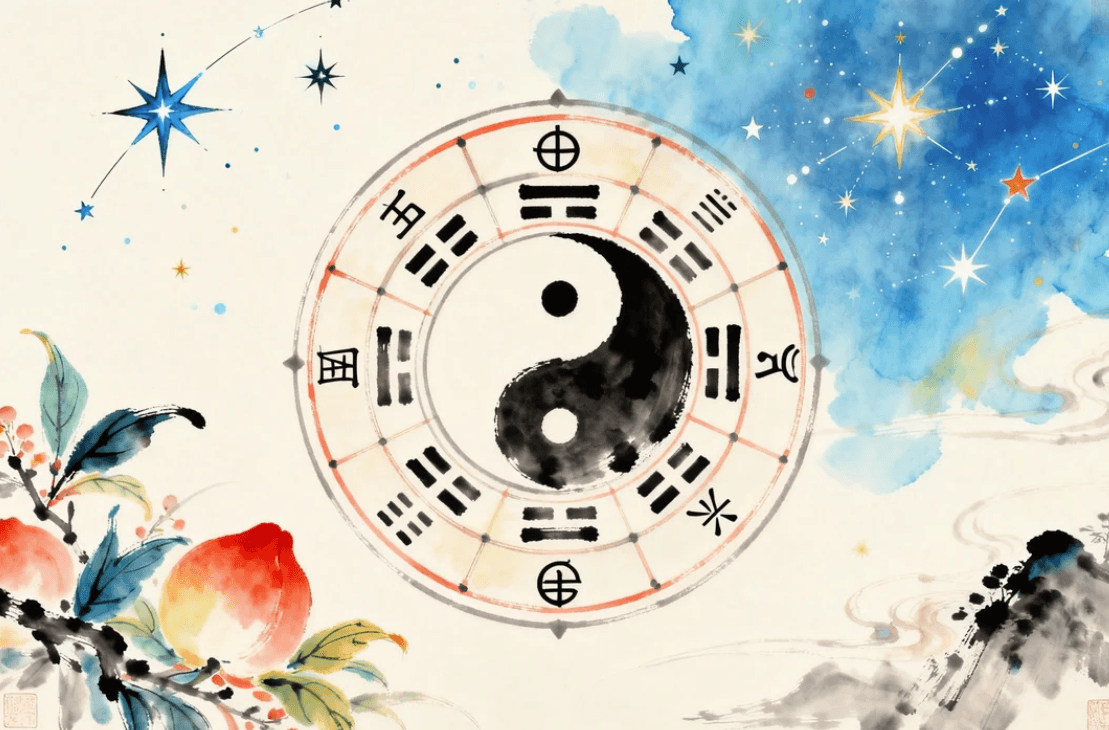
A missing element in BaZi means that one of the Five Elements—Wood, Fire, Earth, Metal, or Water—is completely absent from the Heavenly Stems and Hidden Stems of your birth chart.
The first step is to identify which element is missing and determine whether it is favorable to your chart. If your chart benefits from that element, traditional Five Elements practices offer ways to incorporate its symbolism into your daily life through colors, home decor, accessories, activities, and personal interests.
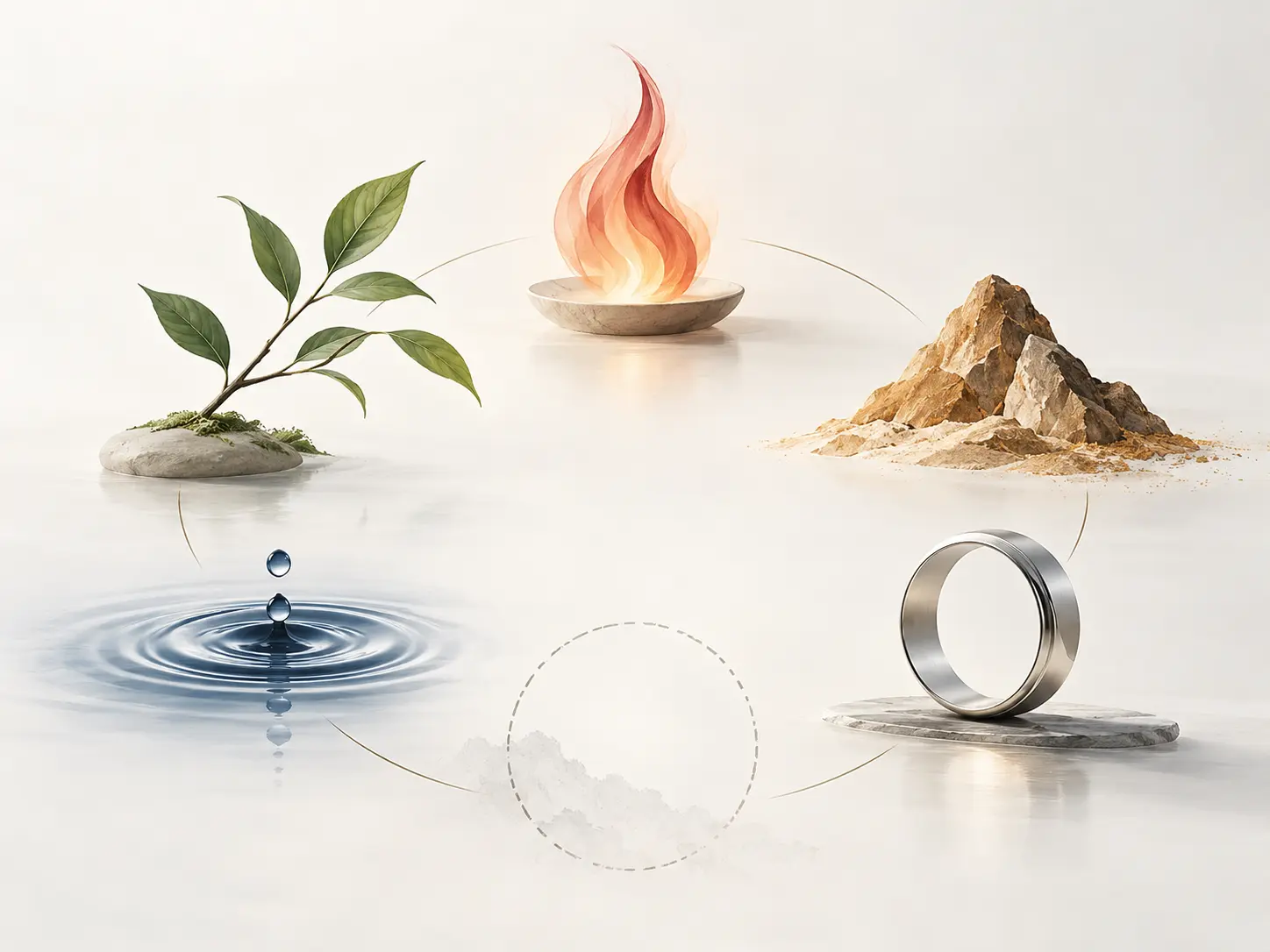
This guide explains how to identify missing elements in your BaZi chart and what you can do if Wood, Fire, Earth, Metal, or Water is missing.
How to Find Missing Elements in Your BaZi Chart
Start by generating your Four Pillars using the free BaZi Calculator. Enter your birth date and time, then examine the Heavenly Stems and Earthly Branches in your chart.
Step 1: Check the Heavenly Stems
A BaZi chart consists of four pillars representing your birth year, month, day, and hour. Each pillar contains one Heavenly Stem and one Earthly Branch.
The Ten Heavenly Stems are divided among the Five Elements:
| Element | Heavenly Stems |
|---|---|
| Wood | Jia (甲), Yi (乙) |
| Fire | Bing (丙), Ding (丁) |
| Earth | Wu (戊), Ji (己) |
| Metal | Geng (庚), Xin (辛) |
| Water | Ren (壬), Gui (癸) |
Look at the four Heavenly Stems in your chart and identify which elements appear.
You can learn more about these stems and their characteristics in the Day Master guide.
Step 2: Check the Hidden Stems
Each of the Twelve Earthly Branches has a primary element and contains one or more Hidden Stems.
For example:
-
Shen (申), Monkey: Primarily Metal, with Geng Metal (庚), Ren Water (壬), and Wu Earth (戊) hidden inside.
-
Chen (辰), Dragon: Primarily Earth, with Wu Earth (戊), Yi Wood (乙), and Gui Water (癸) hidden inside.
-
Hai (亥), Pig: Primarily Water, with Ren Water (壬) and Jia Wood (甲) hidden inside.
Suppose your chart has no Ren (壬) or Gui (癸) among its four visible Heavenly Stems, but one of its Earthly Branches is Shen (申). Since Shen contains Ren Water as a Hidden Stem, Water is still present in your chart.
The classical BaZi text San Ming Tong Hui (三命通会), Volume 2, discusses the Hidden Stems and their seasonal functions in its section On the Governing Human Elements (论人元司事).
Checking both visible and Hidden Stems gives you a more complete picture of which elements are present.
What's the Difference Between a Missing Element and a Weak Element?
A missing element is completely absent from the Heavenly Stems and Hidden Stems of your BaZi chart.
A weak element appears in the chart but has limited strength because of the birth season, its roots, or its interactions with other elements.
Element strength depends on more than the number of times it appears.
The ancient text Wu Xing Da Yi (五行大义), Volume 2, explains seasonal element strength:
春则木王,火相,水休,金囚,土死。
In spring, Wood is dominant, Fire receives support, Water rests, Metal is constrained, and Earth is in a weakened state. The character 王 here carries the meaning of 旺, or flourishing.
For example, Jia Wood (甲) born in the Tiger month (寅月) receives strong seasonal support. Even if Jia appears only once among the visible Heavenly Stems, Wood may still be strong because of the season and its roots.
To identify a missing element, examine the Heavenly Stems and Hidden Stems. To evaluate element strength, consider the birth season, roots, and generating and controlling relationships between the elements.
What to Do If Your BaZi Is Missing Wood
Wood represents growth, expansion, flexibility, and renewal in traditional Five Elements theory. It is associated with spring, the East, and green or blue-green colors.
If Wood is a favorable element in your BaZi chart, you can explore the following traditional Wood-related practices.
1. Colors and clothing
Incorporate green, blue-green, or light green into your wardrobe. A green shirt, scarf, bag, or other everyday accessory is an easy starting point.
You can also use light green bedding, curtains, or cushions to introduce Wood-associated colors into your living space.
2. Home environment and direction
Add living plants such as pothos, spider plants, or other easy-care greenery to your desk, balcony, or living room.
Natural wooden furniture, bamboo accessories, and wood-grain decorations also reflect the Wood element.
Traditionally, Wood corresponds to the East. You can pay attention to the eastern area of your home, keeping it tidy, well-ventilated, and suitable for plants where lighting conditions allow.
3. Accessories and names
Wooden bracelets, bamboo accessories, and green jewelry are common symbolic choices associated with Wood.
In traditional Chinese naming practices, characters such as 林 (Lin), 森 (Sen), and 桐 (Tong) are commonly classified as Wood because of their components and meanings.
When choosing a Chinese name, you can consider these characters alongside their pronunciation, meaning, and overall suitability.
4. Daily activities and career interests
Spend time in parks, forests, and gardens. Activities such as hiking, gardening, growing plants, or learning woodworking are practical ways to engage with Wood-related themes.
Forestry, horticulture, plant cultivation, and woodworking have direct associations with Wood. Some modern Five Elements classifications also associate education, writing, and publishing with the growth and development qualities of Wood.
If these fields interest you, consider taking a course or starting a small personal project.
What to Do If Your BaZi Is Missing Fire
Fire symbolizes warmth, light, activity, expression, and transformation. It corresponds to summer, the South, and red in traditional Five Elements theory.
If Fire is favorable in your chart, the following practices reflect its traditional associations.
1. Colors and clothing
Choose red, orange, and other warm colors for clothing or accessories. A red jacket, orange scarf, or warm-colored handbag can introduce Fire-associated colors into your daily routine.
At home, red or orange cushions, artwork, and warm-toned lighting can create a brighter atmosphere.
2. Home environment and direction
Make better use of natural daylight. Open curtains during the day and arrange furniture to allow more light into the rooms you use most often.
Fire is traditionally associated with the South. If your home has a bright southern area, you might use it for reading, relaxing, or other daytime activities.
Comfortable lighting and good ventilation should guide your arrangement.
3. Accessories and names
Red agate, garnet, and other red-colored accessories are commonly associated with Fire in modern Five Elements practices.
In Chinese naming traditions, characters such as 炎 (Yan), 煜 (Yu), 炜 (Wei), and 灿 (Can) are often classified as Fire.
These characters may be considered when choosing a Chinese name, together with their meaning and pronunciation.
4. Daily activities and career interests
Try activities that involve movement and expression, such as jogging, dancing, public speaking, singing, photography, or video production.
Energy, lighting, cooking, and performing arts are commonly associated with Fire in traditional or modern Five Elements classifications.
You can explore these interests through cooking classes, photography projects, or communication and presentation skills.
What to Do If Your BaZi Is Missing Earth
Earth represents stability, support, nourishment, and transformation. It is traditionally associated with the Center and the color yellow.
If Earth is favorable in your chart, you can incorporate its symbolism through natural materials, earthy colors, and structured routines.
1. Colors and clothing
Wear yellow, beige, khaki, brown, or other earth tones.
For your home, consider beige bedding, brown rugs, or yellow cushions to create a warm, grounded atmosphere.
2. Home environment and direction
In traditional Five Elements correspondences, Earth occupies the Center. You can focus on keeping the central area of your home clean, open, and organized.
Use natural materials such as ceramic bowls, pottery, stone decorations, or terracotta plant pots.
Organizing storage spaces and keeping frequently used items in designated places can also reflect Earth's symbolism of stability and order.
3. Accessories and names
Ceramic jewelry, natural stone accessories, and yellow or brown pieces are commonly associated with Earth.
In Chinese naming practices, characters such as 坤 (Kun), 培 (Pei), and 垚 (Yao) are often categorized as Earth because of their components or meanings.
4. Daily activities and career interests
Pottery, gardening, and working with soil are natural ways to explore Earth-related activities.
You can also establish regular routines, such as a weekly home-cleaning schedule, a consistent work plan, or an organized workspace.
Agriculture, land management, construction, and ceramics are traditionally or symbolically connected with Earth. If you are interested in these fields, consider learning pottery, architectural design, or practical construction skills.
What to Do If Your BaZi Is Missing Metal
Metal symbolizes structure, discipline, precision, boundaries, and decisiveness. It corresponds to autumn, the West, and white.
If Metal is favorable in your BaZi chart, the following activities and choices reflect its traditional qualities.
1. Colors and clothing
Choose white, silver, gold, or light gray for your clothing and accessories.
A white shirt, silver-colored watch, or metallic accessory can incorporate Metal-associated colors into your everyday style.
For interiors, white and light gray furnishings combined with metal finishes create a clean, structured appearance.
2. Home environment and direction
Use practical metal objects such as stainless steel drinkware, metal desk lamps, or metal shelving.
Metal is traditionally associated with the West. You can organize the western area of your home, keeping surfaces tidy and frequently used items accessible.
3. Accessories and names
Silver jewelry, stainless steel bracelets, and metal watch straps are common choices. Precious metals are unnecessary for expressing Metal symbolism.
In Chinese naming traditions, characters such as 铭 (Ming), 钧 (Jun), and 锦 (Jin) are commonly classified as Metal because they contain the 金 radical.
4. Daily activities and career interests
Try metalworking, mechanical model building, playing a musical instrument, or crafts that require careful measurement and precision.
You can also establish more structured work habits, such as maintaining task lists, organizing digital files, and reviewing your progress regularly.
Metalworking, mechanical engineering, and precision instrument manufacturing have direct associations with Metal. Some modern Five Elements systems also classify finance, auditing, and quality control under Metal because of their emphasis on rules and precision.
What to Do If Your BaZi Is Missing Water
Water represents flow, adaptability, nourishment, storage, and change. It is associated with winter, the North, and black.
If Water is favorable in your BaZi chart, you can explore the following traditional Water-related practices.
1. Colors and clothing
Choose black, navy blue, deep blue, or other dark colors.
A black coat, navy backpack, or dark blue bedding can introduce Water-associated colors into your daily environment.
For home decor, consider blue cushions or artwork featuring rivers, lakes, waterfalls, or oceans.
2. Home environment and direction
Water-themed artwork can be an easy way to incorporate Water symbolism into your home.
A small aquarium or indoor water feature is another option if you have suitable space and can maintain it safely.
Water corresponds to the North in traditional Five Elements theory. You can pay attention to the northern area of your home, keeping it clean, ventilated, and free of excess moisture.
If you install an aquarium or water feature, consider electrical safety, cleaning, and maintenance requirements.
3. Accessories and names
Black or dark blue accessories, such as obsidian or lapis lazuli jewelry, are often associated with Water in modern Five Elements practices.
In Chinese naming traditions, characters such as 泽 (Ze), 涵 (Han), and 清 (Qing) are commonly classified as Water because they contain the water radical 氵.
4. Daily activities and career interests
Swimming, boating, and walking beside rivers or lakes are natural ways to engage with Water-related activities.
Traveling, reading, learning new skills, and exploring unfamiliar subjects also reflect Water's traditional associations with movement and adaptability.
Water management, shipping, fisheries, and logistics have direct associations with Water. Some modern Five Elements classifications also connect tourism and trade with Water because these industries involve movement and exchange.
A Note on Traditional Five Elements Remedies
The colors, directions, accessories, names, and activities described above come from traditional Five Elements symbolism and its later cultural applications.
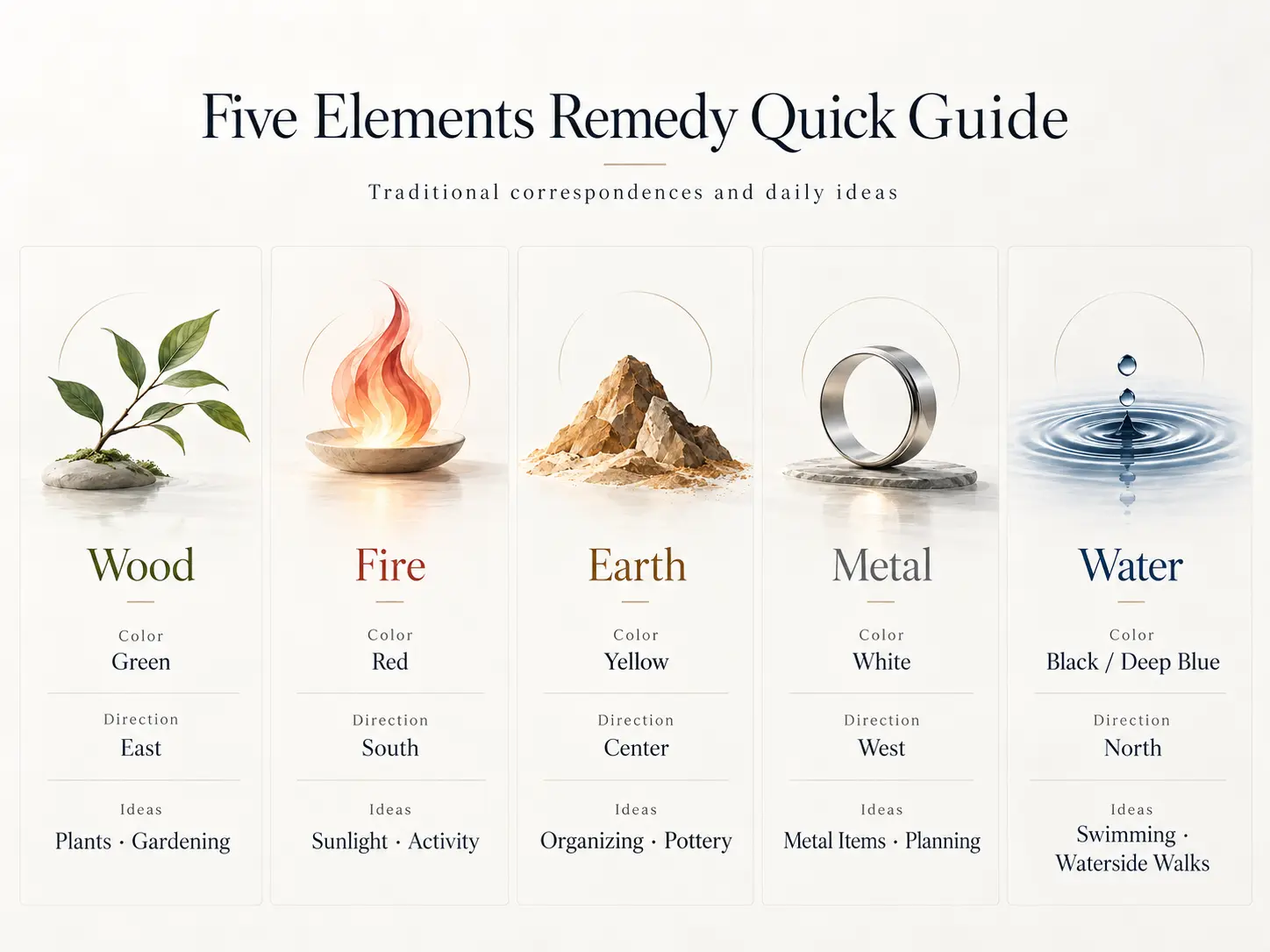
Wu Xing Da Yi, Volume 3, On the Correspondence of the Five Colors (论配五色), records the classical associations:
-
Wood — East — Blue-green
-
Fire — South — Red
-
Earth — Center — Yellow
-
Metal — West — White
-
Water — North — Black
Modern practices extend these associations to clothing, home decoration, gemstones, names, and lifestyle activities.
You can use these ideas as cultural references when making everyday choices. Wearing particular colors, changing your name, or placing specific objects in your home does not alter your birth chart. There is no reliable scientific evidence that these symbolic practices improve luck or change life outcomes.
Should You Always Add a Missing Element in BaZi?
Whether a missing element should be strengthened depends on its role in the overall BaZi chart.
The classical text Di Tian Sui (滴天髓), in its section on illness and elemental harmony, includes the following statement in the original commentary:
全者宜全,缺者宜缺,生者宜生,克者宜克。
The passage explains that some charts benefit from having all five elements, while others function well with certain elements absent. The appropriate generating and controlling relationships depend on the chart's structure.
For example, suppose Wood is already very strong in a chart, while Water is completely absent. Since Water generates Wood, adding Water could further strengthen the already dominant Wood element.
In another chart, Wood may be weak and benefit from additional support. Water could then serve a favorable role because it generates Wood.
Traditional BaZi analysis evaluates several factors to determine the Useful and Favorable Elements:
-
Day Master strength: How much support, control, or energy drainage the Day Master receives.
-
Birth season (Month Branch): The seasonal influence on each element's strength.
-
Stem and Branch interactions: Generating, controlling, draining, and consuming relationships, as well as combinations and clashes.
-
Overall chart structure: How the elements interact and whether their roles support the chart's broader pattern.
These factors help identify the Useful Element (Yong Shen, 用神), Favorable Elements (Xi Shen, 喜神), and Unfavorable Elements (Ji Shen, 忌神) within traditional BaZi interpretation.
Once you understand which elements are favorable, you can select relevant practices from the five sections above according to your preferences and daily circumstances.
Frequently Asked Questions
Can Luck Pillars and Annual Luck Bring a Missing Element into a BaZi Chart?
Yes. In traditional BaZi analysis, 10-Year Luck Pillars (Da Yun) and annual influences (Liu Nian) introduce additional Heavenly Stems and Earthly Branches that interact with your natal chart.
For example, if Wood is missing from your birth chart, a luck period or year involving Jia (甲), Yi (乙), Yin (寅), or Mao (卯) introduces Wood-related influences.
When Wood is favorable, these influences may be interpreted positively. When Wood is unfavorable, they may create additional challenges within the traditional system.
Your natal Four Pillars remain fixed. Luck Pillars and annual influences describe how different elements interact with the original chart over time.
Can a Missing Element in BaZi Affect Your Physical Health?
Traditional Five Elements theory associates Wood with the liver, Fire with the heart, Earth with the spleen, Metal with the lungs, and Water with the kidneys.
These correspondences belong to traditional Chinese cosmology and medicine.
A BaZi chart showing missing Wood cannot establish a liver condition, and missing Water cannot establish a kidney problem. There is no reliable scientific evidence that missing elements in a birth chart can predict diseases or physical health outcomes.
Health concerns should be assessed through symptoms, medical examinations, and qualified healthcare professionals. BaZi is a traditional interpretive system and cannot replace medical diagnosis or treatment.
Classical References
The following classical sources provide the foundations for the Five Elements correspondences, seasonal strength, Hidden Stems, and relationships used in traditional BaZi analysis. The practical lifestyle suggestions in this article are modern applications of these traditional concepts.
-
Wu Xing Da Yi (五行大义) — Xiao Ji (萧吉), Sui Dynasty. Volume 1, Explanation of the Five Elements (释五行名); Volume 2, Generating Relationships (论相生) and Seasonal Strength (论四时休王); Volume 3, Correspondence of the Five Colors (论配五色). These sections discuss elemental characteristics, seasonal influences, directions, and colors. Wikisource: Volume 1 · Volume 2 · Volume 3
-
San Ming Tong Hui (三命通会) — Wan Minying (万民英), Ming Dynasty. Volume 2, On the Governing Human Elements (论人元司事). Referenced for the traditional system of Hidden Stems within the Earthly Branches and their seasonal functions. Wikisource: Volume 2
-
Di Tian Sui Chan Wei (滴天髓阐微) — Commentary by Ren Tieqiao (任铁樵), Qing Dynasty. Referenced for discussions of elemental harmony, strength, weakness, and the relationships that determine favorable and unfavorable influences, particularly the chapter on illness (疾病). Wikisource: Full Text