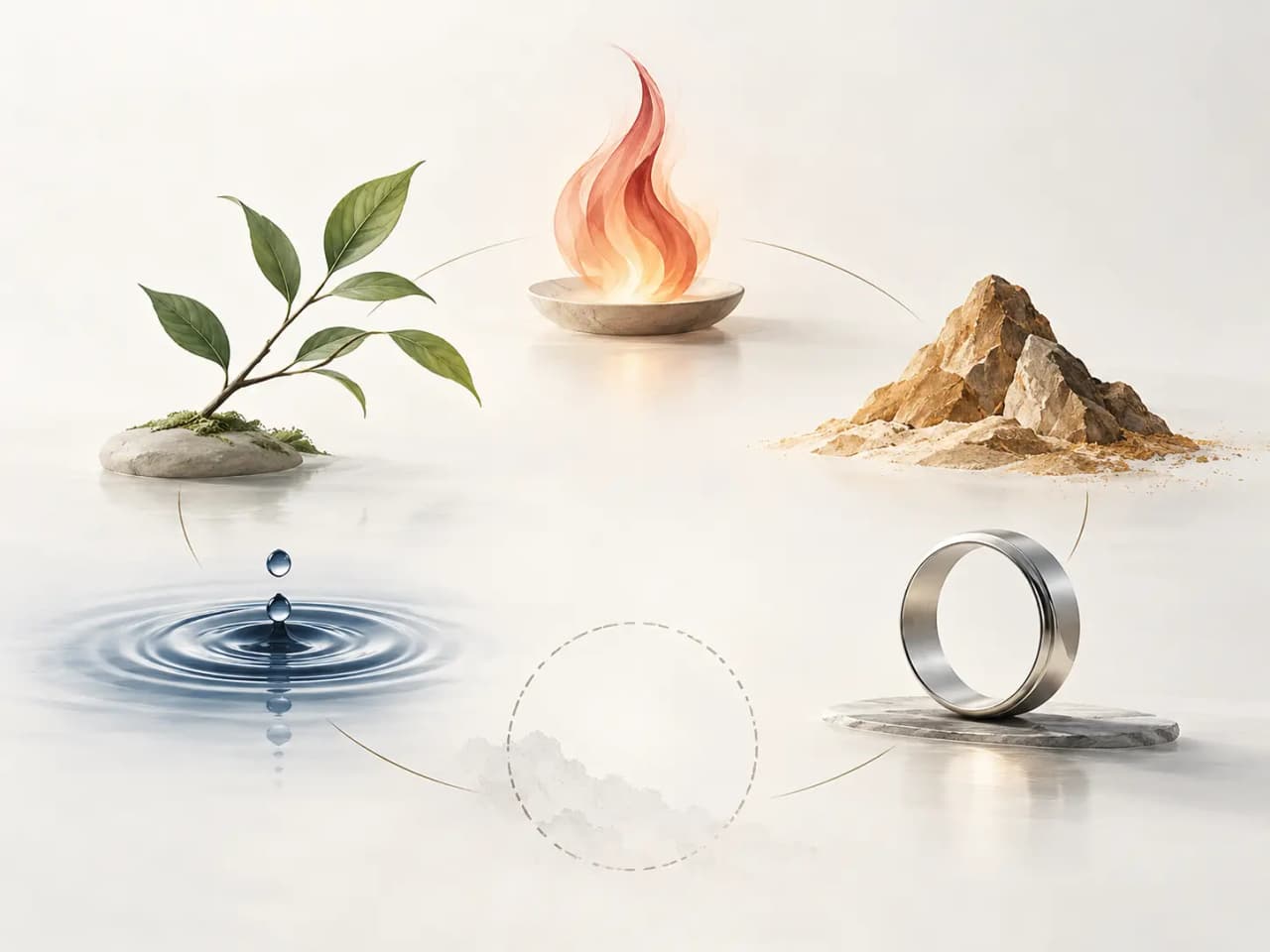
BaZi uses several methods to determine useful and unfavorable elements. This article explains the differences between Yong Shen, Xi Shen, and Ji Shen, introduces common approaches to selecting them, and focuses on the strength-balancing method used by ShenShu AI.
What Are Yong Shen, Xi Shen, and Ji Shen?
In BaZi, Yong Shen, Xi Shen, and Ji Shen describe how different Five Elements are assessed within a birth chart. Under the strength-balancing method, each serves a different purpose.
Yong Shen (Useful Element)
The useful element is the core element selected to address the main imbalance in a BaZi chart. Its selection begins with assessing the strength of the Day Master and identifying which elements can help balance the chart.
For example, a strong Day Master may benefit from elements that restrain, drain, or consume its strength. A weak Day Master may benefit from elements that strengthen or support it.
Xi Shen (Favorable Element)
A favorable element supports the useful element or helps improve the overall balance of the chart.
It may strengthen the useful element through the generating cycle or help regulate other elements through its own relationships within the Five Elements.
Ji Shen (Unfavorable Element)
An unfavorable element tends to worsen the chart's imbalance or interfere with the useful element's function.
For example, if the Day Master is already strong, an element that further strengthens it may increase the existing imbalance.
What Methods Are Used to Determine Useful and Unfavorable Elements?
Traditional BaZi uses several approaches to selecting useful and unfavorable elements. Each focuses on different aspects of the birth chart, so the method being used matters.
The Strength-Balancing Method
The strength-balancing method (旺衰扶抑法) focuses on the Day Master's strength and the relationships between the Five Elements. It determines whether the Day Master needs support or whether its strength needs to be restrained, drained, or consumed.
For a strong Day Master, the usual approach is to reduce excessive strength. For a weak Day Master, the focus is on providing support.
This is the method ShenShu AI uses to determine useful and unfavorable elements.
The Climate Adjustment Method
The climate adjustment method (调候法) examines the chart's coldness, heat, dryness, and dampness. It considers the season, month, and overall elemental configuration to determine what kind of adjustment the chart needs.
For example, a winter birth chart with pronounced coldness may call for Fire to provide warmth. A summer chart with excessive heat and dryness may benefit from Water to cool and moisten it.
This method focuses on the chart's climatic conditions, rather than primarily on the Day Master's strength.
The Pattern-Based Method
The pattern-based method (格局法) examines the structure established by the birth month and its relationships with the Heavenly Stems and Earthly Branches. It identifies the chart's pattern and evaluates its structure and combinations to determine the appropriate approach to selecting useful elements.
The Mediation Method
The mediation method (通关法) addresses conflicts between the Five Elements by examining whether another element can connect them through the generating cycle.
For example, Metal controls Wood, but Water is generated by Metal and generates Wood. Water can therefore mediate the Metal–Wood conflict under suitable conditions.
This article focuses on the strength-balancing method used by ShenShu AI. The following sections explain how it determines useful and unfavorable elements.
How to Determine Useful and Unfavorable Elements Using the Strength-Balancing Method
The process has four main steps: assess the Day Master's strength, determine the direction of adjustment, select the useful element, and identify favorable and unfavorable elements.
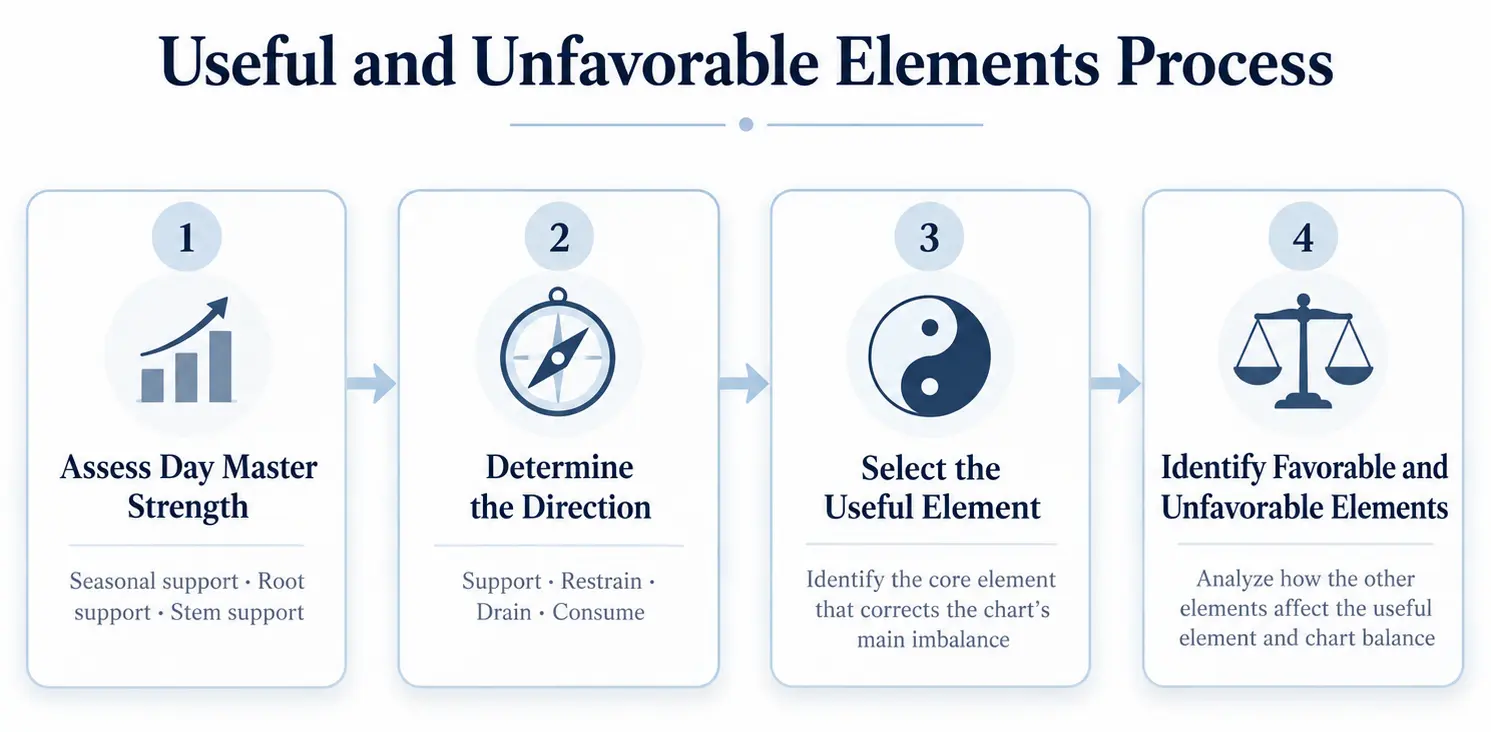
Step 1: Assess the Day Master's Strength
The Day Master is the Heavenly Stem of the Day Pillar. Its strength is assessed primarily through seasonal support, root support, and stem support, alongside the generating and controlling relationships within the chart.
Seasonal support (得令) refers to whether the Day Master receives support from the birth month. The month establishes the seasonal context of the chart, and the strength of each element varies by season. A Day Master supported by the month generally receives more seasonal strength.
Root support (得地) refers to the roots available to the Day Master in the Earthly Branches. When the hidden stems contain elements that support the Day Master, they provide roots that contribute to its strength. The number, strength, and placement of these roots all matter.
Stem support (得势) refers to support from other Heavenly Stems. Resource stars generate the Day Master, while Companion stars strengthen it. The more effective this support is, the more strength the Day Master receives.
The assessment also considers elements that control, drain, or consume the Day Master's strength, as well as hidden stems and relationships such as combinations, clashes, punishments, and harms between the Earthly Branches.
Together, these factors establish whether the Day Master is strong, weak, or relatively balanced.
Step 2: Determine Whether the Day Master Needs Support or Restraint
Once the Day Master's strength has been assessed, the general direction for selecting useful elements becomes clearer.
| Day Master condition | General direction | Purpose |
|---|---|---|
| Strong or relatively strong | Restraint, draining, or consumption | Reduce excessive strength |
| Weak or relatively weak | Generation or support | Strengthen the Day Master |
| Relatively balanced | Assess the overall chart | Identify any other significant imbalance |
For a strong Day Master, the analysis usually considers the roles of Officer and Seven Killings stars, Output stars, and Wealth stars. Officer and Seven Killings restrain the Day Master, Output stars drain its energy, and Wealth stars consume its strength.
For a weak Day Master, Resource and Companion stars are common candidates. Resource stars generate the Day Master, while Companion stars provide direct support.
For example, consider a Wood Day Master born in spring. If Wood receives seasonal support, has strong roots in the Earthly Branches, and receives additional support from Jia or Yi Wood in the Heavenly Stems, the Day Master may be strong.
The analysis would then consider Fire, Earth, and Metal as potential balancing elements. Fire drains Wood through the generating cycle. Wood must expend strength to control Earth, its Wealth element. Metal restrains Wood through the controlling cycle.
For a weak Wood Day Master, the direction changes. Water can generate Wood, while Wood itself can provide additional support. The next step is to determine which element can most effectively address the chart's imbalance.
Step 3: Select the Useful Element
After establishing the general direction, compare the candidate elements and identify the one that best addresses the chart's main imbalance.
Several factors are particularly important:
-
Elemental strength: Whether the candidate element has sufficient strength to perform its role.
-
Roots and placement: Whether the element has roots and receives support from the Heavenly Stems or Earthly Branches.
-
Generating and controlling relationships: Whether other elements strengthen or restrict it, and whether it can effectively support or regulate the Day Master.
-
Branch relationships: Whether combinations, clashes, punishments, or harms affect the strength and function of the relevant elements.
For a strong Wood Day Master, Fire, Earth, and Metal may all be candidates. Fire drains Wood, Earth consumes Wood's strength because Wood controls Earth, and Metal restrains Wood.
If Fire has strong roots and can effectively drain the excessive Wood, while the other candidates are restricted or less effective, Fire may be selected as the useful element.
The key is to identify the element that best addresses the main imbalance, rather than choosing one based solely on whether it generates or controls the Day Master.
Step 4: Identify Favorable and Unfavorable Elements
Once the useful element has been selected, assess how the other elements affect it and the chart's balance.
Favorable elements support the useful element or help correct the chart's imbalance. An element may be favorable because it generates the useful element or helps regulate an excessive force.
Unfavorable elements tend to intensify the existing imbalance or weaken the useful element. An element may be unfavorable because it strengthens an already excessive Day Master or directly restrains the useful element.
For example, suppose a Wood Day Master is strong and Fire is selected as the useful element. Fire drains Wood, reducing the Day Master's excessive strength.
Earth can be favorable in this example. Fire generates Earth, and Earth is the Wealth element for a Wood Day Master. Controlling Earth consumes some of Wood's strength, while Earth also receives support from the useful element, Fire.
Water, by contrast, generates Wood and controls Fire. It can further strengthen the already strong Day Master while weakening the useful element, making it a potential unfavorable element in this chart.
This completes the process of determining the useful, favorable, and unfavorable elements under the strength-balancing method.
Useful Elements and BaZi Compatibility
Useful elements can also be considered when comparing two BaZi charts. Comparing each person's useful elements with the Five Elements present in the other person's chart can reveal areas of potential elemental complementarity.
Comparing Each Person's Useful Elements
For example, suppose Water is favorable for Person A, and Person B's chart contains Water with strong roots. This may provide a useful source of elemental support for Person A.
The comparison can also be made in reverse: identify the elements favorable to Person B, then examine whether those elements are present and able to serve a useful role in Person A's chart.
To see how your Five Elements compare with your partner's, use the ShenShu AI BaZi Compatibility Tool to examine both charts, including their favorable and unfavorable elements, Spouse Palaces, and Heavenly Stem and Earthly Branch relationships.
Frequently Asked Questions
Why Isn't a Missing Element Necessarily a Useful Element?
A missing element is one that does not appear in the chart's Heavenly Stems, Earthly Branches, or hidden stems. Determining useful elements requires assessing how an element affects the chart's balance.
If adding a missing element would worsen the imbalance or create an unfavorable effect on the Day Master, that element would not automatically be considered useful.
The strength-balancing method first assesses the Day Master's strength, then evaluates the relative strength of the Five Elements and their generating and controlling relationships.
For a more detailed explanation of missing elements, including what it means to lack Wood, Fire, Earth, Metal, or Water, read Missing Elements in BaZi: How to Identify and Address Them.
What Role Do Useful and Unfavorable Elements Play in BaZi Readings?
Useful and unfavorable elements help explain how the Five Elements contribute to a chart's balance and which elements support or strain it.
When interpreting the natal chart, they help identify the roles played by different elements. When analyzing 10-year luck cycles and annual influences, they provide a basis for assessing how the elements introduced by a particular period affect the chart.
For example, a year with strong Fire may bring more favorable elemental support to someone whose chart benefits from Fire. For someone whose chart is unfavorable to Fire, the same elemental influence may intensify an existing imbalance.
Useful and unfavorable elements therefore provide a framework for interpreting the Five Elements in the natal chart and assessing changes introduced by luck cycles and annual influences.