The Support and Restraint Method (Fu Yi, 扶抑法) is a traditional BaZi method for selecting useful and favorable elements based on the strength of the Day Master. It examines how the Five Elements generate, reinforce, drain, consume, and control one another to determine which influences can improve the balance of a birth chart.
The method involves two closely related stages: assessing the Day Master's strength and weakness, followed by selecting the elements that provide the appropriate support or restraint. This forms the basis for identifying Useful, Favorable, and Unfavorable Elements.
Fu Yi belongs to the broader Zi Ping tradition of BaZi astrology. Its principles appear in classical works such as Di Tian Sui (滴天髓) and Yuan Hai Zi Ping (渊海子平). In modern BaZi practice, strength-based interpretations are often associated with the Strength and Weakness School or Fu Yi approach.
The method is widely used in interpreting wealth, marriage, career, and luck cycles. Understanding how it works also helps distinguish it from other traditional approaches, including the Structure Method, Seasonal Adjustment, Illness and Remedy, and Elemental Mediation.

Classical Origins of the Support and Restraint Method
1. Di Tian Sui establishes the principles of support and restraint
One of the clearest classical explanations of Fu Yi appears in Di Tian Sui (滴天髓), in the chapter Shuai Wang Lun (衰旺论, On Strength and Weakness):
旺则宜泄宜伤,衰则喜帮喜助,子平之理也。
When strong, draining or restraint is appropriate; when weak, reinforcement and support are favored. This is a principle of Zi Ping.
The passage establishes the basic relationship between Day Master strength and elemental adjustment.
A strong Day Master may benefit from releasing excess energy through Output stars, consuming energy through Wealth stars, or receiving control from Officer stars.
A weak Day Master may benefit from Resource stars that generate it or Companion stars that reinforce it.
The same chapter continues:
旺中有衰者存,不可损也。衰中有旺者存,不可益也。
Within strength, there may be weakness that should not be reduced; within weakness, there may be strength that should not be increased.
This introduces a distinction between the Day Master's overall strength and the individual forces operating within a chart.
For example, a strong Day Master may have a weak but useful Officer star. Introducing a powerful Output star could drain the Day Master while simultaneously damaging that Officer star. The intended restraint would weaken a part of the chart that already needs support.
Similarly, two weak Day Masters may require different forms of assistance. One may need Resource stars to transform excessive Officer influence into support, while another may benefit more from Companion stars that help it deal with excessive Wealth.
The method therefore evaluates which type of support or restraint produces the desired change, rather than treating every supporting or controlling element as equally useful.
2. Ren Tieqiao explains why support and restraint must be selected differently
A particularly useful explanation appears in Di Tian Sui Chan Wei (滴天髓阐微), where commentator Ren Tieqiao (任铁樵) expands on the principles of supporting and restraining.
He distinguishes between the different functions of the four key actions: draining, controlling, reinforcing, and generating.
宜泄则泄之为妙,宜伤则伤之有功。
Drain when draining is appropriate; control when control will be effective.
In this commentary, draining refers to the action of Output stars, while controlling refers to the action of Officer and Seven Killings stars.
Ren explains that a strong Day Master does not always benefit from the same type of restraint.
If a chart contains excessive Companion strength but a weak Officer star, introducing more Output may further damage the Officer. Strengthening the Officer's controlling influence can be more effective.
If a chart is dominated by Companions and has no effective Officer influence, Output may offer a smoother way to release the concentration of energy. Introducing direct control could instead create an intense conflict.
He makes a similar distinction for weak Day Masters.
When Wealth is excessively strong and the Day Master is weak, Companion stars may provide direct reinforcement while helping to restrain the excessive Wealth element.
When Officer or Seven Killings stars are excessively strong, Resource stars may be preferable because they can transform the controlling influence into support for the Day Master.
These examples explain why "strong favors restraint, weak favors support" is only the beginning of Fu Yi analysis. The next decision is whether to use Output, Officers, Resource, or Companions, and what each would do to the existing relationships.
3. Yuan Hai Zi Ping considers both Day Master strength and chart structure
Yuan Hai Zi Ping (渊海子平), in Lun Ri Wei Zhu (论日为主, Taking the Day as the Primary Reference), states:
以日为主,大要看日加临于甚度,或身旺?或身弱?又看地支有何格局?
Take the Day as the primary reference, examine whether the Day Master is strong or weak, and then consider the structure formed by the Earthly Branches.
This passage places strength assessment and chart structure within the same traditional analytical framework.
The Day Master provides the reference point for defining the Ten Gods. The Month Command and Earthly Branches establish the seasonal environment and contribute to the chart's structure.
Modern practitioners sometimes distinguish a Strength and Weakness School from a Structure School. These names describe differences in analytical priorities within the Zi Ping tradition.
Fu Yi emphasizes Day Master strength and the selection of supporting or restraining elements. Structure-based approaches emphasize the Month Command, the configuration of the Ten Gods, and the conditions governing a particular structure.
The classical material contains both lines of analysis. The modern labels do not represent a single, universally standardized classification established by the early texts.
4. Classical texts distinguish between different uses of Yong Shen
The term Yong Shen (用神), often translated as Useful God or Useful Element, is central to BaZi interpretation. Its precise meaning differs between analytical traditions.
Di Tian Sui, in Ti Yong Lun (体用论, On Substance and Function), states:
道有体用,不可以一端论也,要在扶之抑之得其宜。
The relationship between substance and function cannot be understood from a single perspective. What matters is applying support and restraint appropriately.
The chapter also makes a distinction between the meaning of Yong in the concept of substance and function and its meaning in Yong Shen.
In modern Support and Restraint analysis, Yong Shen usually refers to the key element selected to correct an imbalance in Day Master strength.
In the Structure Method, especially the Month Command approach associated with Zi Ping Zhen Quan (子平真诠), Yong Shen is identified through the Month Command and the Ten Gods that establish the chart's structure.
For example, a Direct Officer Structure may identify the Officer associated with the Month Command as its structural Yong Shen. Its successful operation is then evaluated through relationships such as Wealth generating Officer, Resource protecting Officer, and Hurting Officer interfering with Officer.
A strength-based analysis of the same chart may identify Resource as the most useful supporting influence for a weak Day Master.
The term Yong Shen appears in both interpretations, but it serves a different role in each.
How Support and Restraint Works in BaZi
The method begins with Day Master strength and then examines five fundamental elemental relationships to identify useful forms of support or restraint.
1. The five relationships between the Day Master and the elements
The Heavenly Stem of the Day Pillar is called the Day Master, or Day Yuan.
Each of the other elements has one of five relationships with it.
| Elemental relationship | Ten Gods category | Effect on the Day Master |
|---|---|---|
| Generates me | Resource stars | Generates and supports |
| Same element as me | Companion stars | Reinforces and strengthens |
| Generated by me | Output stars: Eating God, Hurting Officer | Drains and releases energy |
| Controlled by me | Wealth stars: Direct Wealth, Indirect Wealth | Consumes energy |
| Controls me | Officer stars: Direct Officer, Seven Killings | Controls and restrains |
Consider a Jia Wood (甲木) Day Master:
-
Water generates Wood. Ren and Gui Water are Resource stars.
-
Wood reinforces Wood. Jia and Yi Wood are Companion stars.
-
Wood generates Fire. Bing and Ding Fire are Output stars.
-
Wood controls Earth. Wu and Ji Earth are Wealth stars.
-
Metal controls Wood. Geng and Xin Metal are Officer stars.
These five relationships explain how the same element can serve different functions depending on the Day Master.
Water supports Jia Wood, but Water drains Metal and is controlled by Earth. The relationship is always defined from the Day Master's perspective.
2. Fu means supporting or reinforcing the Day Master
Fu (扶) refers to support. In strength-based analysis, this primarily involves Resource and Companion stars.
Resource stars generate the Day Master.
For Jia Wood, Water provides this support. If Jia Wood is weak and under strong Metal control, Water also has an additional function: Metal generates Water, and Water generates Wood.
This creates a productive sequence:
Metal → Water → Wood
Instead of Metal acting only as a controlling force against Wood, Water becomes an intermediary that transforms Metal's influence into Resource support.
Companion stars work differently.
Additional Wood directly reinforces Jia Wood. If excessive Earth Wealth is placing a heavy burden on a weak Jia Wood Day Master, Companion Wood can help the Day Master withstand and control that Earth.
The choice between Resource and Companions therefore changes according to the source of the Day Master's weakness.
3. Yi means restraining or reducing excessive strength
Yi (抑) refers to restraint. In Fu Yi analysis, excessive Day Master strength can be reduced through three mechanisms.
Draining (泄) occurs when the Day Master generates Output.
For Jia Wood, Fire is Output. Wood generates Fire and releases energy through that relationship.
Consuming (耗) occurs when the Day Master controls Wealth.
For Jia Wood, Earth is Wealth. Wood expends energy exercising control over Earth.
Controlling (克) occurs when Officer stars restrain the Day Master.
For Jia Wood, Metal provides direct control.
These mechanisms reduce strength in different ways.
Draining directs energy into an element produced by the Day Master. Consuming directs energy toward an element the Day Master controls. Controlling introduces an external force acting upon the Day Master.
For a strong Wood Day Master, Fire may create a productive sequence of Wood → Fire → Earth. Metal instead acts directly on Wood through the controlling cycle.
Choosing between Fire and Metal therefore changes the relationships among Output, Wealth, and Officer stars.
4. How to choose between support and restraint
The initial strength assessment gives two broad directions.
| Day Master condition | Main direction | Elements considered |
|---|---|---|
| Weak | Support and reinforce | Resource and Companions |
| Strong | Drain, consume, or control | Output, Wealth, and Officers |
A more detailed Fu Yi analysis distinguishes the conditions under which each option becomes useful.
| Chart condition | Preferred mechanism | Reason |
|---|---|---|
| Weak Day Master under strong Officer control | Resource support | Officer generates Resource, which generates the Day Master |
| Weak Day Master with excessive Wealth | Companion support | Companions reinforce the Day Master and help control Wealth |
| Strong Day Master with a weak but useful Officer | Strengthen the controlling function | Strong Output could damage the already weak Officer |
| Strong Day Master dominated by Companions | Output draining | Output provides a productive release for concentrated energy |
These are traditional selection patterns, explained particularly clearly in Ren Tieqiao's commentary on Di Tian Sui.
The distinction becomes easier to understand through two Jia Wood examples.
5. Example: Weak Jia Wood with strong Wealth versus strong Officers
Consider a weak Jia Wood Day Master with excessive Earth Wealth.
Water can generate Wood. However, Earth controls Water, so an already powerful Earth element can also attack the Resource that Jia Wood would rely upon.
Companion Wood works differently. It reinforces Jia Wood and directly controls Earth.
In this configuration, Companion support may serve the purpose more effectively than Resource support.
Now consider a weak Jia Wood Day Master facing strong Metal Officers.
Adding more Wood introduces further Wood that Metal can control. Water provides another solution because Metal generates Water and Water generates Wood.
Here, Resource support can transform the controlling influence into a source of support.
Both Day Masters are weak. Their most useful supporting elements differ because one is burdened by Wealth and the other is controlled by Officers.
6. Example: Strong Jia Wood with and without effective Officer control
Consider a strong Jia Wood Day Master with powerful Wood roots and additional Companion support.
If the chart has no effective Officer influence, Fire can drain Wood and release its excess energy. Fire can also generate Earth Wealth, extending the productive flow.
Now consider a similarly strong Jia Wood Day Master whose Metal Officer is weak but serves an important structural function.
Strong Fire Output may drain Wood, but Fire also controls Metal. Introducing Fire could therefore damage the Officer.
Strengthening the Metal Officer or supporting it through Earth generating Metal may be more effective.
This illustrates the deeper logic of Fu Yi: a successful adjustment must improve the relevant relationships in the chart, not simply reduce or increase the Day Master's strength.
Assessing Day Master Strength
A practical strength assessment examines three dimensions: Seasonal Support (De Ling, 得令), Root Support (De Di, 得地), and Stem Support (De Shi, 得势).
These identify the Day Master's seasonal position, its roots in the Earthly Branches, and the support or pressure it receives from the other Heavenly Stems.
1. De Ling (得令): Seasonal Support
The Month Branch, or Month Command (Yue Ling, 月令), represents the seasonal environment of the birth chart.
Each season favors particular elemental energies:
-
Wood is generally strongest during spring.
-
Fire is strongest during summer.
-
Metal is strongest during autumn.
-
Water is strongest during winter.
Earth requires particular attention to the relevant transitional months and individual Earthly Branches.
Di Tian Sui, in Yue Ling Lun (月令论, On the Month Command), states:
月令提纲,譬之宅也,人元用事之神,宅之向也,不可以不卜。
The Month Command provides the main framework, like a house; the active element within it is like the direction the house faces and deserves careful examination.
Season establishes the starting conditions for assessing strength.
For example, Jia Wood born in the Mao (卯) month receives strong seasonal support. Jia Wood born in the You (酉) month faces a season dominated by Metal.
The Month Command is also central to structure-based analysis, which is one reason strength and structure methods frequently examine the same evidence from different perspectives.
2. De Di (得地): Root Support
Root Support examines the Day Master's connection to the Hidden Heavenly Stems within the Earthly Branches.
A root provides an underlying source of strength.
For Jia Wood, Yin (寅) and Mao (卯) are particularly important Wood roots.
Roots vary in strength according to their type, position, seasonal condition, and interactions with other branches.
For example, Wood appearing as the main Qi of a branch provides a different level of support from Wood appearing only as a secondary or residual Hidden Stem.
Clashes and other branch relationships may also change the effectiveness of a root.
A Jia Wood Day Master with substantial Yin and Mao roots has a stronger foundation than one with no Wood roots in any of its branches.
Root Support therefore measures the quality and effectiveness of the Day Master's roots, rather than simply counting Hidden Stems.
3. De Shi (得势): Stem Support
Stem Support examines the influences among the visible Heavenly Stems.
For Jia Wood:
-
Ren and Gui Water provide Resource support.
-
Jia and Yi Wood provide Companion support.
-
Bing and Ding Fire drain Wood through Output.
-
Wu and Ji Earth consume Wood's energy through Wealth.
-
Geng and Xin Metal control Wood through Officer stars.
The strength of each influence is affected by whether it has roots, whether it receives seasonal support, and how it interacts with the other stems and branches.
For example, a Ren Water Resource star supported by strong Water roots can provide more substantial nourishment than a Ren Water stem with no effective roots and strong opposing forces.
4. Combining Seasonal, Root, and Stem Support
A practical assessment follows five stages:
-
Evaluate the Month Command. Establish the seasonal strength of the Day Master's element.
-
Examine the Earthly Branches. Identify roots and distinguish strong roots from weaker hidden support.
-
Assess Resource and Companion stars. Determine how much generation and reinforcement the Day Master receives.
-
Measure Output, Wealth, and Officer influences. Examine how much energy is drained, consumed, or controlled.
-
Apply stem and branch interactions. Account for combinations, clashes, and other relationships that alter the effective strength of these influences.
The result identifies the Day Master as strong, weak, or relatively balanced.
Consider two Jia Wood charts.
In the first, Jia Wood is born in the You month and loses seasonal support. However, it has strong Yin and Mao roots, together with substantial Water Resource support. These factors can compensate for the lack of seasonal strength.
In the second, Jia Wood is born in spring but has little root support, weak Resources, and strong Metal control. Seasonal support alone does not guarantee a strong Day Master.
This is why element counts provide an incomplete measure of strength.
Two charts may contain the same number of Wood characters while producing very different strength assessments.
Support and Restraint Compared with Other BaZi Methods
Traditional BaZi contains several approaches to analyzing a chart and identifying useful influences.
Some methods establish an overall analytical framework, while others address a particular issue within the elemental relationships.
| Method | Central question | Main focus |
|---|---|---|
| Support and Restraint (Fu Yi) | Does the Day Master need support or restraint? | Day Master strength, generation, draining, consumption, and control |
| Structure Method (Ge Ju) | What structure does the Month Command establish? | Ten Gods configuration, structural success, disruption, and protection |
| Seasonal Adjustment (Tiao Hou) | Is the chart too cold, hot, dry, or damp? | Seasonal temperature and moisture |
| Illness and Remedy (Bing Yao) | What is the chart's principal problem? | Identifying the harmful influence and its remedy |
| Elemental Mediation (Tong Guan) | What obstruction separates conflicting elements? | Creating a productive connection |
| Following and Special Patterns (Cong Ge) | Does the chart follow a dominant elemental force? | Special structural conditions and corresponding selection rules |
1. Structure Method (格局法): Month Command and chart configuration
The Structure Method, or Ge Ju, focuses on the pattern established through the Month Command and the relationships among the Ten Gods.
It examines how a structure forms, what sustains it, and what disrupts it.
Consider a Jia Wood Day Master born in the You month.
You contains Xin Metal, which is the Direct Officer for Jia Wood. This creates the starting point for examining a Direct Officer Structure (正官格).
The Structure Method then evaluates the Officer's condition and supporting relationships.
Earth Wealth can generate Metal Officer. Water Resource can receive Metal's energy and generate Wood, forming an Officer–Resource relationship.
Ding Fire, however, is the Hurting Officer for Jia Wood. Fire controls Metal, so a strong Ding Fire influence may interfere with the Direct Officer.
A Fu Yi analysis of the same chart begins by assessing Jia Wood's strength.
If Jia Wood is weak and Metal control is strong, Water Resource becomes a natural candidate because Metal generates Water and Water generates Wood.
In this example, both approaches may favor Resource, but for different reasons.
Fu Yi favors Resource for its support of the weak Day Master and its ability to transform Officer influence.
The Structure Method examines Resource for its role in supporting and protecting the Officer configuration.
The distinction becomes especially important when an element improves Day Master strength but damages an established structure.
This is also why a Fu Yi Useful Element and a Structure Yong Shen should not automatically be treated as the same thing.
2. Seasonal Adjustment (调候法): Cold, warmth, dryness, and moisture
The Seasonal Adjustment Method, or Tiao Hou, focuses on the climatic conditions represented by the birth chart.
Di Tian Sui, in Han Nuan Lun (寒暖论, On Cold and Warmth), states:
天道有寒暖,发育万物,人道得之,不可过也。
Heaven has cold and warmth through which all things develop. Neither should become excessive.
The text also states:
地道有燥湿,生成品汇,人道得之,不可偏也。
Earth has dryness and moisture through which things are formed. Neither should dominate excessively.
Consider Jia Wood born in winter, surrounded by strong Water.
Under Fu Yi analysis, Water is Resource and generates Wood.
Under Seasonal Adjustment, abundant Water may contribute to a cold environment. Fire becomes important because warmth is needed for Wood's growth.
The difference is clear:
-
Water supports Wood through the generating cycle.
-
Fire improves the cold seasonal conditions through its warming quality.
The two methods can therefore identify different elemental priorities without disagreeing about the underlying Five Element relationships.
3. Illness and Remedy (病药法): Identifying the central problem
The Illness and Remedy Method, or Bing Yao, identifies the chart's main problem and the element that can resolve it.
Shen Feng Tong Kao (神峰通考), in Bing Yao Shuo Lei (病药说类), explains:
何以为之病?原八字中原所害之神也;何以为之药?如八字原有所害之字,而得一字以去之谓了。
The illness is the harmful influence within the original chart. The remedy is an element that removes or resolves that influence.
Author Zhang Nan gives several examples.
When excessive Earth constitutes the problem, Wood may serve as the remedy by controlling Earth.
When Companion stars interfere with Wealth, Officer stars can restrain those Companions and protect the Wealth element.
When a useful Output star is suppressed by Resource, Wealth may help because it controls Resource, allowing Output to function.
This method starts by identifying the influence causing the problem, then examines how another element removes it.
Fu Yi instead begins with Day Master strength and considers the support or restraint required.
For example, excessive Wealth burdening a weak Day Master may lead both approaches to consider Companion support. But the Illness and Remedy Method can also focus on a damaged Officer, a blocked Output relationship, or another problem that is not primarily about Day Master strength.
4. Elemental Mediation (通关法): Connecting conflicting elements
The Elemental Mediation Method, or Tong Guan, examines whether an intermediary can connect elements involved in conflict.
Di Tian Sui, in Tong Ge Lun (通隔论, On Connection and Obstruction), states:
两意本相通,中间有关隔,此关若通也,到处欢相得。
Two forces may be capable of connecting, but an obstruction stands between them. Once the obstruction is removed, their relationship can flow.
The text describes several elemental mediation relationships.
| Elemental conflict | Mediating element | Productive sequence |
|---|---|---|
| Wood and Earth | Fire | Wood → Fire → Earth |
| Fire and Metal | Earth | Fire → Earth → Metal |
| Earth and Water | Metal | Earth → Metal → Water |
| Metal and Wood | Water | Metal → Water → Wood |
| Water and Fire | Wood | Water → Wood → Fire |
Consider Metal controlling Wood.
Water can serve as the intermediary because Metal generates Water and Water generates Wood.
The original controlling relationship is redirected into a generating sequence.
This is especially relevant when a weak Wood Day Master faces strong Metal control. Water provides Resource support under Fu Yi and mediation under Tong Guan.
The same element serves two related functions, each described by a different analytical method.
5. Following Patterns (从格): Following an exceptionally dominant force
Ordinary Fu Yi analysis seeks to support a weak Day Master or restrain an excessively strong one.
Following Patterns, known as Cong Ge, operate differently.
Consider a Day Master that is extremely weak, has no effective roots, and receives almost no support, while the remaining elements form a concentrated and dominant force.
Under a valid Following Pattern, the selection principle shifts toward following that dominant force.
For example, a conventional weak Day Master may favor Resource or Companion support. A genuine Following Pattern may instead favor elements that sustain the dominant structure.
Di Tian Sui addresses following and transformation in its discussions of special configurations.
This is why the original text distinguishes ordinary weakness from extreme weakness. The two situations can require different selection principles.
How Fu Yi Is Used in Modern BaZi Readings
Support and Restraint is a common approach in modern BaZi interpretation, particularly in readings that emphasize Day Master strength, Useful Elements, and favorable or unfavorable elemental influences.
A typical Fu Yi-oriented reading proceeds through five stages:
-
Calculate the Four Pillars and identify the Day Master.
-
Assess the Day Master's strength using seasonal, root, and stem support.
-
Identify the appropriate supporting or restraining influences and select Useful, Favorable, and Unfavorable Elements.
-
Interpret the Ten Gods in specific areas such as wealth, relationships, and career.
-
Examine how 10-year luck cycles and annual influences interact with the natal chart.
For example, a reading may identify a weak Jia Wood Day Master, explain why Water Resource is helpful against strong Metal control, and then examine what the Officer and Resource configuration means for career or relationships.
A different Jia Wood chart may favor Companion support because excessive Earth Wealth places a burden on the Day Master.
Both readings use Fu Yi, but they select different useful influences because the underlying strength relationships differ.
The method provides a clear sequence from strength assessment to elemental selection and interpretation.
It is particularly useful for explaining why an element is classified as favorable or unfavorable, rather than simply presenting a list of favorable elements without a supporting rationale.
Applying Fu Yi to Wealth, Marriage, Career, and Luck Cycles
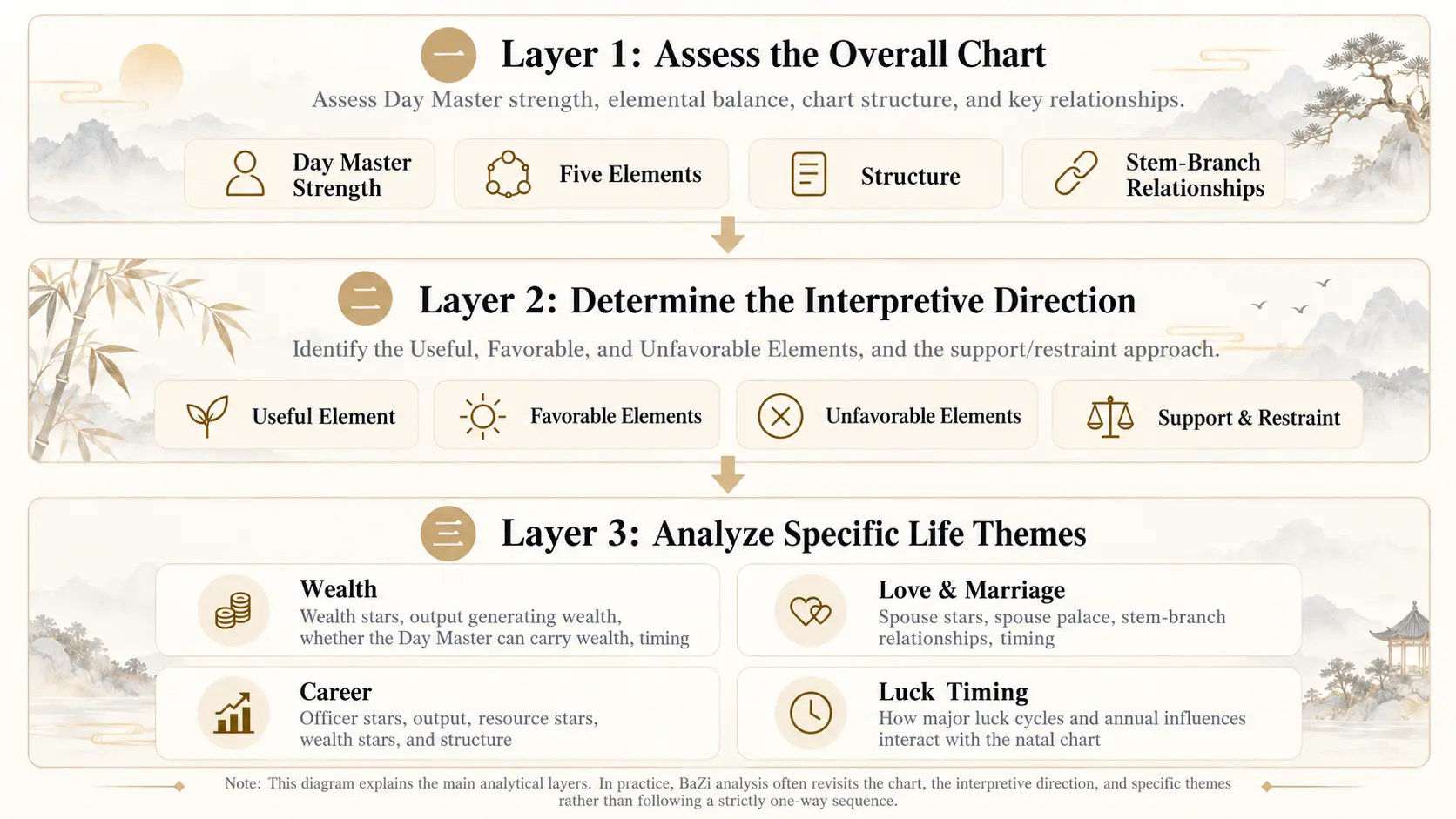
Fu Yi establishes the Day Master's strength and the role of different elements. Specific life themes are interpreted through the relevant Ten Gods, palaces, stem-and-branch relationships, and timing influences.
1. Wealth: The relationship between Day Master strength and Wealth stars
In BaZi, the element controlled by the Day Master represents Wealth.
For Jia Wood, Earth is the Wealth element.
A chart may contain powerful Earth Wealth stars, but their meaning changes according to the strength of Jia Wood and the relationships among the other elements.
San Ming Tong Hui (三命通会), Volume Six, discusses this relationship in its chapter on Direct Wealth:
故财要得时乘旺,不偏正混乱,不重叠多见,自家日主有力,皆能发福。
Wealth should be seasonally strong and properly configured, while the Day Master must have sufficient strength to benefit from it.
The surrounding passage explains the traditional concept of a Day Master being too weak to handle abundant Wealth.
Consider a weak Jia Wood Day Master with powerful Earth Wealth stars.
Under Fu Yi analysis, the immediate issue is the imbalance between weak Wood and strong Earth.
Adding Companion Wood reinforces the Day Master and provides additional strength to control Earth.
Water Resource also generates Wood, but excessive Earth can control Water. When that relationship is dominant, Companion support may be more direct.
Now consider a strong Jia Wood Day Master with limited Earth Wealth but substantial Fire Output.
Wood generates Fire, and Fire generates Earth. This creates an Output-to-Wealth relationship in which the Day Master's energy can be directed toward Wealth.
The two examples produce different interpretations:
-
Weak Wood with excessive Earth focuses on strengthening the Day Master to handle Wealth.
-
Strong Wood with effective Fire Output focuses on channeling excess strength into the production of Wealth.
A complete wealth reading then examines whether the Wealth stars are rooted, seasonally supported, exposed in the Heavenly Stems, or activated during particular luck cycles.
Fu Yi establishes the strength relationship. The Wealth configuration and timing provide the specific financial interpretation.
2. Marriage and relationships: Day Master strength, Spouse Stars, and the Spouse Palace
Traditional Zi Ping BaZi analyzes marriage through several related concepts, including Spouse Stars, the Spouse Palace, and luck cycles.
In its historical gender-based framework, Yuan Hai Zi Ping associates Wealth stars with a wife in a male chart and Officer-related stars with a husband in a female chart. The Day Branch is an important reference for marriage and the spouse.
These traditional indicators serve different functions in an interpretation.
| Analytical component | What it examines |
|---|---|
| Support and Restraint | The strength relationship between the Day Master and relevant Ten Gods |
| Spouse Stars | The condition, placement, and interactions of traditional partner indicators |
| Spouse Palace | The Day Branch and its relationships with other branches |
| Luck cycles | Periods when Spouse Stars, the Spouse Palace, or related elements are activated |
Consider a traditional male chart with a weak Jia Wood Day Master and strong Earth Wealth stars.
Fu Yi evaluates whether Jia Wood has enough strength to interact with the dominant Earth element.
If Companion Wood is selected as a useful influence, it strengthens the Day Master and helps counter excessive Earth.
In the marriage interpretation, however, Companion stars also carry the traditional meaning of peers or competitors. A strong Companion influence interacting with Wealth may therefore raise the separate question of competition over the Wealth star used as a spouse indicator.
This illustrates an important difference between elemental balance and relationship interpretation.
An element that supports the Day Master does not automatically produce a favorable result in every life theme.
Fu Yi explains how Companion Wood affects the Day Master's strength. The marriage analysis examines how Companion, Wealth, and the Spouse Palace relate to one another.
The next step is to examine the Day Branch.
For example, a clash involving the Day Branch draws attention to the traditional Spouse Palace, while a combination involving a Spouse Star may become significant in a particular luck cycle.
These interactions provide a different category of information from Day Master strength.
The distinction becomes even more important in BaZi compatibility, where two natal charts are compared. Compatibility analysis examines the interaction between two Day Masters, Spouse Palaces, elemental configurations, and timing patterns, rather than relying on the strength classification of either person alone.
3. Career: How Officer, Resource, and Output stars interact
Career analysis frequently uses Officer, Resource, Output, and Wealth stars to interpret different configurations.
Officer stars control the Day Master, while Resource stars generate it.
Consider a weak Day Master facing strong Officer or Seven Killings influences.
An effective Resource star can create this sequence:
Officer / Seven Killings → Resource → Day Master
The Officer element generates Resource, and Resource generates the Day Master.
Resource therefore serves two purposes: it supports the weak Day Master and transforms the controlling influence into a productive relationship.
This mechanism is important in traditional patterns such as Sha Yin Xiang Sheng (杀印相生), commonly described as Seven Killings generating Resource.
Another configuration uses Eating God to control Seven Killings.
This is known as Shi Shen Zhi Sha (食神制杀), or Eating God controlling Seven Killings.
These mechanisms solve different problems.
-
Seven Killings generating Resource redirects the controlling force through Resource.
-
Eating God controlling Seven Killings uses Output to restrain the controlling force.
Consider Jia Wood facing Geng Metal Seven Killings.
Ren Water can receive Metal's generating influence and support Jia Wood, creating a Metal → Water → Wood sequence.
Bing Fire, on the other hand, is Jia Wood's Eating God and can control Geng Metal directly.
The first approach emphasizes transformation through Resource. The second emphasizes control through Output.
This illustrates why career-related Ten Gods cannot be interpreted solely as favorable or unfavorable based on their names.
Their significance comes from how they interact with the Day Master and one another.
4. Luck cycles: How favorable elements affect timing
After establishing the natal chart's strength and useful elements, Fu Yi can be applied to 10-year luck cycles (Da Yun, 大运) and annual influences (Liu Nian, 流年).
Consider a weak Jia Wood Day Master born in the You month, with strong Metal control and limited Water support.
A luck cycle introducing Water may strengthen Resource support and create a Metal → Water → Wood relationship.
The Day Master becomes better supported, changing its relationship with the natal Officer influence.
Now suppose an annual influence introduces strong Fire.
Fire drains Jia Wood, and it may also control the Metal Officer. If the Fire corresponds to Hurting Officer, the interaction can create a structural conflict involving the Officer star.
The two periods introduce different mechanisms:
-
Water strengthens the Day Master and provides an intermediary between Metal and Wood.
-
Fire drains the Day Master and exerts control over Metal.
The same reasoning can be applied to Wealth stars, Spouse Stars, and the Spouse Palace.
A useful timing interpretation identifies which natal relationships are activated, how the incoming stems and branches change them, and which life themes those relationships represent.
This is more informative than assigning a single positive or negative label to an entire year.
Common Misunderstandings About Support and Restraint
1. Day Master strength can be determined by counting elements
Element counts show how often Wood, Fire, Earth, Metal, and Water appear, but they do not measure their effective strength.
Season, root quality, stem support, control, and branch relationships all affect elemental strength.
Two charts with the same number of Wood characters can produce different strength assessments.
2. A strong Day Master is always favorable
Strength is a description of the Day Master's position within the elemental relationships.
A strong Day Master may need Output or Officer influence to release or regulate excess strength. A weak Day Master may benefit from Resource or Companion support.
Strength alone is not a direct measure of wealth, ability, career achievement, or relationship quality.
3. Every weak Day Master benefits equally from Resource and Companion stars
Resource and Companions provide support through different mechanisms.
Resource generates the Day Master, while Companions reinforce it directly.
For weak Wood facing excessive Metal, Water Resource may transform Metal's controlling influence into support.
For weak Wood burdened by excessive Earth Wealth, Companion Wood may be more useful because strong Earth can also control Water Resource.
The type of weakness determines which supporting mechanism addresses it.
4. A missing element should automatically be added
An element absent from the Heavenly Stems and Hidden Stems is simply missing from those positions in the natal chart.
Its usefulness is determined by the relevant selection rules.
For example, a strong Jia Wood chart may contain no additional Wood beyond the Day Master itself, yet adding more Wood could still increase an already excessive concentration of Wood energy.
The presence or absence of an element is a separate question from whether it is useful.
5. Useful Elements are identical across Fu Yi and Structure analysis
Fu Yi selects useful influences through the Day Master's strength and the required adjustment.
Structure analysis identifies and evaluates the configuration established through the Month Command.
For example, a weak Jia Wood Day Master in a Direct Officer Structure may favor Water Resource for strength-related reasons, while the Structure Method examines the same Resource in relation to the Officer's operation.
The two approaches can identify the same element while assigning it different theoretical functions.
Understanding the distinction prevents confusion when reading classical texts or comparing BaZi interpretations from different schools.
Conclusion: The Role of Support and Restraint in BaZi
The Support and Restraint (Fu Yi) Method is an important approach within the Zi Ping BaZi tradition. It begins by assessing the Day Master's strength and then selects elements that provide the appropriate form of support, draining, consumption, or control.
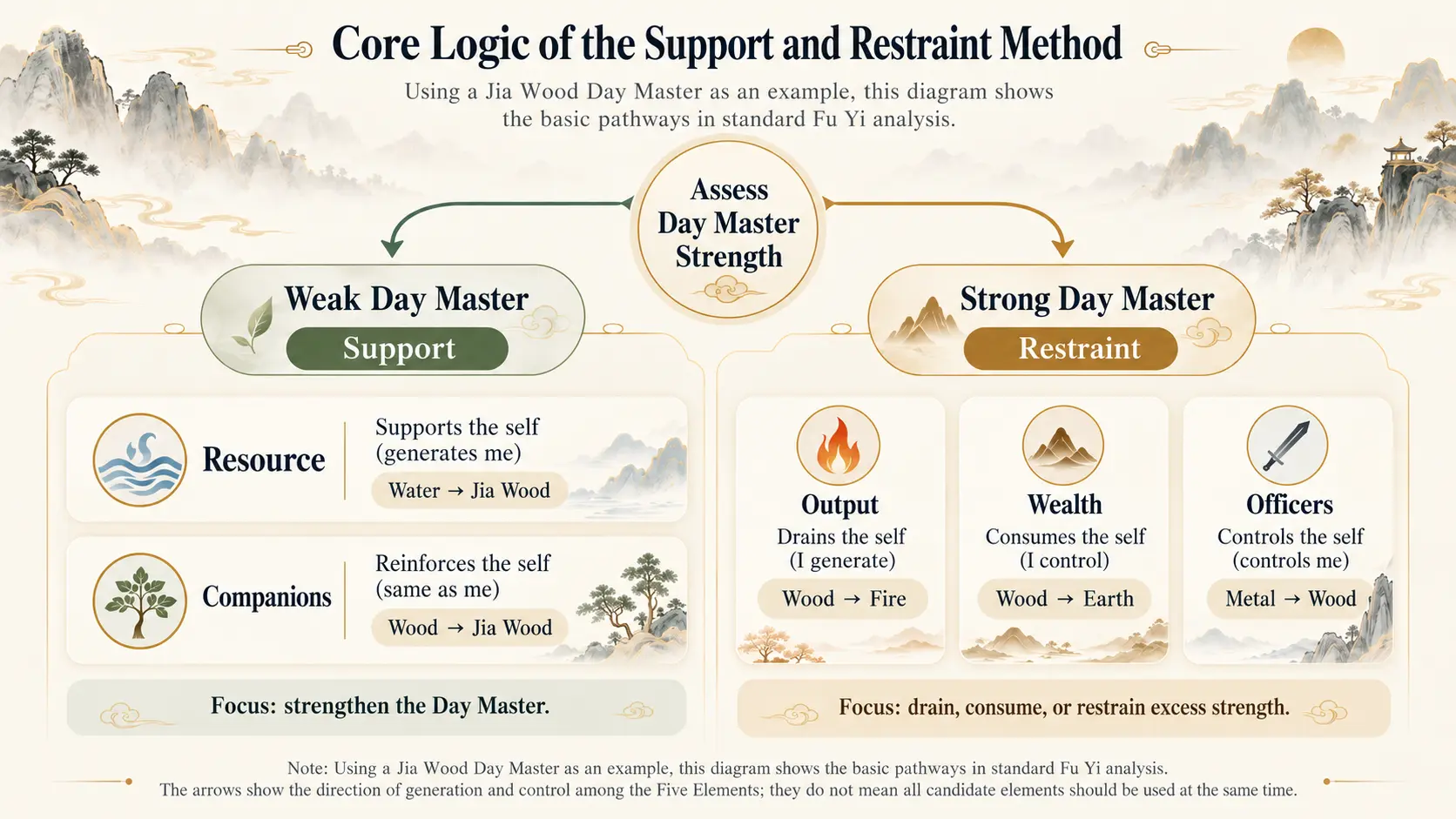
Its central questions are:
-
How strong is the Day Master, based on the Month Command, roots, and other elemental influences?
-
Which form of support or restraint addresses the chart's specific strength imbalance?
-
How do the selected elements interact with Wealth, Officer, Resource, and other Ten Gods in particular areas of life?
The distinction between different supporting and restraining mechanisms is essential. Resource and Companions do not support the Day Master in the same way, just as Output, Wealth, and Officers do not reduce strength through identical relationships.
Other BaZi methods examine different aspects of the same system. The Structure Method focuses on the Month Command and the operation of chart patterns. Seasonal Adjustment addresses temperature and moisture. Illness and Remedy identifies harmful influences and their remedies, while Elemental Mediation examines how conflicting elements can be connected.
Together, these methods explain how traditional BaZi analysis moves from the Four Pillars and Day Master strength to useful elements, structural relationships, and interpretations of wealth, marriage, career, and luck cycles.
Classical References
-
Di Tian Sui · Shuai Wang Lun (滴天髓·衰旺论): Establishes the principles of supporting weak elements and restraining strong ones. A central classical source for Support and Restraint.
-
Di Tian Sui Chan Wei (滴天髓阐微): Includes Ren Tieqiao's detailed commentary on when to use Resource, Companions, Output, or Officers in strength-based analysis.
-
Yuan Hai Zi Ping · Lun Ri Wei Zhu (渊海子平·论日为主): Discusses Day Master strength, the Month Command, and chart structure within the Zi Ping tradition.
-
Di Tian Sui · Ti Yong Lun (滴天髓·体用论): Explores substance, function, support, restraint, and distinctions in the meaning of Yong Shen.
-
Di Tian Sui · Han Nuan Lun (滴天髓·寒暖论): Discusses cold, warmth, dryness, and moisture as conditions affecting the chart.
-
Di Tian Sui · Tong Ge Lun (滴天髓·通隔论): Explains the role of intermediary elements in connecting conflicting elemental forces.
-
Shen Feng Tong Kao · Bing Yao Shuo Lei (神峰通考·病药说类): Describes the Illness and Remedy approach, including examples of harmful influences and their remedies.
-
San Ming Tong Hui · Volume Six · On Direct Wealth (三命通会·卷六·论正财): Discusses Wealth stars, Day Master strength, and the traditional principle of being able to carry Wealth.
These works provide the classical foundations for the relationships among strength, support, restraint, useful elements, and chart structure. In modern English-language BaZi writing, Support and Restraint (Fu Yi) describes the selection method, while Day Master Strength and Weakness refers specifically to the strength assessment that informs it.